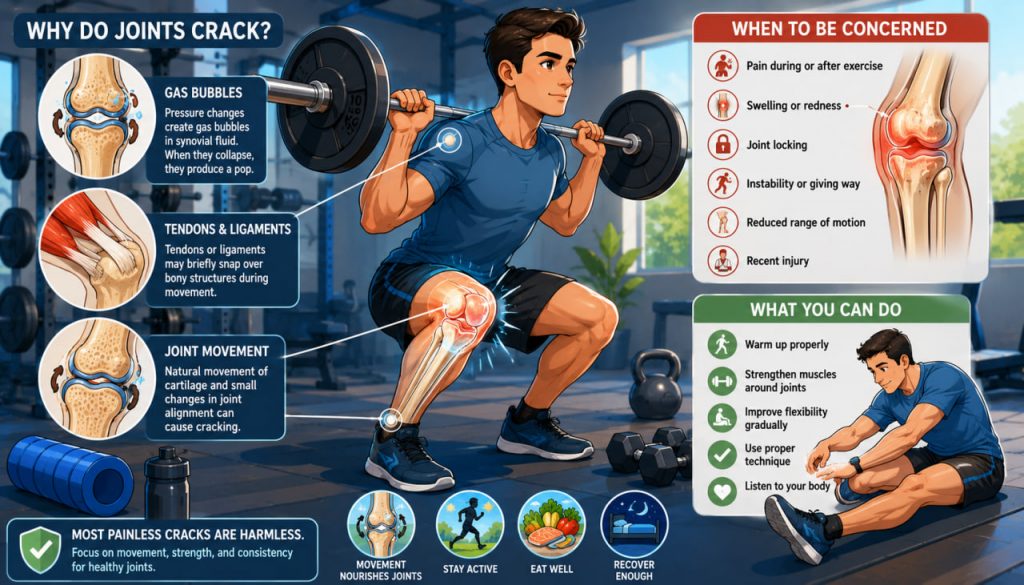
Many people notice clicking, popping, or cracking sounds coming from their knees, shoulders, ankles, hips, or fingers during workouts. These sounds can be surprising, especially when starting a new exercise routine or performing deep squats, lunges, or stretching exercises. Fortunately, joint cracking is often completely normal and does not necessarily indicate injury or arthritis.
However, not every popping sound should be ignored. When accompanied by pain, swelling, instability, or reduced mobility, joint noises may signal an underlying problem that deserves medical evaluation. Understanding why joints crack can help athletes and fitness enthusiasts distinguish harmless sounds from symptoms that require attention.
Why Do Joints Crack?
Joints are complex structures where two or more bones meet. They are surrounded by a joint capsule filled with synovial fluid, which lubricates the joint and reduces friction during movement.
Several mechanisms can produce cracking sounds.
The most common include:
- Gas bubbles forming and collapsing inside synovial fluid
- Tendons or ligaments moving over bony structures
- Small changes in joint alignment during movement
- Natural movement of cartilage surfaces
In most healthy individuals, painless joint cracking is considered a normal part of joint movement.
The Gas Bubble Theory
One of the best-supported explanations involves gases dissolved in synovial fluid.
This fluid naturally contains oxygen, nitrogen, and carbon dioxide.
When a joint is stretched or rapidly separated, pressure inside the joint decreases.
This pressure change allows tiny gas bubbles to form in a process called cavitation.
The formation of these bubbles—and possibly their rapid collapse—can create the familiar popping sound.
Afterward, it usually takes several minutes before the same joint can produce another identical crack because the gases must dissolve back into the fluid.
This explains why repeatedly cracking the same knuckle immediately afterward is often impossible.
Tendons and Ligaments Can Also Snap
Not every joint sound comes from gas bubbles.
Sometimes a tendon or ligament briefly catches on a nearby bone before sliding back into its normal position.
This often occurs in:
- Shoulders
- Knees
- Hips
- Ankles
- Wrists
Athletes may notice these sounds more frequently because repetitive movement increases tendon motion around joints.
As long as the movement is painless and does not limit function, it is usually harmless.
Why Do Joints Crack More During Exercise?
Exercise increases joint motion through larger ranges of movement.
During physical activity:
- Synovial fluid circulates more efficiently.
- Tendons move more frequently.
- Muscles lengthen and shorten repeatedly.
- Joint pressure changes continuously.
Exercises that commonly produce joint sounds include:
- Squats
- Lunges
- Push-ups
- Shoulder presses
- Yoga stretches
- Deep knee bends
Many people notice that cracking decreases after warming up because muscles become more flexible and joint lubrication improves.
Does Joint Cracking Cause Arthritis?
This is one of the most common myths.
Current scientific evidence does not support the idea that painless joint cracking causes arthritis.
Several studies have investigated habitual knuckle cracking over many years.
Researchers have generally found no convincing evidence that cracking healthy joints increases the risk of osteoarthritis.
That said, cracking accompanied by pain or joint disease should not be considered harmless.
The sound itself is usually not the problem—its accompanying symptoms are far more important.
When Should You Be Concerned?
Although most joint noises are harmless, certain warning signs deserve medical evaluation.
Seek professional advice if joint cracking is accompanied by:
- Persistent pain
- Swelling
- Redness
- Warmth around the joint
- Locking of the joint
- A feeling that the joint gives way
- Reduced range of motion
- A recent injury
These symptoms may indicate conditions such as:
- Meniscus injuries
- Ligament tears
- Tendon injuries
- Cartilage damage
- Osteoarthritis
- Inflammatory joint diseases
Early diagnosis often improves treatment outcomes.
How to Reduce Excessive Joint Clicking
While harmless joint noises usually require no treatment, maintaining healthy joints may reduce excessive clicking.
Helpful habits include:
- Warming up before exercise
- Strengthening muscles around the joints
- Improving flexibility gradually
- Avoiding sudden increases in training intensity
- Maintaining a healthy body weight
- Staying physically active
- Using proper exercise technique
Strong muscles provide better support for joints and may reduce unnecessary mechanical stress during movement.
Nutrition and Joint Health
Healthy joints depend on more than exercise alone.
A balanced diet supports the tissues that make up cartilage, ligaments, tendons, and bone.
Important nutrients include:
- Protein
- Vitamin D
- Calcium
- Vitamin C
- Omega-3 fatty acids
Adequate hydration also helps maintain normal synovial fluid function.
While many supplements claim to improve joint health, scientific evidence varies depending on the specific product, and individuals should consult healthcare professionals before beginning supplementation.
Common Myths About Joint Cracking
Several misconceptions continue to circulate.
Myth: Every crack means damage.
Reality: Most painless cracking is a normal mechanical phenomenon.
Myth: Cracking joints causes arthritis.
Reality: Current research has not established a causal relationship between painless joint cracking and osteoarthritis.
Myth: You should completely avoid moving joints that crack.
Reality: Regular physical activity generally supports joint health unless movement causes pain or injury.
Understanding these myths helps reduce unnecessary anxiety during exercise.
Expert Perspective
Orthopedic surgeon Dr. Robert Klapper, a clinical professor at the David Geffen School of Medicine at UCLA, has noted that painless joint popping is usually a normal mechanical event rather than a sign of disease. Similarly, many sports medicine specialists emphasize that the presence of sound alone is much less important than associated symptoms such as pain, swelling, instability, or loss of function.
Organizations including the American Academy of Orthopaedic Surgeons (AAOS) also advise that joint noises without pain are often harmless, while persistent painful symptoms should be evaluated to rule out injury or underlying joint disorders.
Keeping Your Joints Healthy for the Long Term
Healthy joints are designed to move—and movement is essential for maintaining their function.
Regular exercise helps:
- Strengthen supporting muscles
- Improve flexibility
- Enhance joint lubrication
- Support cartilage nutrition
- Maintain balance and coordination
Rather than fearing occasional painless cracking, focus on proper training technique, progressive exercise, adequate recovery, and listening to your body’s warning signs.
When joint sounds occur without pain or dysfunction, they are usually nothing more than a normal reminder that your joints are doing exactly what they were designed to do: move.
Interesting Facts
- Synovial fluid becomes less viscous during movement, helping joints move more smoothly as you warm up.
- Some people’s joints naturally produce more clicking sounds than others without indicating any disease.
- The knee is one of the most commonly reported joints for painless cracking during exercise.
- Tendons can temporarily shift over bones before returning to their normal position, creating audible snaps.
- Research has found no convincing evidence that habitual knuckle cracking causes osteoarthritis.
- Regular physical activity helps nourish cartilage because cartilage receives nutrients through joint movement rather than direct blood vessels.
- Many elite athletes experience harmless joint popping throughout their careers.
Glossary
- Synovial Fluid — A lubricating fluid inside movable joints that reduces friction and nourishes cartilage.
- Cavitation — The formation of tiny gas bubbles within synovial fluid due to pressure changes inside a joint.
- Cartilage — Smooth connective tissue covering the ends of bones inside joints, allowing low-friction movement.
- Ligament — A strong band of connective tissue that connects one bone to another and stabilizes joints.
- Tendon — A tough connective tissue that attaches muscle to bone and transmits force during movement.
- Osteoarthritis — A degenerative joint disease involving gradual breakdown of cartilage.
- Range of Motion — The full extent of movement possible at a joint.
- Orthopedics — The branch of medicine specializing in the diagnosis and treatment of bones, joints, muscles, ligaments, and tendons.