Throughout history, stories have appeared about so-called “feral children” — children who grew up isolated from normal human society, sometimes surviving among animals or in extreme neglect. These cases have fascinated scientists, psychologists, and philosophers because they reveal something fundamental about human nature: being biologically human is not enough to fully develop as a human being.
Language, social behavior, emotional understanding, and even basic thinking patterns depend heavily on interaction with other people during childhood. Without society, the human brain develops very differently.
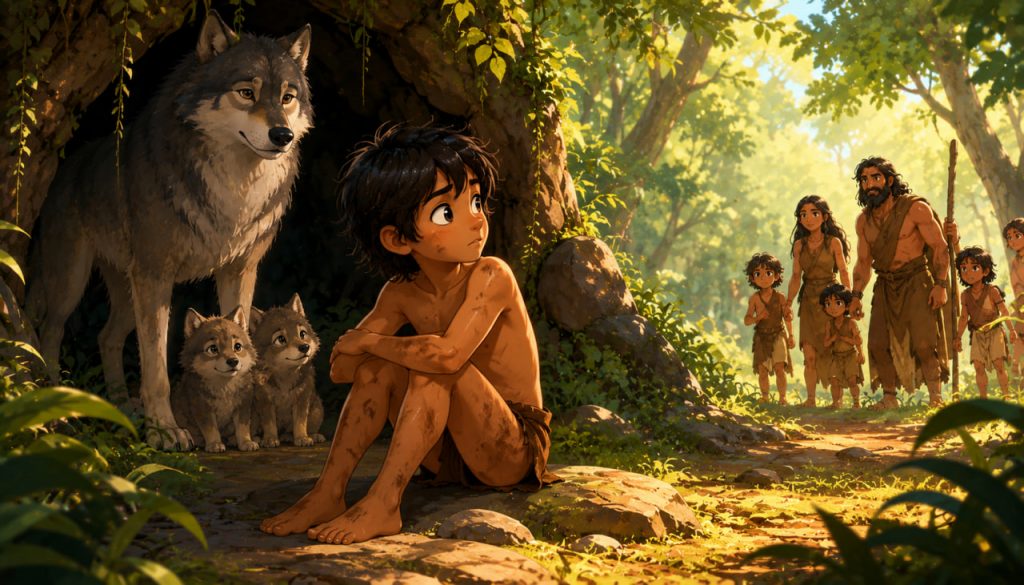
The phenomenon is often associated with the fictional image of “Mowgli” from literature, but real-life cases are far more tragic and scientifically important.
What Are Feral Children?
Feral children are individuals who experienced extreme social isolation during critical stages of childhood development.
Some were:
- Raised without normal human contact
- Severely neglected
- Isolated in confined environments
- Found living in the wild or among animals
These children often lacked:
- Language skills
- Social understanding
- Emotional communication
- Normal behavioral patterns
Their development provides scientists with rare insight into how much of human behavior is learned rather than purely instinctive.
Why Human Society Is Essential
Humans are highly social creatures. Unlike many animals, human children are born with brains that require long periods of learning and interaction to fully develop.
A child learns through:
- Communication
- Observation
- Emotional bonding
- Imitation
Without these experiences, important brain systems may never fully mature.
Psychologist Lev Vygotsky emphasized this idea by arguing:
“Human cognitive development is fundamentally shaped through social interaction.”
This means intelligence and personality are deeply connected to society itself.
The Critical Importance of Language
One of the most striking characteristics of feral children is difficulty with language.
Human language is not automatically programmed into the brain. Instead, children must be exposed to speech during early developmental periods.
Scientists call this the critical period for language acquisition.
If a child grows up without language exposure:
- Grammar becomes extremely difficult to learn later
- Speech development may remain limited permanently
- Abstract thinking can also be impaired
Language is more than communication — it shapes how humans organize thoughts and understand reality.
How Isolation Changes Brain Development
Modern neuroscience shows that the brain develops in response to experience. Neural connections strengthen when used and weaken when neglected.
In socially isolated children:
- Emotional regulation may not develop normally
- Problem-solving abilities may remain limited
- Fear responses can become extreme
- Social understanding may be severely impaired
The earlier and longer the isolation occurs, the greater the developmental impact.
Real Historical Cases
Several documented cases of feral or isolated children have deeply influenced psychology.
One of the most famous is the case of Genie, a girl discovered in California in 1970 after years of extreme isolation. Although she later learned some language and social behaviors, she never fully developed normal communication skills.
Other historical cases involved children allegedly found living among animals, though some reports remain controversial.
These cases consistently demonstrate the importance of early human interaction for healthy development.
Why Humans Need More Than Survival
Animals can survive with instinct alone, but humans rely heavily on culture and learning.
Human society provides:
- Language
- Moral understanding
- Emotional attachment
- Shared knowledge
- Cultural identity
Without these systems, a person may survive biologically but struggle to function psychologically and socially as a typical human being.
This is one reason why human civilization depends so strongly on education and family structures.
Emotional Development and Attachment
Human emotions are also shaped through social relationships.
Children normally develop emotional understanding through:
- Facial expressions
- Physical comfort
- Shared experiences
- Caregiver attachment
Without these interactions, emotional responses may become underdeveloped or abnormal.
Psychiatrist John Bowlby, known for attachment theory, showed that early emotional bonds are essential for psychological stability later in life.
Can Feral Children Fully Recover?
Recovery depends on:
- Age at rescue
- Duration of isolation
- Quality of rehabilitation
Young children may regain many abilities if rescued early enough. However, prolonged isolation during critical developmental periods can cause permanent effects.
This demonstrates how strongly early childhood shapes the human mind.
What Feral Children Teach Us About Humanity
Feral children reveal that humanity is not defined only by biology. Human identity emerges through:
- Society
- Language
- Relationships
- Shared culture
The human brain is designed not only to think, but to connect with others.
Without social interaction, many of the traits people consider uniquely human fail to fully develop.
The Deeper Philosophical Question
The existence of feral children raises an important question:
What truly makes someone human?
These cases suggest that humanity is not only genetic, but also deeply cultural and social. A person becomes fully human partly through interaction with other humans.
This idea continues to influence psychology, philosophy, neuroscience, and education today.
Interesting Facts
- Human children require one of the longest developmental periods in the animal kingdom.
- Language development is strongly linked to early childhood exposure.
- Some isolated children developed animal-like behaviors such as walking on all fours.
- Brain plasticity decreases with age, making later recovery more difficult.
- Social interaction affects not only emotions, but also brain structure itself.
Glossary
- Feral Child — A child raised with little or no human social contact.
- Critical Period — A developmental stage when the brain is especially sensitive to learning certain skills.
- Language Acquisition — The process of learning language.
- Brain Plasticity — The brain’s ability to adapt and reorganize.
- Attachment Theory — A psychological theory about emotional bonds between children and caregivers.