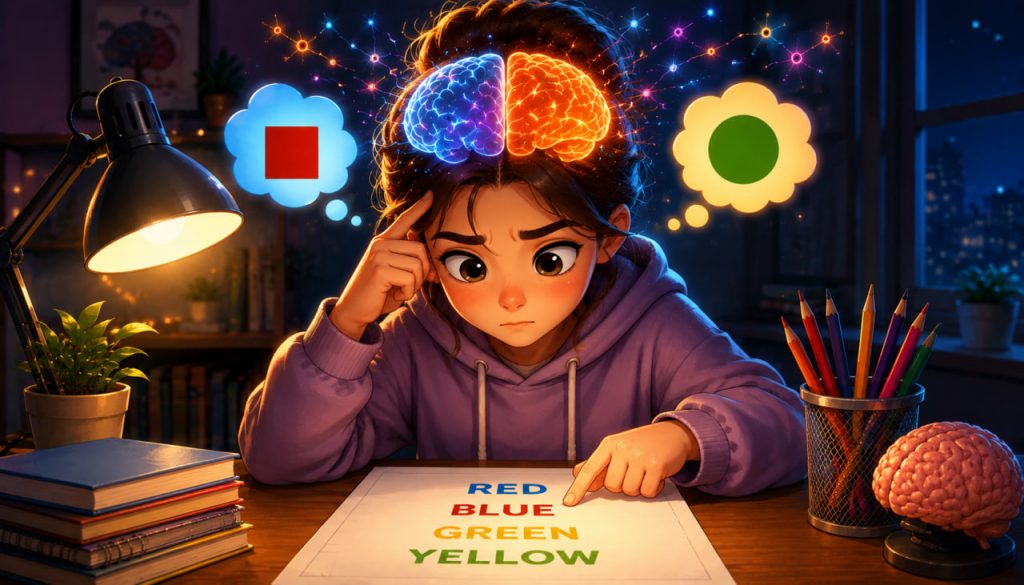
The human brain processes enormous amounts of information every second, often performing complex tasks automatically without conscious effort. One of the most fascinating demonstrations of how attention and cognition work is the Stroop Effect — a psychological phenomenon where the brain experiences interference when trying to identify the color of a word rather than reading the word itself.
Although the effect seems simple, it reveals deep insights into attention, automatic thinking, decision-making, and the limits of mental processing. Today, the Stroop Effect is widely used in psychology, neuroscience, and cognitive research to study how the brain handles conflicting information.
What Is the Stroop Effect?
The Stroop Effect occurs when the meaning of a word conflicts with the color in which the word is printed.
For example:
- The word “BLUE” printed in blue ink is processed quickly.
- But the word “BLUE” printed in red ink creates mental conflict.
In this situation, the brain must suppress the automatic tendency to read the word in order to correctly identify the ink color.
This conflict causes:
- Slower reaction times
- Increased mental effort
- More frequent mistakes
The effect was first described by psychologist John Ridley Stroop in 1935 and has since become one of the most famous experiments in cognitive psychology.
Why the Brain Struggles
Reading is a highly automated process for literate adults. Over years of practice, the brain becomes extremely efficient at recognizing words almost instantly.
Color recognition, however, requires more conscious attention.
When conflicting information appears, two mental systems compete:
- The automatic process of reading
- The controlled process of identifying color
The brain must inhibit the stronger automatic response, which creates cognitive interference.
This is why people pause slightly longer when performing a Stroop test.
How Scientists Study the Stroop Effect
In classic experiments, participants are asked to quickly name the color of words displayed on a screen.
Researchers measure:
- Reaction speed
- Accuracy
- Brain activity
The results consistently show that conflicting word-color combinations slow performance significantly.
Modern neuroscience studies use brain imaging technologies to observe which areas become active during the task.
What Happens Inside the Brain
The Stroop Effect involves several important brain regions associated with attention and control.
Key areas include:
- The prefrontal cortex, involved in decision-making and self-control
- The anterior cingulate cortex, which detects conflict and errors
- Attention-related neural networks that help suppress automatic responses
These systems work together to resolve the competition between reading and color recognition.
Neuroscientist Michael Posner explained:
“Attention is the mechanism that allows the brain to resolve conflict between competing processes.”
The Stroop task is considered one of the clearest demonstrations of this principle.
Why the Stroop Effect Matters
The Stroop Effect may seem like a simple laboratory experiment, but it has important real-world applications.
Researchers use it to study:
- Attention and concentration
- Cognitive flexibility
- Mental fatigue
- Brain disorders
It is often used in research involving:
- ADHD
- Alzheimer’s disease
- Schizophrenia
- Brain injuries
Because the task measures executive control, it helps scientists understand how efficiently the brain manages competing information.
Automatic Thinking vs Conscious Control
One of the most important lessons of the Stroop Effect is that much of human thinking is automatic.
The brain constantly tries to:
- Save energy
- Recognize patterns quickly
- Automate repeated tasks
This efficiency is useful in everyday life, but it can also create interference when flexibility is required.
The Stroop task demonstrates how difficult it can be to override deeply learned behaviors.
The Stroop Effect in Everyday Life
Although most people encounter the effect only in psychology experiments, similar mental conflicts happen constantly in daily life.
Examples include:
- Driving while distracted
- Ignoring smartphone notifications while working
- Trying to focus in noisy environments
In all these cases, the brain must filter competing information and maintain attention on the correct task.
Can the Brain Improve at This Task?
Practice and cognitive training can improve performance in tasks involving attention and inhibition.
Activities that may strengthen cognitive control include:
- Meditation and mindfulness
- Focused attention exercises
- Problem-solving tasks
- Learning new skills
However, the automatic nature of reading makes the Stroop Effect difficult to eliminate completely.
What the Stroop Effect Reveals About Human Intelligence
The Stroop Effect highlights an important truth about the human brain: intelligence is not only about knowledge, but also about control over attention and behavior.
Even simple tasks can become difficult when automatic processes conflict with conscious goals.
This phenomenon provides scientists with valuable insight into:
- How decisions are made
- How attention works
- Why the brain sometimes makes errors
It remains one of the most elegant demonstrations of cognitive interference ever discovered.
Interesting Facts
- The Stroop Effect has been studied for nearly 90 years.
- Literate adults experience the effect more strongly than young children who cannot yet read fluently.
- The Stroop test is widely used in neuroscience and clinical psychology.
- Brain imaging shows increased activity during conflicting tasks.
- Variations of the Stroop task are used to study emotional reactions and addiction.
Glossary
- Stroop Effect — A delay in reaction caused by conflicting information.
- Cognitive Interference — Mental conflict between competing processes.
- Prefrontal Cortex — Brain region involved in planning and self-control.
- Attention — The ability to focus on specific information.
- Executive Control — Mental processes that regulate behavior and decision-making.