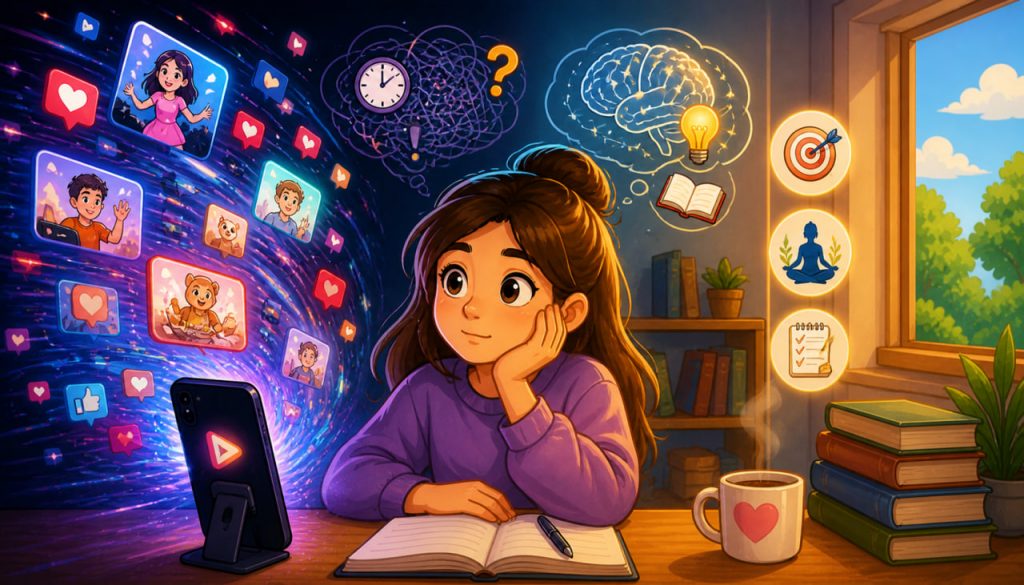
In the digital age, information is consumed faster than ever. Social media, short videos, headlines, and notifications constantly compete for attention. This has led to a phenomenon often called “clip thinking”—a way of processing information in short, fragmented pieces rather than deep, continuous analysis.
Understanding this shift is essential because it affects memory, attention, learning, and decision-making.
What Is Clip Thinking?
Clip thinking refers to a cognitive style where people:
- Prefer short, visual, and fast information
- Struggle with long, complex texts
- Switch attention quickly between topics
Instead of building a deep understanding, the brain processes information in “clips” or fragments.
This is not necessarily a disorder—it is an adaptation to the modern information environment.
Why Clip Thinking Is Emerging
The rise of clip thinking is closely linked to digital technology.
Key factors include:
- Social media feeds
- Short-form video platforms
- Constant notifications
- Information overload
The brain adapts by filtering information quickly and focusing only on what seems immediately relevant.
How the Brain Adapts
The human brain is highly flexible and changes based on experience. When exposed to fast, fragmented information:
- Attention spans may become shorter
- The brain prioritizes speed over depth
- Multitasking becomes more common
Neuroplasticity, the brain’s ability to reorganize itself, plays a key role here. Repeated patterns of behavior reshape how we think.
Effects on Attention and Memory
Clip thinking has noticeable effects on cognition.
Attention
People may:
- Lose focus more quickly
- Prefer switching tasks frequently
- Find long reading difficult
Memory
Information is often:
- Stored briefly
- Replaced quickly by new content
- Less deeply processed
This can reduce long-term retention.
Impact on Learning
Learning styles are changing as a result of clip thinking.
Positive effects:
- Faster information scanning
- Better visual learning
- Ability to process large amounts of data quickly
Negative effects:
- Difficulty with deep analysis
- Reduced critical thinking
- Less patience for complex subjects
Balance is crucial for effective learning.
Expert Perspective
Psychologist Daniel Levitin, a neuroscientist known for his work on attention and memory, has emphasized:
“The constant bombardment of information trains the brain to crave novelty, often at the expense of deep focus.”
This highlights how modern media shapes cognitive habits.
Social and Cultural Influence
Clip thinking also affects communication and culture.
- Messages become shorter and more visual
- Complex ideas are simplified
- Emotional reactions are often immediate
This can make information more accessible but also less nuanced.
Benefits of Clip Thinking
Despite concerns, clip thinking has advantages:
- Faster decision-making
- Ability to adapt to information-rich environments
- Improved visual and pattern recognition skills
- Efficient multitasking in certain contexts
In many professions, quick thinking is an asset.
Risks and Challenges
However, there are important challenges:
- Reduced ability to concentrate deeply
- Increased susceptibility to misinformation
- Superficial understanding of complex issues
- Mental fatigue from constant stimulation
Overexposure to fragmented information can overwhelm the brain.
How to Maintain Balance
It is possible to balance clip thinking with deep thinking.
Practical strategies:
- Set time for focused reading
- Limit constant notifications
- Practice single-tasking
- Engage in activities that require concentration
These habits help maintain cognitive flexibility.
Why This Matters
Clip thinking reflects a major shift in how humans interact with information. It is neither entirely good nor bad—it is a response to modern conditions.
The key is learning to:
- Use its advantages
- Avoid its downsides
- Maintain the ability to think deeply when needed
The future of thinking depends on balance, not rejection of technology.
Interesting Facts
- The average attention span has decreased in the digital era.
- Visual content is processed faster than text.
- The brain adapts quickly to repeated information patterns.
- Multitasking often reduces overall efficiency.
- Deep focus can be trained like a skill.
Glossary
- Clip Thinking — Processing information in short, fragmented pieces.
- Neuroplasticity — The brain’s ability to change and adapt.
- Multitasking — Performing multiple tasks at once.
- Attention Span — The length of time a person can focus.
- Information Overload — Excessive amount of information to process.