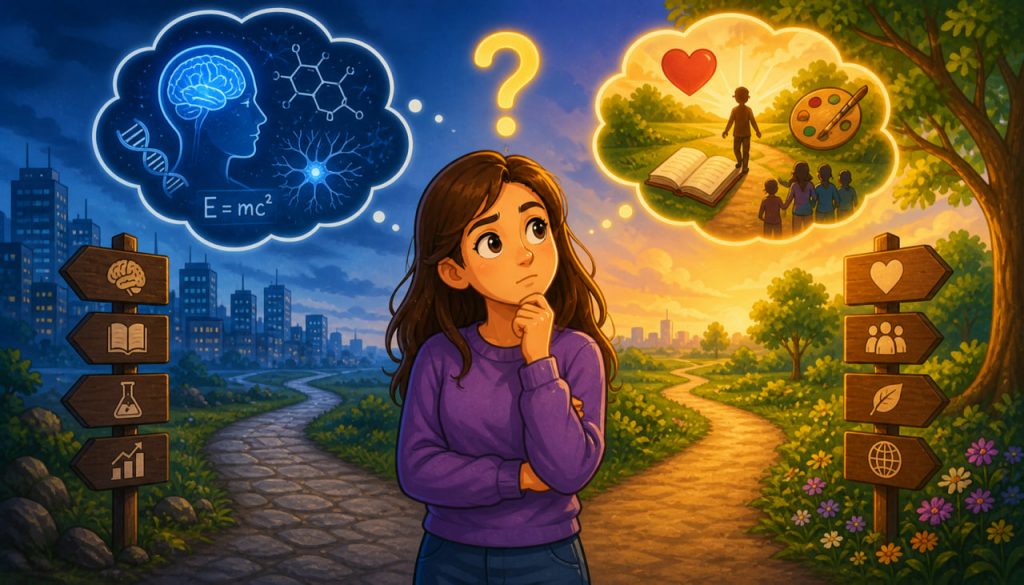
The question of free will has fascinated philosophers, scientists, and thinkers for centuries. Do humans truly make independent decisions, or are our actions determined by biology, environment, and prior causes? Today, this debate extends beyond philosophy into neuroscience, psychology, and physics. Understanding free will is essential because it shapes how we view responsibility, morality, and human behavior.
What Is Free Will?
Free will is the idea that individuals can make choices that are not entirely determined by external forces or internal mechanisms.
In simple terms, it means:
- You can choose between different options
- Your decisions are not fully predetermined
- You have control over your actions
However, defining free will precisely is complex and debated.
The Main Philosophical Positions
There are three major perspectives on free will.
Determinism
Determinism suggests that every event, including human decisions, is caused by prior events.
According to this view:
- All choices are the result of previous conditions
- True freedom may not exist
- The universe follows cause-and-effect laws
Libertarian Free Will
This perspective argues that humans have genuine freedom.
It claims:
- Decisions are not fully determined
- Individuals can initiate actions independently
- Free will is real and meaningful
Compatibilism
Compatibilism attempts to reconcile both ideas.
It suggests:
- Free will can exist even in a determined universe
- Freedom means acting according to one’s desires and intentions
This is one of the most widely accepted views among modern philosophers.
What Neuroscience Says
Modern neuroscience has added a new dimension to the debate.
Experiments have shown that:
- Brain activity can occur before a person becomes aware of a decision
- Certain choices can be predicted based on neural signals
One famous set of experiments by neuroscientist Benjamin Libet found that the brain initiates actions milliseconds before conscious awareness.
This raises an important question:
Are we making decisions consciously, or are we simply becoming aware of them after they begin?
Expert Perspective
Neuroscientist Sam Harris has argued:
“Free will is an illusion. Our thoughts and intentions emerge from background causes we are not aware of and cannot control.”
While this view is controversial, it highlights how neuroscience challenges traditional ideas of free will.
The Role of Consciousness
Consciousness plays a key role in how we experience choice.
Even if decisions begin unconsciously:
- Conscious awareness can influence actions
- People can reflect and change behavior
- Long-term planning involves deliberate thought
This suggests that human agency may still exist, even if it is more complex than traditionally believed.
Psychology and Decision-Making
Psychology shows that many factors influence decisions:
- Emotions
- Habits
- Social environment
- Past experiences
People often believe they are making rational choices, but unconscious processes play a significant role.
Free Will and Responsibility
The concept of free will is closely linked to responsibility.
If free will exists:
- People are accountable for their actions
- Moral responsibility makes sense
If it does not:
- Responsibility may need to be redefined
- Behavior may be seen as the result of causes beyond control
This has important implications for law, ethics, and society.
A Balanced View
Many researchers support a balanced perspective.
They suggest:
- Complete freedom may not exist
- Complete determinism may also be too simplistic
- Human behavior is influenced but not entirely fixed
This means that we may have limited but meaningful control over our actions.
Why This Question Matters
The idea of free will affects how we see ourselves and others.
It influences:
- Personal responsibility
- Motivation and self-improvement
- Social systems and justice
Believing in some level of control can encourage positive behavior and growth.
P.S. Unfortunately, without self-knowledge, a person actually lives like a matrix, and only you, as an individual, can break this vicious cycle by making your own choices. If you are interested in learning more about this topic, please feel free to leave a comment.
Interesting Facts
- Brain activity related to decisions can occur before conscious awareness.
- Philosophers have debated free will for thousands of years.
- Many people intuitively believe they have free will.
- Psychology shows decisions are influenced by hidden factors.
- The debate continues across science and philosophy.
Glossary
- Free Will — The ability to make independent choices.
- Determinism — The idea that all events are caused by prior conditions.
- Consciousness — Awareness of thoughts and surroundings.
- Neuroscience — The study of the brain and nervous system.
- Agency — The ability to act independently.