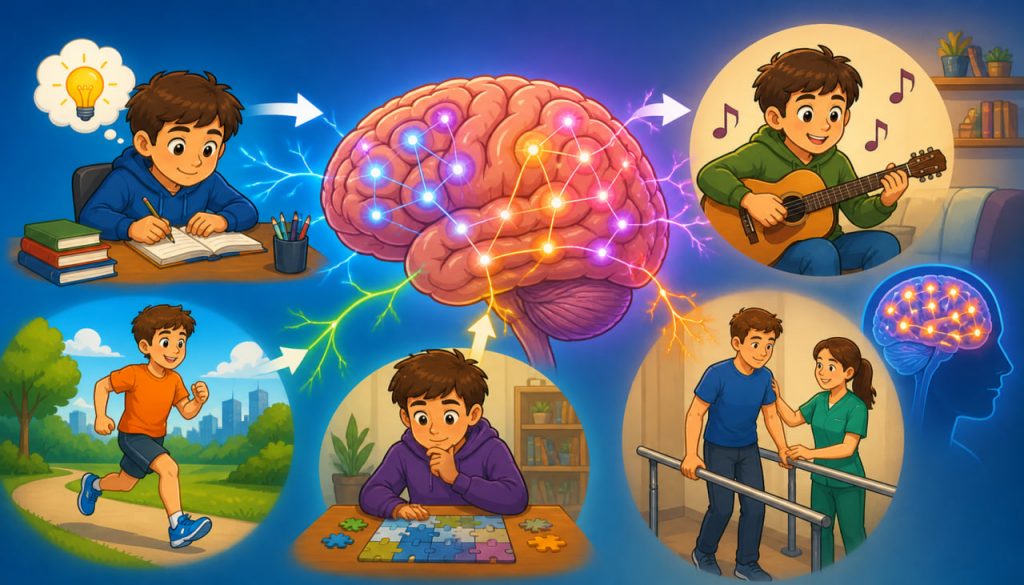
The human brain is not a fixed structure. For a long time, scientists believed that brain development stopped after childhood. Today, research shows the opposite: the brain can reorganize itself throughout life. This ability is called neuroplasticity, and it plays a crucial role in learning, memory, recovery, and behavior.
Understanding neuroplasticity helps explain how we learn new skills, recover from injuries, and adapt to changing environments.
What Is Neuroplasticity?
Neuroplasticity is the brain’s ability to change its structure and function in response to experience.
This includes:
- Forming new neural connections
- Strengthening or weakening existing connections
- Reorganizing brain regions
In simple terms, the brain rewires itself based on what we do, think, and experience.
How the Brain Changes
The brain is made up of billions of neurons that communicate through connections called synapses.
When we learn something new:
- Certain neural pathways are activated
- Repeated use strengthens these connections
- Unused connections weaken over time
This process allows the brain to become more efficient and specialized.
Types of Neuroplasticity
There are different forms of neuroplasticity.
Functional Plasticity
The brain can move functions from damaged areas to healthy ones.
Structural Plasticity
The brain physically changes its structure by forming new connections.
Both types are essential for adaptation and recovery.
Neuroplasticity and Learning
Learning is one of the most important examples of neuroplasticity in action.
When you:
- Practice a skill
- Study new information
- Repeat an activity
The brain strengthens the relevant neural pathways.
This is why repetition and consistency are key to mastering new abilities.
Recovery After Brain Injury
Neuroplasticity is critical in recovery from injuries such as strokes or trauma.
The brain can:
- Reassign functions to undamaged areas
- Create new pathways to restore lost abilities
- Improve function through rehabilitation
This process may take time, but it demonstrates the brain’s remarkable ability to heal and adapt.
Factors That Influence Neuroplasticity
Several factors affect how well the brain adapts.
Positive influences:
- Learning and mental stimulation
- Physical activity
- Healthy sleep
- Social interaction
Negative influences:
- Chronic stress
- Lack of stimulation
- Poor sleep
- Unhealthy lifestyle
Daily habits have a direct impact on brain plasticity.
Expert Insight
Neuroscientist Michael Merzenich, one of the pioneers in neuroplasticity research, has stated:
“The brain is continuously changing, and every experience you have leaves a trace in its structure.”
This emphasizes how dynamic and responsive the brain truly is.
Neuroplasticity and Habit Formation
Habits are formed through repeated neural activity.
When a behavior is repeated:
- Neural pathways become stronger
- The behavior becomes automatic
- Less conscious effort is required
This explains why habits can be both helpful and difficult to change.
Can Neuroplasticity Be Improved?
Yes, neuroplasticity can be enhanced through intentional actions.
Helpful strategies include:
- Learning new skills
- Engaging in problem-solving
- Practicing mindfulness
- Staying physically active
Challenging the brain regularly keeps it adaptable.
Misconceptions About Neuroplasticity
There are some common misunderstandings.
- It does not mean unlimited ability to change instantly
- Changes require time and repetition
- Not all brain damage can be fully reversed
Understanding realistic expectations is important.
Why Neuroplasticity Matters
Neuroplasticity is the foundation of learning, adaptation, and recovery. It shows that the brain is not static but constantly evolving.
This means that personal growth, skill development, and even behavioral change are always possible, regardless of age.
Interesting Facts
- The brain forms new connections throughout life.
- Learning a new language changes brain structure.
- Physical exercise improves brain plasticity.
- Sleep plays a key role in strengthening neural connections.
- The brain can adapt after injury to regain lost functions.
Glossary
- Neuroplasticity — The brain’s ability to change and adapt.
- Neuron — A nerve cell that transmits information.
- Synapse — A connection between neurons.
- Neural Pathway — A network of connected neurons.
- Rehabilitation — Therapy to recover lost abilities.