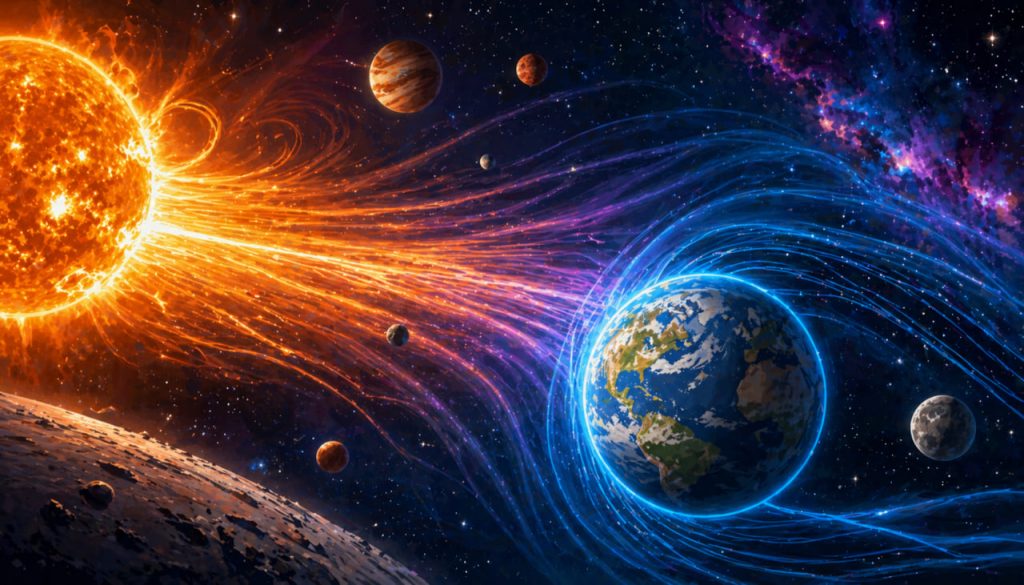
Stellar wind, often called “star wind,” is a continuous flow of charged particles ejected from the outer layers of a star. Though invisible to the human eye, this powerful stream of plasma plays a crucial role in shaping planetary systems, influencing space weather, and even determining whether life can exist on nearby worlds.
From our own Sun to massive distant stars, stellar winds are a fundamental process in astrophysics. Understanding them helps scientists uncover how stars evolve, how galaxies change over time, and how cosmic environments are formed.
What Is Stellar Wind?
Stellar wind is a stream of ionized gas—primarily protons and electrons—that flows outward from a star’s atmosphere into space. In the case of the Sun, this is known as the solar wind, which constantly bathes the entire solar system in charged particles.
These winds vary greatly in strength depending on the type of star:
- Sun-like stars produce moderate, steady winds
- Massive stars generate extremely powerful winds capable of shaping entire nebulae
- Dying stars can release intense bursts of stellar material
The particles in stellar wind travel at speeds ranging from hundreds to thousands of kilometers per second, carrying energy and magnetic fields far into space.
How Stellar Wind Forms
Stellar wind originates in the outer layers of a star, particularly in regions where temperatures are extremely high. For stars like the Sun, the outer atmosphere—called the corona—can reach temperatures of over a million degrees Celsius.
At such extreme temperatures:
- Gas becomes ionized (turns into plasma)
- Particles gain enough energy to escape the star’s gravity
- Magnetic fields accelerate and guide the flow of particles
For more massive stars, radiation pressure—the force exerted by intense light—can push material outward, creating even stronger stellar winds.
The Solar Wind and Its Effects on Earth
The solar wind is the most studied example of stellar wind because it directly affects Earth and the rest of the solar system.
As solar wind interacts with Earth’s magnetic field, it creates spectacular phenomena such as the aurora borealis (northern lights) and aurora australis (southern lights). These glowing displays occur when charged particles collide with gases in Earth’s atmosphere.
However, solar wind can also have disruptive effects:
- It can interfere with satellites and GPS systems
- It can affect power grids during strong solar storms
- It contributes to space weather, which impacts astronauts and spacecraft
According to NASA astrophysicist Dr. C. Alex Young:
“The solar wind is not just a gentle breeze—it can become a powerful force that shapes space weather and impacts our technology on Earth.”
Stellar Wind and Planetary Habitability
One of the most important roles of stellar wind is its influence on planetary atmospheres. A strong stellar wind can strip away the atmosphere of a planet over time, making it less suitable for life.
Mars is a well-known example. Scientists believe that the loss of its magnetic field allowed solar wind to gradually erode its atmosphere, transforming it from a potentially habitable planet into the cold, dry world we see today.
In contrast, Earth’s magnetic field acts as a protective shield, deflecting much of the solar wind and preserving our atmosphere.
Stellar Wind in Massive Stars
Massive stars produce much stronger stellar winds than the Sun. These winds can:
- Remove large amounts of mass from the star
- Shape surrounding gas clouds into nebulae
- Influence how the star evolves and eventually dies
Over time, strong stellar winds can determine whether a star ends its life as a supernova or collapses into a black hole.
In regions of active star formation, stellar winds from young stars can compress nearby gas, triggering the birth of new stars. In this way, stellar wind plays a key role in the life cycle of the universe.
The Role of Magnetic Fields
Magnetic fields are central to the behavior of stellar wind. They:
- Guide the direction of particle flow
- Create complex structures in space
- Influence how energy is distributed
In the Sun, magnetic activity leads to solar flares and coronal mass ejections—sudden, powerful releases of energy and particles that intensify the solar wind.
Stellar Wind and Space Exploration
Understanding stellar wind is essential for modern space missions. Spacecraft traveling beyond Earth must be designed to withstand radiation and charged particles carried by solar wind.
Astronauts, especially those on missions to the Moon or Mars, are exposed to higher levels of radiation due to reduced protection from Earth’s magnetic field. Studying stellar wind helps scientists develop better shielding technologies and safer mission plans.
Why Stellar Wind Matters in Astronomy
Stellar wind is more than just a stream of particles—it is a fundamental force that shapes the universe.
It helps scientists:
- Understand how stars lose mass over time
- Study the formation of planetary systems
- Analyze the evolution of galaxies
- Predict space weather events
By observing stellar winds from distant stars, astronomers gain insights into environments far beyond our solar system.
Interesting Facts
- The solar wind can travel at speeds of over 800 km/s during strong solar events.
- It takes about 1–3 days for solar wind to travel from the Sun to Earth.
- Without Earth’s magnetic field, solar wind could strip away our atmosphere over time.
- Massive stars can lose the equivalent of Earth’s mass in just a few days through stellar wind.
- Stellar winds help create stunning cosmic structures such as planetary nebulae.
Glossary
- Stellar Wind — A continuous flow of charged particles emitted from a star’s outer layers.
- Solar Wind — The stellar wind produced by the Sun.
- Plasma — A state of matter made of charged particles, common in stars.
- Corona — The outer atmosphere of a star, extremely hot and the source of stellar wind.
- Magnetic Field — A region of force that influences charged particles and their motion.
- Aurora — Natural light displays caused by solar wind interacting with a planet’s atmosphere.
- Radiation Pressure — The force exerted by light on matter.
- Nebula — A cloud of gas and dust in space, often shaped by stellar winds.