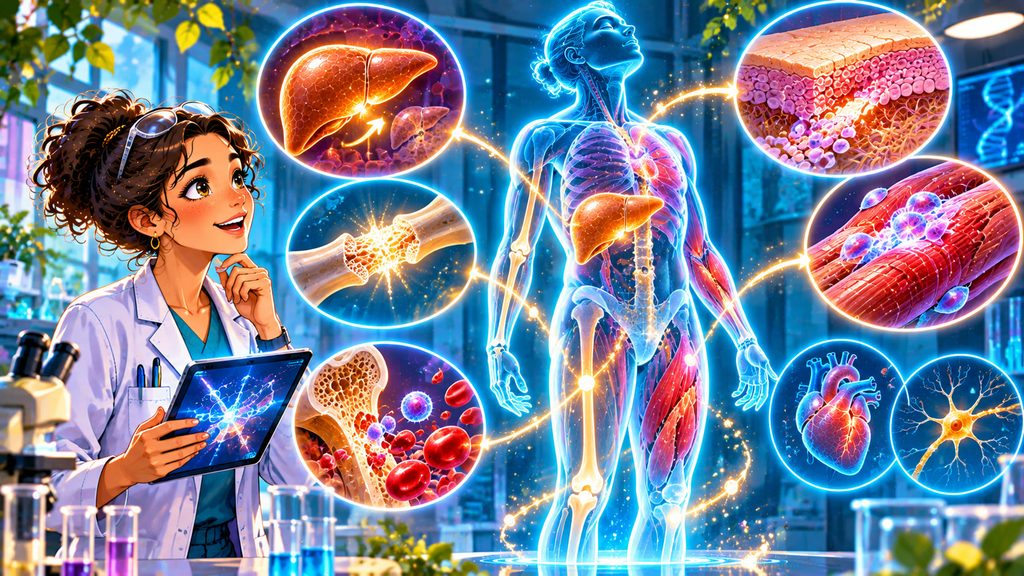
A scraped knee closes, a broken bone joins together, and a liver can recover much of its lost mass. These remarkable repairs happen without conscious instruction, as cells communicate, multiply, and rebuild damaged structures. Yet a severed finger will not simply grow back, and a badly injured spinal cord may never recover its original function.
The human body is constantly renewing itself, but regeneration is not equally powerful everywhere. Discovering why some tissues recover quickly while others form scars is one of medicine’s most fascinating challenges.
What Does Regeneration Really Mean?
Regeneration means replacing damaged or missing cells or tissues with functioning counterparts. Everyday cell replacement, called cell turnover, maintains healthy organs even when no injury has occurred. Following damage, some tissues can rebuild much of their original structure, while others rely mainly on fibrosis, the production of scar-like connective tissue.
A scar can be lifesaving because it closes an injury and restores mechanical strength. But scar tissue may lack the specialized properties of the tissue it replaces. Healing and complete regeneration are related processes, not identical outcomes.
Stem Cells: The Body’s Repair Reserve
Many renewing tissues rely on adult stem cells, specialized cells that can divide and produce particular kinds of replacement cells. Their descendants undergo cell differentiation, acquiring the characteristics needed to become skin cells, blood cells, or other specialized types. Signals from surrounding tissues tell these cells when to remain inactive and when to multiply.
Unlike an imaginary universal repair cell, most adult stem cells have limited options. Muscle stem cells primarily support muscle, while blood-forming stem cells produce blood components. This specialization helps explain why the body cannot automatically rebuild any missing organ.
Skin: A Protective Barrier That Rebuilds
Skin continually replaces cells in its outermost layer, the epidermis. When a shallow scrape occurs, surviving skin cells migrate across the exposed area and multiply until the barrier closes. Deeper wounds require an organized response involving clotting, inflammation, collagen production, and remodeling.
Collagen provides structural support, but extensive collagen deposition may leave a scar rather than perfectly reconstructed skin. Hair follicles and sweat glands may not return after a deep injury. The difference between a small scrape and a severe burn reveals the limits of the skin’s healing machinery.
The Intestine: One of the Fastest-Renewing Tissues
The intestinal lining faces digestive chemicals, food particles, and huge numbers of microorganisms every day. To maintain its barrier, most of its epithelial cells are replaced approximately every three to five days. Stem cells located in tiny intestinal pockets called crypts continually generate replacements.
As new cells move outward, they mature into cells that absorb nutrients or perform protective functions. This rapid turnover is essential for digestion, but it also requires exceptionally careful control. Disrupted cell division may contribute to intestinal disease, including cancer.
Blood: A Continuous Production Line
Red blood cells transport oxygen but cannot divide to replace themselves. They typically circulate for about 120 days before being removed, while bone marrow produces new cells to maintain the supply. Hematopoietic stem cells also generate the different kinds of white blood cells and platelets.
This production system adjusts to changing needs, such as recovery after blood loss. It depends on nutrients including iron, vitamin B12, and folate, along with hormonal signals. When bone marrow is severely damaged, its ability to replenish blood may become dangerously impaired.
Why the Liver Is a Regeneration Champion
The liver has a particularly impressive response to tissue loss. After surgeons remove a substantial portion, remaining liver cells can multiply and enlarge, helping restore functional mass. In suitable circumstances, a healthy liver can recover volume even after removal of roughly two-thirds of the organ.
This process is often called compensatory regeneration. The missing piece does not grow back in its original shape; instead, the tissue that remains expands. Chronic scarring, advanced disease, and insufficient healthy tissue can prevent recovery, so regeneration is not unlimited.
Broken Bones Can Rebuild Their Structure
When a bone fractures, bleeding first forms a protective clot around the break. Repair cells create a temporary callus, which gradually develops into stronger bone. During bone remodeling, specialized cells remove excess material and reorganize the tissue in response to mechanical demands.
Unlike many soft tissues, properly healed bone can regain a structure resembling its original architecture. However, the process can require months, and alignment, blood supply, and overall health strongly affect the outcome. A fracture needs correct protection and, sometimes, medical stabilization to heal well.
Muscles Repair Themselves After Injury
Skeletal muscle contains satellite cells, dormant stem cells positioned alongside muscle fibers. Injury can activate them, causing them to divide and help repair damaged fibers. This response supports recovery after ordinary muscle damage as well as more significant injuries.
Muscle repair becomes less effective with aging, severe injury, or prolonged inactivity. Exercise, adequate nutrition, and recovery can support normal muscle maintenance, but they cannot guarantee complete restoration after extensive damage. Stronger muscles emerge through adaptation, not unlimited regeneration.
Why Nerves Recover So Slowly
Some injured peripheral nerves can regrow their long extensions, called axons, with support from surrounding cells. A commonly cited average is roughly one millimeter per day, although actual recovery varies with injury severity and location. Reaching the correct muscle or sensory target may take months and sometimes fails.
The brain and spinal cord have a much more restricted ability to restore damaged long-distance connections. Their environment contains barriers to axon growth, and complex circuits are difficult to reconstruct. This is why recovery after a spinal cord injury remains such a demanding medical problem.
Can the Heart and Brain Regenerate?
Human heart muscle does replace a small fraction of its cells over time, but not enough to rebuild major damage from a heart attack. In a landmark study, Olaf Bergmann and colleagues estimated that roughly 1% of heart muscle cells renew annually in young adults, with the rate declining with age. After significant injury, the heart largely forms scar tissue.
The brain also has limited and region-dependent capacity to generate new neurons, while surviving networks can reorganize through neuroplasticity. This adaptability supports some functional recovery after injury, but it is not the same as replacing all the lost cells or connections.
Can Regenerative Medicine Go Beyond Natural Healing?
Regenerative medicine aims to restore damaged tissues using cell therapies, engineered materials, or biological signals. Blood-forming stem cell transplantation is already an established treatment for selected serious blood disorders. Specialized skin-based therapies and engineered tissues are also used for certain conditions.
Nobel Prize-winning scientist Shinya Yamanaka helped transform this field by demonstrating how mature cells could be reprogrammed into induced pluripotent stem cells, capable of producing many cell types. The possibilities are exciting, but claims that unapproved injections can regenerate any joint, nerve, or organ are not supported by established clinical evidence.
How Can We Support the Body’s Natural Repair?
Recovery requires sufficient energy, protein, essential nutrients, sleep, and suitable physical activity. Avoiding smoking and managing conditions such as diabetes also supports tissue health and wound healing. Injuries need appropriate treatment: rest alone cannot straighten a displaced fracture or repair a severed tendon.
The goal is not to activate some mysterious hidden regeneration switch. It is to give the body’s existing repair systems the conditions they need while recognizing when medical treatment is necessary. What surprises you most about human regeneration: the liver’s remarkable recovery, the intestine’s constant renewal, or the limited healing abilities of the heart and spinal cord? Share your thoughts in the comments.
Interesting Facts
- The intestinal epithelium replaces most of its cells approximately every three to five days.
- A typical red blood cell lives about 120 days before being recycled.
- The liver can regain substantial volume after surgeons remove roughly two-thirds of its healthy tissue.
- Bone repairs fractures using a temporary callus that is later remodeled.
- Peripheral nerve axons may regenerate at an average rate near one millimeter per day.
- One influential study estimated annual heart muscle cell renewal at about 1% in young adults.
- Axolotls can regrow limbs, but humans cannot regenerate complete lost limbs.
Glossary
- Regeneration — Replacement or restoration of damaged cells and tissues.
- Cell Turnover — Ongoing replacement of old or dying cells.
- Fibrosis — Formation of fibrous connective tissue, often during scarring.
- Adult Stem Cells — Tissue-resident cells capable of making selected replacement cell types.
- Cell Differentiation — The process through which a cell develops specialized functions.
- Collagen — A structural protein that strengthens many body tissues.
- Crypts — Small pockets in the intestinal lining containing renewing stem cells.
- Hematopoietic Stem Cells — Stem cells that generate blood cells.
- Compensatory Regeneration — Restoration of functional tissue mass by growth of remaining tissue.
- Callus — Temporary repair tissue surrounding a healing bone fracture.
- Bone Remodeling — Reshaping and renewal of bone by specialized cells.
- Satellite Cells — Stem cells that support skeletal muscle repair.
- Axons — Long extensions of neurons that carry electrical signals.
- Neuroplasticity — The nervous system’s capacity to change its connections and activity.
- Regenerative Medicine — Medical approaches intended to restore or replace damaged tissues.
- Induced Pluripotent Stem Cells — Adult cells reprogrammed to produce many specialized cell types.