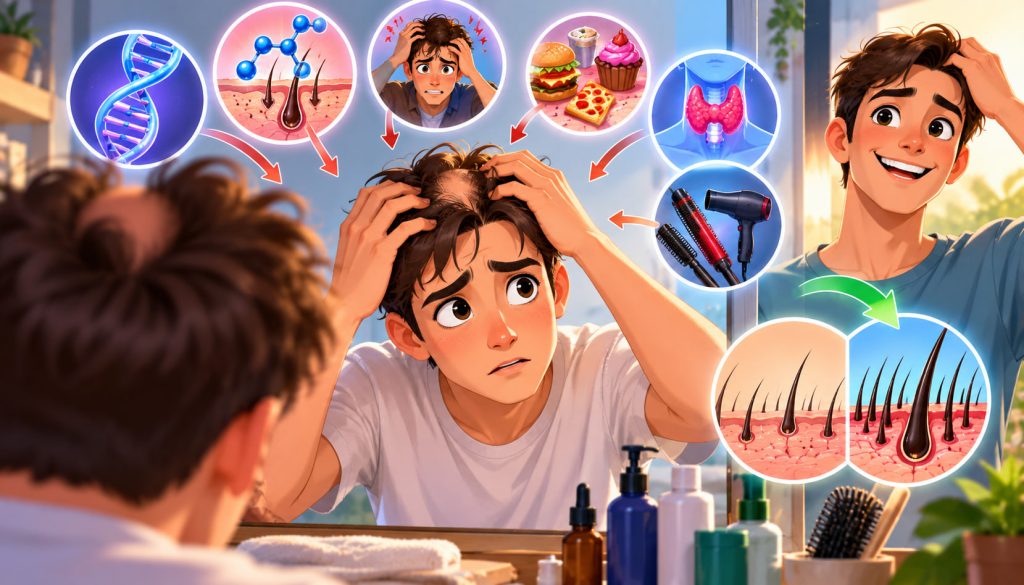
Hair loss is one of the most common appearance-related concerns in both men and women. Some people notice a slowly receding hairline, others see widening of the part, increased shedding in the shower, or circular bald patches that seem to appear suddenly.
The important point is that “baldness” is not one single condition. Hair loss can result from genetics, hormones, illness, medications, stress, nutritional problems, autoimmune disease, or damage to the hair and scalp.
The best treatment depends entirely on the cause, which is why understanding the pattern matters before choosing products or procedures.
The Most Common Cause: Genetic Hair Loss
The leading cause of progressive hair thinning is androgenetic alopecia, often called male-pattern or female-pattern hair loss.
This condition is strongly influenced by genetics and sensitivity of hair follicles to androgen hormones, especially a hormone derivative called dihydrotestosterone, or DHT.
In men, it often begins with recession at the temples or thinning at the crown.
In women, the hairline is often preserved, while the part gradually becomes wider and overall density decreases over the top of the scalp.
Genetic hair loss usually develops slowly over years rather than suddenly over days or weeks.
Why Hair Follicles Become Smaller
Hair grows in repeated cycles.
Each follicle goes through a growth phase, a transition phase, and a resting phase before the hair eventually sheds.
In androgenetic alopecia, affected follicles gradually undergo miniaturization.
This means each new hair becomes thinner, shorter, and less pigmented.
Eventually, some follicles may produce hair so fine that it is barely visible.
The follicle itself is not necessarily dead at the beginning, which is why early treatment can sometimes preserve or improve hair density.
Hormones and Hair Loss
Hormonal changes can influence hair growth significantly.
Hair thinning may occur with:
- Thyroid disorders
- Polycystic ovary syndrome
- Menopause
- Pregnancy-related hormonal changes
- Certain endocrine disorders
After childbirth, many women experience increased shedding several months later.
This is usually telogen effluvium, a temporary shift in the hair cycle caused by hormonal changes and physiological stress.
In most cases, postpartum shedding improves gradually.
Stress Can Cause Real Hair Shedding
Stress-related hair loss is not imaginary.
Severe emotional stress, fever, surgery, rapid weight loss, major illness, or other intense physical stress can push a larger-than-normal number of hairs into the resting phase.
The shedding often begins two or three months after the triggering event.
This delay can make the cause difficult to recognize.
Telogen effluvium usually produces diffuse shedding across the scalp rather than a single bald patch.
If the underlying trigger resolves, hair growth often recovers over time.
Nutritional Deficiencies
Hair follicles are highly active structures and require adequate nutrition.
Deficiencies in iron, protein, zinc, vitamin B12, or other nutrients can sometimes contribute to hair loss.
Iron deficiency is especially important in people with heavy menstrual bleeding or restrictive diets.
However, taking supplements without confirmed deficiency is not always helpful.
More vitamins do not automatically mean more hair.
Excessive intake of certain nutrients, including vitamin A and selenium, can actually contribute to hair loss.
Blood testing may be useful when nutritional deficiency is suspected.
Alopecia Areata: When the Immune System Attacks Hair Follicles
Alopecia areata is an autoimmune condition.
It often causes smooth, round or oval bald patches on the scalp or other areas of the body.
In some people, only one or two patches appear.
In others, hair loss can become more extensive.
The follicles usually remain alive, meaning regrowth is possible.
Treatment may include corticosteroids and newer immune-targeting medications in selected cases.
Sudden patchy hair loss should be evaluated by a dermatologist.
Hair Damage Is Not Always True Baldness
Sometimes hair appears thinner because the hair shafts are breaking rather than falling from the follicles.
Frequent bleaching, chemical straightening, excessive heat styling, or aggressive brushing can weaken the hair.
Tight hairstyles can also create repeated pulling on the follicles.
This condition, known as traction alopecia, is commonly associated with hairstyles that place constant tension on the scalp.
Early traction alopecia can improve when tension stops.
Long-term repeated damage may cause permanent scarring and irreversible hair loss.
Scalp Conditions Can Affect Hair Growth
A healthy scalp supports healthy hair follicles.
Conditions such as severe seborrheic dermatitis, fungal infections, psoriasis, and inflammatory scalp diseases can contribute to irritation, breakage, or shedding.
Some forms of inflammatory hair loss lead to scarring alopecia.
In these conditions, inflammation permanently damages the follicles.
Scarring hair loss requires early medical treatment because destroyed follicles usually cannot regrow hair.
Expert Perspective: Diagnosis Comes Before Treatment
Dermatologists generally emphasize that hair loss should be treated according to its cause rather than with a universal “hair growth” product.
A specialist may examine the scalp, look at the distribution of thinning, perform a hair-pull test, use magnification, and sometimes request blood tests.
In unusual cases, a scalp biopsy may be needed.
The timing and pattern of hair loss often provide important clues.
Gradual thinning over years suggests something very different from sudden patchy loss or rapid shedding after illness.
Minoxidil: One of the Most Established Treatments
Topical minoxidil is one of the best-known treatments for androgenetic hair loss.
It can prolong the growth phase of hair follicles and improve density in some people.
Both men and women may use appropriate formulations, depending on medical advice.
Results require patience.
Visible improvement may take several months, and treatment generally needs to continue to maintain the benefit.
Some people notice temporary increased shedding when they first start treatment.
This can occur as follicles shift into a new growth cycle.
Finasteride and DHT Reduction
Finasteride is an oral medication commonly used for male-pattern hair loss.
It reduces conversion of testosterone into DHT.
This can slow hair loss and improve growth in some men.
However, it is not suitable for everyone and may cause side effects.
Finasteride must also be handled carefully around pregnancy because exposure can be harmful to a developing male fetus.
Women with hormonal hair loss may sometimes receive other medications, such as anti-androgen therapy, depending on their medical situation.
These treatments require professional supervision.
What About Hair Transplants?
Hair transplantation can provide long-lasting results for selected people with stable androgenetic alopecia.
Hair follicles are usually moved from areas resistant to genetic thinning, such as the back of the scalp, into thinning areas.
Modern techniques can produce very natural results.
However, transplantation does not stop ongoing genetic hair loss in untreated follicles.
For this reason, medical therapy is often used alongside surgery.
A transplant is also much less useful when hair loss is caused by active autoimmune or scarring disease.
Do Shampoos Cure Baldness?
Most cosmetic shampoos cannot reverse genetic baldness.
They may improve scalp health, reduce dandruff, increase hair volume, or make individual hairs look thicker.
That can improve appearance, but it does not usually change the underlying biology of androgenetic alopecia.
Products advertised as instantly “reactivating dead follicles” should be viewed cautiously.
Hair growth is a slow biological process, so genuine treatments usually require months rather than days.
When Hair Loss Needs Medical Attention
A medical evaluation is especially useful when hair loss is:
- Sudden
- Patchy
- Rapidly worsening
- Accompanied by scalp pain or redness
- Associated with scaling or scarring
- Combined with unexplained fatigue or weight changes
- Occurring alongside menstrual or hormonal changes
Early assessment is particularly important when permanent follicle damage is possible.
What Actually Helps Protect Hair
For most people, the basics matter.
Avoiding repeated chemical damage, reducing tight hairstyles, eating enough protein and iron, treating scalp disease, and managing chronic health conditions can all support hair health.
Good sleep and stress management may also help when shedding is related to physiological stress.
But lifestyle alone cannot completely prevent genetically programmed hair loss.
That is why effective treatment often combines healthy habits with evidence-based medical options.
Interesting Facts
- The average scalp contains roughly 100,000 hair follicles, although the number varies between individuals.
- Losing some hair every day is normal because follicles constantly cycle through growth and resting phases.
- Androgenetic alopecia can affect both men and women.
- Hair follicles can gradually produce thinner hairs long before an area becomes visibly bald.
- Hair growth averages roughly one centimeter per month, although this varies.
- Severe stress-related shedding often begins months after the stressful event.
- Cutting or shaving hair does not make it grow back thicker because it does not change the follicle.
- Gray hair and hair loss are separate biological processes.
- Tight hairstyles can cause permanent hair loss if traction continues for years.
- Early treatment of genetic hair loss generally offers better chances of preserving existing hair.
Glossary
- Alopecia — The medical term for hair loss.
- Androgenetic Alopecia — Inherited, hormone-related hair thinning commonly known as pattern hair loss.
- DHT — Dihydrotestosterone, an androgen hormone involved in genetic hair loss.
- Hair Follicle — The skin structure from which an individual hair grows.
- Miniaturization — Progressive shrinking of hair follicles that causes hairs to become thinner and shorter.
- Telogen Effluvium — Diffuse shedding caused by an increased number of hairs entering the resting phase.
- Alopecia Areata — An autoimmune condition that commonly causes round patches of hair loss.
- Traction Alopecia — Hair loss caused by repeated pulling or tension on hair follicles.
- Scarring Alopecia — Hair loss in which inflammation destroys follicles and replaces them with scar tissue.
- Minoxidil — A medication used to stimulate and maintain hair growth in some types of hair loss.
- Finasteride — A medication that reduces DHT production and is commonly used for male-pattern hair loss.
- Hair Transplantation — A surgical procedure that moves hair follicles from one part of the scalp to another.