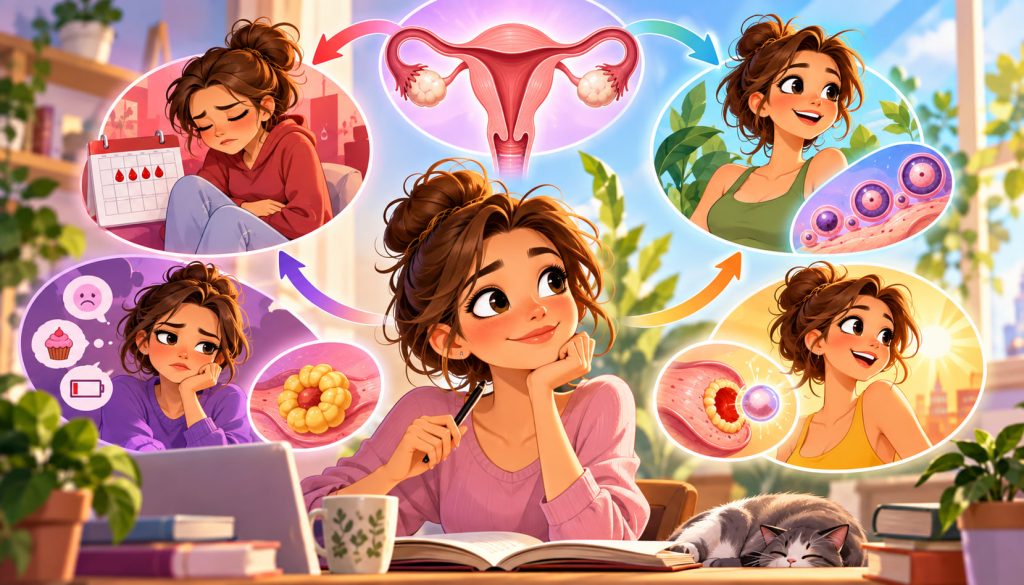
The menstrual cycle is a natural biological process controlled by hormones and closely connected to reproductive health. It prepares the body for a possible pregnancy, but it can also influence energy, mood, appetite, sleep, skin, body temperature, and physical performance.
Although a 28-day cycle is often presented as the standard, real menstrual cycles vary considerably. A healthy cycle does not have to be exactly 28 days long.
Understanding the main phases of the menstrual cycle can make it easier to recognize normal changes and identify symptoms that deserve medical attention.
What Is the Menstrual Cycle?
The menstrual cycle begins on the first day of menstrual bleeding and continues until the day before the next period starts.
In many adults, cycles commonly fall somewhere around 21 to 35 days, although individual patterns vary.
The cycle is regulated by communication between the brain, pituitary gland, ovaries, and uterus.
Four major phases are usually described:
- Menstruation
- Follicular phase
- Ovulation
- Luteal phase
Each phase involves different hormonal changes.
Menstruation: The Beginning of the Cycle
Menstruation is the shedding of the uterine lining.
If pregnancy has not occurred, levels of estrogen and progesterone fall. This hormonal drop signals the uterus to release the lining that had developed during the previous cycle.
Menstrual bleeding commonly lasts several days.
Some people experience cramps, fatigue, headaches, lower-back discomfort, digestive changes, or mood changes during this phase.
Cramps occur partly because substances called prostaglandins stimulate uterine muscle contractions.
Mild to moderate discomfort can be normal, but severe pain that interferes with everyday activities should be evaluated.
The Follicular Phase
The follicular phase begins on the first day of menstruation and continues until ovulation.
During this time, the pituitary gland releases follicle-stimulating hormone, or FSH.
FSH encourages several follicles in the ovaries to begin developing. Each follicle contains an immature egg.
Usually, one follicle becomes dominant.
As it develops, it produces increasing amounts of estrogen.
Estrogen helps rebuild the uterine lining and prepares the reproductive system for possible pregnancy.
Some people notice rising energy, better mood, or increased motivation as estrogen levels increase.
Ovulation: When an Egg Is Released
Ovulation occurs when a mature egg is released from the ovary.
A rise in estrogen eventually triggers a sharp increase in luteinizing hormone, or LH.
This LH surge causes ovulation.
Ovulation does not necessarily occur on day 14. The timing varies depending on overall cycle length and individual biology.
Ovulation usually happens approximately two weeks before the next menstrual period rather than automatically on the 14th day of every cycle.
The released egg travels into the fallopian tube, where fertilization may occur if sperm are present.
The Fertile Window
The egg survives for a relatively short period after ovulation, usually around 12 to 24 hours.
Sperm can survive in the female reproductive tract for several days.
Because of this, pregnancy can occur from intercourse that takes place before ovulation as well as on the day of ovulation.
The fertile window generally includes the several days before ovulation and the day of ovulation itself.
Signs that may occur around ovulation include:
- Clearer, more slippery cervical mucus
- Mild pelvic discomfort
- Increased sexual desire
- A small rise in basal body temperature after ovulation
These signs vary and are not perfectly reliable for everyone.
The Luteal Phase
After ovulation, the emptied follicle changes into a temporary structure called the corpus luteum.
It produces progesterone.
Progesterone helps stabilize and maintain the uterine lining in case pregnancy occurs.
If fertilization and implantation do not happen, the corpus luteum breaks down.
Progesterone and estrogen levels then fall.
This hormonal decline leads to the next menstrual period.
The luteal phase is often more consistent in length than the follicular phase.
PMS and Hormonal Changes
Premenstrual syndrome, or PMS, refers to physical and emotional symptoms that appear before menstruation.
Common symptoms include:
- Breast tenderness
- Bloating
- Food cravings
- Irritability
- Fatigue
- Headaches
- Mood changes
- Sleep disturbances
These symptoms are linked to the body’s response to changing hormone levels.
For many people, symptoms are mild.
For others, they can significantly affect work, relationships, or quality of life.
A more severe condition called premenstrual dysphoric disorder, or PMDD, causes intense emotional symptoms and requires medical assessment.
Is an Irregular Cycle Always a Problem?
Occasional variation is common.
Stress, travel, illness, weight changes, intense exercise, and sleep disruption can alter cycle timing.
Cycles can also be irregular during adolescence and during the years approaching menopause.
However, repeated irregularity may sometimes indicate an underlying condition.
Possible causes include polycystic ovary syndrome, thyroid disorders, elevated prolactin, significant weight changes, eating disorders, or other hormonal problems.
A persistent change from your usual cycle pattern is often more important than a single unusual period.
Expert Perspective: Regularity Matters More Than Perfection
Gynecologists generally emphasize that the menstrual cycle should be evaluated as an individual pattern rather than compared rigidly with a 28-day model.
A cycle that regularly occurs every 25 or 32 days may be completely normal.
Doctors usually pay closer attention when cycles suddenly become much shorter, much longer, unusually heavy, repeatedly absent, or significantly more painful.
The menstrual cycle can provide useful information about reproductive and hormonal health.
For this reason, tracking cycle length, bleeding, pain, and other symptoms can be helpful during medical consultations.
How Much Menstrual Bleeding Is Normal?
Menstrual flow varies considerably.
Some people bleed lightly, while others have heavier periods.
Bleeding may be considered unusually heavy when it requires very frequent protection changes, repeatedly soaks through clothing or bedding, produces large clots, or leads to symptoms of anemia such as extreme fatigue, weakness, shortness of breath, or dizziness.
Heavy menstrual bleeding can have many causes.
These include hormonal disorders, uterine fibroids, adenomyosis, bleeding disorders, medications, and other gynecological conditions.
Persistent heavy bleeding should be assessed rather than accepted as normal.
Menstrual Pain and When It Becomes Concerning
Mild cramping is common during menstruation.
Heat, gentle exercise, rest, and appropriate pain medication may help.
But severe pain may be associated with conditions such as endometriosis, adenomyosis, ovarian cysts, or uterine fibroids.
Pain that causes repeated absence from work or school, wakes someone from sleep, becomes progressively worse, or is associated with pain during sex deserves medical evaluation.
Lifestyle and the Menstrual Cycle
The menstrual cycle is sensitive to overall health.
Adequate nutrition, sleep, stress management, and regular physical activity can support hormonal regulation.
Extreme calorie restriction or very intense training without enough energy intake can suppress ovulation and menstruation.
This can affect fertility and bone health over time.
Iron-rich foods may be particularly important for people with heavy periods.
When to See a Doctor
Medical evaluation is recommended when menstrual changes are persistent or severe.
Reasons to seek advice include very heavy bleeding, periods lasting unusually long, severe pelvic pain, bleeding between periods, repeated missed periods without pregnancy, or sudden major changes in cycle length.
Unexpected bleeding after menopause should always be investigated.
Pregnancy should also be considered when a period is late or absent in someone who could become pregnant.
Interesting Facts
- The menstrual cycle is controlled through communication between the brain, pituitary gland, ovaries, and uterus.
- Ovulation does not always occur on day 14.
- Basal body temperature usually rises slightly after ovulation because of progesterone.
- Stress can delay ovulation and make a cycle longer.
- The follicular phase tends to vary more in length than the luteal phase.
- Menstrual blood contains blood, mucus, uterine tissue, and vaginal secretions.
- Some people experience mild one-sided pelvic discomfort around ovulation.
- Menstrual cycles often change naturally during adolescence and before menopause.
- Very low energy intake can cause periods to become irregular or stop.
- Cycle tracking can help reveal changes that might otherwise be overlooked.
Glossary
- Menstrual Cycle — The recurring hormonal and reproductive changes that occur from one menstrual period to the next.
- Menstruation — Shedding of the uterine lining through vaginal bleeding.
- Follicular Phase — The part of the cycle during which ovarian follicles develop before ovulation.
- Ovulation — Release of a mature egg from an ovary.
- Luteal Phase — The phase after ovulation and before the next menstrual period.
- Estrogen — A group of hormones involved in reproductive function and development of the uterine lining.
- Progesterone — A hormone that helps maintain the uterine lining after ovulation.
- FSH — Follicle-stimulating hormone, which supports the development of ovarian follicles.
- LH — Luteinizing hormone, whose surge triggers ovulation.
- Corpus Luteum — A temporary structure in the ovary that produces progesterone after ovulation.
- PMS — Premenstrual syndrome, a group of physical and emotional symptoms occurring before menstruation.
- PMDD — A severe form of premenstrual disorder with significant emotional and functional symptoms.
- Endometriosis — A condition in which tissue similar to the uterine lining grows outside the uterus.
- Prostaglandins — Compounds that help trigger uterine contractions and can contribute to menstrual cramps.