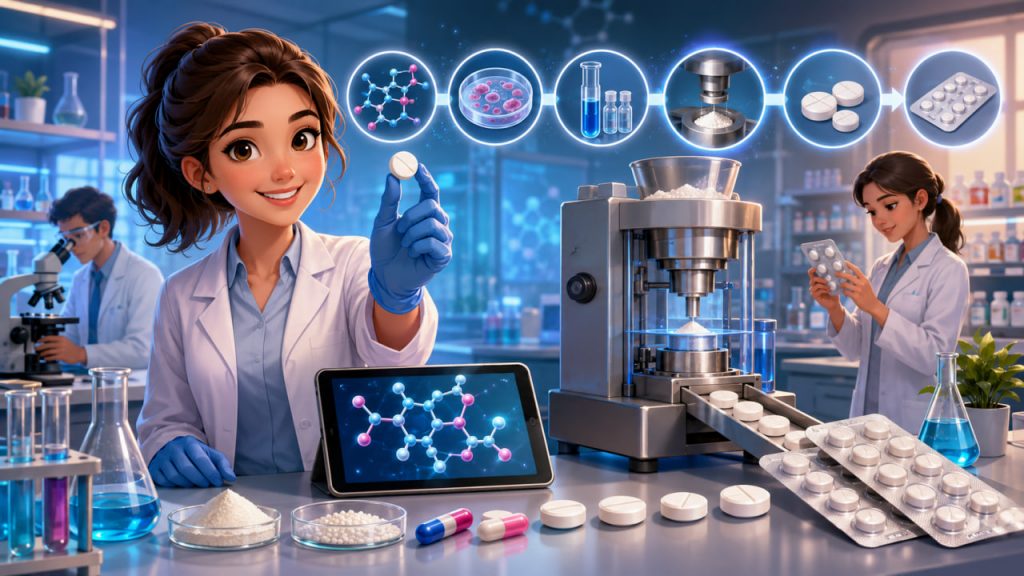
Medicinal tablets are so familiar that their technological importance is easy to overlook. A small compressed dose can contain an active pharmaceutical ingredient, stabilizers, coatings, and carefully selected materials that control how the medicine is swallowed, protected, released, and absorbed.
Before standardized tablets became widespread, medicines were frequently supplied as powders, liquids, extracts, or hand-prepared mixtures. These preparations could be difficult to transport, unpleasant to take, and inconsistent in dose.
The pharmaceutical tablet transformed medicine by making treatment more precise, portable, stable, scalable, and accessible.
Why Tablets Changed Medical Treatment
A tablet packages a measured quantity of medicine into a compact solid form. When manufacturing is properly controlled, every unit should contain the intended amount of active ingredient and behave predictably after administration.
This standardization changed both clinical practice and public health. Doctors could prescribe defined doses, pharmacists could store medicines more efficiently, and patients could take treatments at home without measuring powders or liquids each time.
Tablets also made large-scale distribution easier. They usually occupy less space than liquid medicines, are less likely to spill, and can often remain stable for longer periods under suitable storage conditions.
WHO emphasizes that essential medicines should be available in appropriate dosage forms, in sufficient quantities, at assured quality, and at prices that patients and healthcare systems can afford. The dosage form is therefore part of a medicine’s practical value, not merely its packaging.
What Is Inside a Tablet?
A tablet normally contains more than the substance that produces the medical effect.
The active pharmaceutical ingredient, or API, is combined with inactive ingredients called excipients. Although excipients are not intended to treat the disease directly, they perform essential technical functions.
Common excipient roles include:
- Adding enough bulk for accurate manufacturing
- Helping particles bind during compression
- Allowing the tablet to break apart after swallowing
- Improving powder flow through production equipment
- Preventing material from sticking to machinery
- Protecting the active ingredient from moisture or light
- Improving taste, appearance, or swallowability
Creating the correct formulation is a delicate balancing process. A tablet must be strong enough to survive packaging and transport, but it must also release its medicine at the correct rate after administration.
How Modern Tablets Are Manufactured
Tablet production begins with carefully tested raw materials. The active ingredient and excipients are weighed according to an approved formula and blended until the medicine is distributed uniformly.
Depending on the formulation, the powder may be processed through wet granulation, dry granulation, or direct compression.
Granulation turns fine powders into larger, more manageable particles. This can improve flow, reduce separation between ingredients, and help the mixture compress consistently.
The prepared material enters a tablet press. Powder fills a small cavity called a die, and two punches apply controlled pressure from above and below. The particles bond together, producing a solid tablet.
Modern rotary presses can manufacture large numbers of tablets while continuously controlling weight, thickness, hardness, and compression force.
The tablets may then receive a coating, identifying mark, score line, or protective packaging.
Manufacturing speed is valuable only when every dose meets strict standards for identity, strength, purity, and performance.
Why Some Tablets Have Coatings
Tablet coatings can serve several purposes.
A thin film may hide an unpleasant taste, make the tablet easier to swallow, improve appearance, or protect the contents from humidity and oxygen.
Enteric coatings are designed to remain intact in the acidic environment of the stomach and dissolve later in the intestine. This may protect an acid-sensitive medicine or reduce direct irritation of the stomach.
Other coatings help create modified-release products. These tablets release the active ingredient gradually rather than delivering the full dose immediately.
Modified-release technology can maintain drug levels for longer periods and reduce how frequently a medicine must be taken. However, such tablets should not normally be crushed or divided unless their instructions specifically allow it. Damaging the release system could deliver the dose too quickly.
From Immediate Release to Precision Delivery
A conventional immediate-release tablet breaks apart and releases its medicine relatively soon after swallowing.
Pharmaceutical scientists can now design much more sophisticated delivery systems, including:
- Extended-release tablets
- Delayed-release tablets
- Chewable tablets
- Effervescent tablets
- Sublingual tablets placed under the tongue
- Buccal tablets absorbed through the cheek
- Orodispersible tablets that break apart in the mouth
Different patients require different dosage forms. Young children, older adults, and people with swallowing difficulties may struggle with large conventional tablets.
WHO guidance recognizes the importance of flexible oral solid forms, including tablets that disperse in the mouth or can help prepare oral liquids for younger age groups.
A successful medicine must deliver the correct molecule in a form that the intended patient can actually use.
How a New Tablet Is Developed
A new tablet begins long before the first commercial package reaches a pharmacy.
Scientists first identify or design a substance that may influence a biological target associated with a disease. Laboratory research then examines its chemical properties, potential activity, toxicity, metabolism, and stability.
The FDA divides drug development into five broad stages:
- Discovery and development
- Preclinical research
- Clinical research
- Regulatory review
- Post-market safety monitoring
Preclinical work addresses fundamental safety questions before the medicine is tested extensively in people. Clinical studies then investigate dosage, safety, effectiveness, adverse effects, and performance in relevant patient groups.
At the same time, formulation scientists must turn the active substance into a reliable product. A promising molecule may dissolve poorly, degrade in moisture, taste extremely bitter, or fail to compress into a stable tablet.
Developing the drug and developing the tablet are therefore related but distinct challenges.
Clinical Trials and Regulatory Review
Clinical research is commonly conducted in progressive stages.
Early studies often investigate tolerability, dosage, and how the body processes the drug. Later studies evaluate effectiveness and safety in larger groups of patients.
Regulators review the complete evidence, including clinical results, manufacturing methods, laboratory testing, proposed labeling, and quality controls.
Approval does not end scientific oversight. Once large populations begin using a medicine, rare adverse effects or long-term concerns may become easier to detect. Post-market monitoring allows authorities and manufacturers to update warnings, require additional research, or take other safety measures.
Quality Must Be Designed Into the Product
A finished tablet cannot be judged only by its appearance.
Manufacturers test properties such as:
- Active-ingredient content
- Dose uniformity
- Dissolution rate
- Disintegration time
- Hardness and friability
- Chemical purity
- Microbial quality
- Stability during storage
The European Medicines Agency supports Quality by Design, an approach that uses scientific understanding, statistical analysis, and risk management throughout pharmaceutical development and manufacturing.
The principle is crucial: quality cannot depend solely on testing a few finished tablets at the end of production. It must be built into the formulation, equipment, materials, and manufacturing process from the beginning.
Tablets and the Expansion of Public Healthcare
Reliable tablets helped make long-term treatment possible outside hospitals.
Patients can use oral medicines to manage infections, pain, cardiovascular disease, diabetes, thyroid disorders, allergies, and many other conditions. Fixed-dose combination tablets can place two or more active ingredients in one unit, simplifying certain treatment schedules.
Tablets also support vaccination campaigns indirectly through medicines used for fever, infection control, and chronic-disease management, while oral treatments reduce the need for injections in many situations.
Their compact size makes them especially valuable in supply chains that must reach rural clinics, emergency programs, and countries with limited storage capacity.
However, access still depends on affordability, correct prescribing, secure distribution, patient education, and protection against counterfeit or substandard products.
Expert Perspective
The European Medicines Agency’s pharmaceutical-development guidance stresses that developers must understand how formulation ingredients and manufacturing processes influence the finished medicine’s performance. This scientific knowledge provides the foundation for consistent quality throughout the product’s life.
The wider lesson is that a tablet is not simply compressed powder.
It is a carefully engineered drug-delivery system designed to place a precise medicine into the body at a controlled dose, location, and rate.
The Future of Tablet Technology
Future tablets may become increasingly personalized.
Advanced manufacturing could allow doses to be adjusted for individual patients according to age, metabolism, genetics, organ function, or treatment response. Three-dimensional printing may support unusual tablet shapes, combined ingredients, and complex internal structures that control drug release.
Researchers are also developing smarter coatings, improved taste-masking systems, abuse-resistant formulations, and products that are easier for children and older adults to take.
Digital technologies may help manufacturers monitor production more precisely and identify quality problems earlier.
The next revolution will not necessarily replace the tablet. It may transform the tablet into a more adaptable and personalized medical platform.
Interesting Facts
- Tablets can contain several different excipients even when they deliver only one active medicine.
- A tablet’s shape and score line can influence how easily it is swallowed or divided.
- Some tablets are designed to dissolve on the tongue without water.
- Enteric-coated tablets are intended to resist the acidic conditions of the stomach.
- Effervescent tablets release gas and dissolve when placed in water.
- Dissolution testing measures how quickly and completely a medicine enters a liquid under controlled conditions.
- Two tablets with the same active ingredient may behave differently when their formulations or release mechanisms differ.
- Essential medicines must be supplied in dosage forms appropriate for their intended patients and uses.
- Quality monitoring continues after a drug reaches the market.
- Modern tablet development combines chemistry, biology, engineering, statistics, medicine, and regulatory science.
Glossary
- Tablet — A solid medicinal dosage form usually produced by compressing a prepared mixture.
- Active Pharmaceutical Ingredient — The substance responsible for a medicine’s intended therapeutic effect.
- Excipient — An ingredient added to support manufacturing, stability, appearance, taste, or drug release.
- Dosage Form — The physical form in which a medicine is supplied, such as a tablet, capsule, liquid, or injection.
- Compression — The application of pressure that converts a powder or granulated mixture into a tablet.
- Granulation — A process that combines fine particles into larger granules with improved manufacturing properties.
- Disintegration — The process by which a tablet breaks into smaller pieces after administration.
- Dissolution — The process by which the active ingredient dissolves in fluid before absorption.
- Immediate Release — A formulation designed to release its active ingredient relatively quickly.
- Modified Release — A formulation engineered to delay or extend the release of a medicine.
- Enteric Coating — A protective layer designed to resist stomach acid and dissolve later in the digestive tract.
- Bioavailability — The proportion and rate at which an active ingredient reaches the bloodstream or intended site.
- Clinical Trial — A controlled study involving human participants that evaluates a medical intervention.
- Quality by Design — A systematic approach that builds product quality into development and manufacturing.
- Stability — The ability of a medicine to maintain its required properties throughout storage.
- Friability — The tendency of a tablet to chip, crumble, or lose particles during handling.