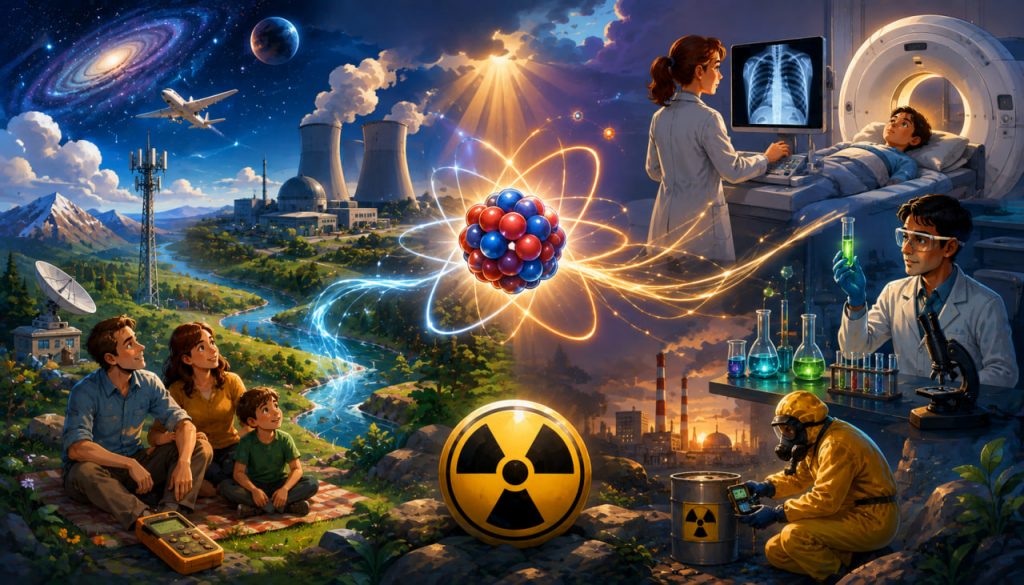
Radiation is often associated with nuclear accidents, medical X-rays, and invisible danger. In reality, radiation is simply energy traveling through space or matter as waves or particles.
Sunlight, radio signals, heat, medical imaging, and radioactive decay all involve radiation. Some forms carry too little energy to remove electrons from atoms, while others can ionize matter and damage living cells.
Understanding the difference between these categories is essential. Radiation is not automatically dangerous: its effects depend on the type, dose, exposure route, distance, and duration.
The Two Main Categories of Radiation
Radiation is broadly divided into non-ionizing and ionizing radiation.
Non-ionizing radiation does not normally carry enough energy per photon to remove electrons from atoms. It includes:
- Radio waves
- Microwaves
- Infrared radiation
- Visible light
- Most ultraviolet radiation
These forms are widely used in communication, heating, lighting, wireless devices, and medical technology. At sufficiently high intensities, some can still damage tissue through heating or photochemical effects.
Ionizing radiation carries enough energy to ionize atoms and molecules. It includes alpha particles, beta particles, gamma rays, X-rays, and neutron radiation. WHO explains that ionizing radiation may travel as electromagnetic waves or as particles released during radioactive processes.
What Is Radioactivity?
Radiation and radioactivity are related, but they are not identical.
Radioactivity is the spontaneous transformation of an unstable atomic nucleus. During this process, the atom may release particles or electromagnetic energy.
An unstable atomic form is called a radionuclide. Different radionuclides decay at different rates and produce different kinds of radiation.
Radiation is the energy or particles emitted during the process. Radioactive material is the substance containing unstable atoms.
This distinction explains why an X-ray machine can produce ionizing radiation without containing a continuously radioactive source. When the machine is switched off, it stops generating X-rays.
Alpha Radiation
Alpha particles consist of two protons and two neutrons. They are relatively heavy, electrically charged, and lose their energy quickly.
Alpha radiation has very low penetrating ability. A sheet of paper, clothing, or the outer layer of human skin can usually stop it.
However, alpha-emitting material can be dangerous when inhaled, swallowed, or introduced through a wound. Once inside the body, it may release substantial energy into a small amount of nearby tissue.
Radon and some of its decay products are important sources of internal alpha exposure.
Beta Radiation
Beta radiation usually consists of fast-moving electrons emitted from unstable nuclei.
Beta particles penetrate farther than alpha particles but less deeply than gamma rays. Plastic, glass, or thin metal can provide shielding, depending on the energy involved.
External beta exposure may injure skin or eyes. Internal exposure can occur when beta-emitting substances enter the body through breathing, food, water, or wounds.
Beta radiation has useful applications in medicine, scientific research, industrial measurement, and radioactive tracing.
Gamma Rays and X-Rays
Gamma rays and X-rays are high-energy electromagnetic radiation. They have no mass and no electrical charge.
The main distinction is their origin. Gamma rays generally come from changes within atomic nuclei, while X-rays are commonly produced by interactions involving electrons or by specialised machines.
Both can penetrate the body and are therefore useful for medical imaging and treatment. Dense materials such as lead, concrete, or thick structural barriers may be used to reduce exposure.
X-rays allow doctors to examine bones and internal structures. Higher doses of carefully directed ionizing radiation can also destroy cancer cells during radiotherapy.
Neutron Radiation
Neutrons are uncharged particles that can penetrate deeply and interact strongly with atomic nuclei.
Neutron radiation is most commonly associated with nuclear reactors, certain research facilities, specialised industrial sources, and nuclear reactions.
Because neutrons can make some materials radioactive through a process called activation, neutron protection requires careful engineering.
Materials rich in hydrogen, such as water, concrete, or certain polymers, are often useful for slowing neutrons. Additional shielding may then capture the slowed particles.
Natural Background Radiation
Radiation is a natural part of the environment.
People are exposed to cosmic radiation from space, radioactive elements in soil and rock, radionuclides in food and water, and radon gas released from the ground.
Exposure varies by location. Altitude, geology, building materials, ventilation, and lifestyle can all influence the dose a person receives.
Radon is especially important because it can accumulate inside poorly ventilated buildings. WHO identifies radon as the largest contributor to natural ionizing-radiation exposure for many populations.
The presence of natural background radiation does not make all additional exposure harmless. It provides context for comparing different sources and doses.
Radiation Dose: Why the Amount Matters
The health effect of radiation cannot be understood from its name alone.
Several quantities are used:
- Becquerel measures radioactive decays per second.
- Gray measures energy absorbed by matter.
- Sievert estimates biological effect by considering radiation type and exposed tissue.
- Dose rate describes how quickly a dose is received.
A small dose distributed over time differs from a very large dose delivered to the whole body within minutes.
WHO reports that very high doses can cause acute effects such as nausea, skin damage, hair loss, tissue injury, acute radiation syndrome, and death. Lower doses do not normally produce immediate symptoms, but they may increase the long-term probability of cancer.
Risk generally increases with dose, but dose, timing, exposed tissue, and individual sensitivity all matter.
Exposure Is Not the Same as Contamination
Radiation exposure occurs when energy from a source reaches the body.
Contamination means that radioactive material is present on a person, object, clothing, skin, or inside the body.
A standard medical X-ray exposes the patient briefly, but it does not make the patient radioactive. CDC guidance confirms that people do not become radioactive after ordinary diagnostic X-ray exposure.
External contamination may often be reduced by removing outer clothing and washing exposed skin carefully.
Internal contamination is more complicated because radioactive material may have been inhaled, swallowed, or absorbed through a wound. Medical specialists may use specific treatments for certain radionuclides.
How to Reduce Radiation Exposure
The three fundamental principles of radiation protection are time, distance, and shielding.
Spend less time near the source. Increase the distance from it. Place appropriate shielding between the source and the body.
The CDC incorporates these principles into ALARA, meaning As Low As Reasonably Achievable. The objective is to avoid unnecessary exposure while considering the practical benefits of a medical, industrial, or scientific procedure.
Different radiation types require different shielding. Paper may stop alpha particles, while penetrating gamma radiation may require dense barriers.
Untrained individuals should never handle an unknown object marked with a radiation warning symbol.
What to Do During a Radiation Emergency
During a serious radiological emergency, official instructions are more reliable than rumours or social-media speculation.
CDC guidance uses the message: Get inside, stay inside, and stay tuned.
Enter a substantial building, move toward the basement or centre, close windows and doors, and follow instructions from emergency authorities. Building walls can reduce exposure, particularly from radioactive material outside.
CDC notes that remaining sheltered for at least 24 hours may provide important protection in some emergencies because radioactive material weakens over time and external contamination settles outside.
Do not take potassium iodide unless public-health authorities specifically recommend it. It protects only the thyroid from radioactive iodine and does not provide general protection against every type of radiation.
Medical Radiation: Benefits and Risks
Medical imaging is the main human-made source of ionizing-radiation exposure for many people. X-rays, CT scans, fluoroscopy, and nuclear-medicine procedures can reveal conditions that would otherwise be difficult or dangerous to diagnose.
A medically justified examination may provide benefits far greater than its radiation risk.
Patients should tell healthcare professionals about pregnancy or possible pregnancy and provide information about recent imaging when relevant. They should not refuse an important examination solely because it uses radiation.
At the same time, unnecessary repeated imaging should be avoided. Healthcare providers should select suitable procedures and optimise the dose for the clinical question.
Expert Perspective
WHO emphasises that ionizing radiation has valuable applications in medicine, industry, agriculture, and research, while also requiring effective protection and dose control. Health effects depend strongly on the dose and the rate at which it is delivered.
The practical lesson is that radiation safety should be based on measurement and context rather than fear.
A dental X-ray, radon accumulation, radioactive contamination, sunlight exposure, and a nuclear emergency are not equivalent situations simply because all involve radiation.
Common Radiation Myths
Radiation cannot usually be detected by human senses. A dangerous source may produce no smell, colour, heat, or visible glow.
Microwave ovens do not make food radioactive. They use non-ionizing electromagnetic energy to heat water-containing material.
Mobile phones communicate using non-ionizing radiofrequency signals, not X-rays or gamma rays.
Radioactive substances do not remain equally active forever. Each radionuclide has a characteristic half-life, although some remain hazardous for very long periods.
Objects that glow in films and cartoons do not represent how most radioactive materials look in real life.
Interesting Facts
- Visible light and radio waves are forms of radiation.
- Ionizing radiation can travel as particles or electromagnetic waves.
- Alpha particles are easy to stop externally but may be hazardous inside the body.
- A medical X-ray does not make the patient radioactive.
- Humans are continually exposed to natural background radiation.
- Cosmic-radiation exposure generally increases at higher altitudes.
- Radon can enter buildings through cracks and openings near the ground.
- Radiation is used to sterilise some medical equipment and biological products.
- Radiation therapy uses controlled high doses to damage cancer cells.
- Time, distance, and shielding are the basic principles of radiation protection.
- Radiation detectors can measure energy that humans cannot see or feel.
- The radiation warning symbol indicates a potential ionizing-radiation hazard, not necessarily immediate danger at every distance.
Glossary
- Radiation — Energy transmitted through space or matter as waves or particles.
- Ionizing Radiation — Radiation energetic enough to remove electrons from atoms or molecules.
- Non-Ionizing Radiation — Lower-energy radiation that does not normally ionize atoms.
- Radioactivity — The spontaneous decay of unstable atomic nuclei.
- Radionuclide — An unstable atomic form that undergoes radioactive decay.
- Alpha Particle — A particle containing two protons and two neutrons.
- Beta Particle — A high-speed electron or positron emitted during nuclear decay.
- Gamma Ray — High-energy electromagnetic radiation emitted from an atomic nucleus.
- X-Ray — Ionizing electromagnetic radiation commonly produced by electronic processes or specialised machines.
- Neutron Radiation — Radiation consisting of free neutrons.
- Becquerel — A unit representing one radioactive decay per second.
- Gray — A unit measuring absorbed radiation energy.
- Sievert — A unit used to estimate the biological effect of ionizing radiation.
- Dose Rate — Radiation dose received during a particular period.
- Contamination — The unwanted presence of radioactive material on or inside something.
- Irradiation — Exposure to radiation without necessarily involving radioactive contamination.
- Half-Life — The time required for half the radioactive atoms in a sample to decay.
- ALARA — A radiation-protection principle meaning As Low As Reasonably Achievable.
- Shielding — Material placed between a radiation source and a person to reduce exposure.
- Radon — A naturally occurring radioactive gas that can accumulate indoors.