Minor burns and cuts are among the most common household injuries. They can happen while cooking, repairing something, handling broken glass, using knives, or touching a hot surface.
Most small injuries can be managed safely at home. However, incorrect first aid may worsen tissue damage, introduce infection, or delay urgently needed treatment.
The priorities are simple: stop the source of injury, control serious bleeding, cool burns correctly, protect damaged tissue, and recognize warning signs.
First Check Whether the Situation Is Safe
Before helping, make sure the source of danger has been controlled.
Turn off hot appliances, move away from flames, disconnect electrical power when safe, and avoid direct contact with spilled chemicals. Wear disposable gloves when available, especially if another person is bleeding.
If the injured person is unresponsive, having difficulty breathing, or losing a large amount of blood, contact emergency services immediately.
For life-threatening external bleeding, the American Red Cross recommends applying firm direct pressure to the wound while emergency assistance is being arranged.
How to Treat a Minor Thermal Burn
A thermal burn may be caused by hot liquids, steam, cooking equipment, fire, or heated objects.
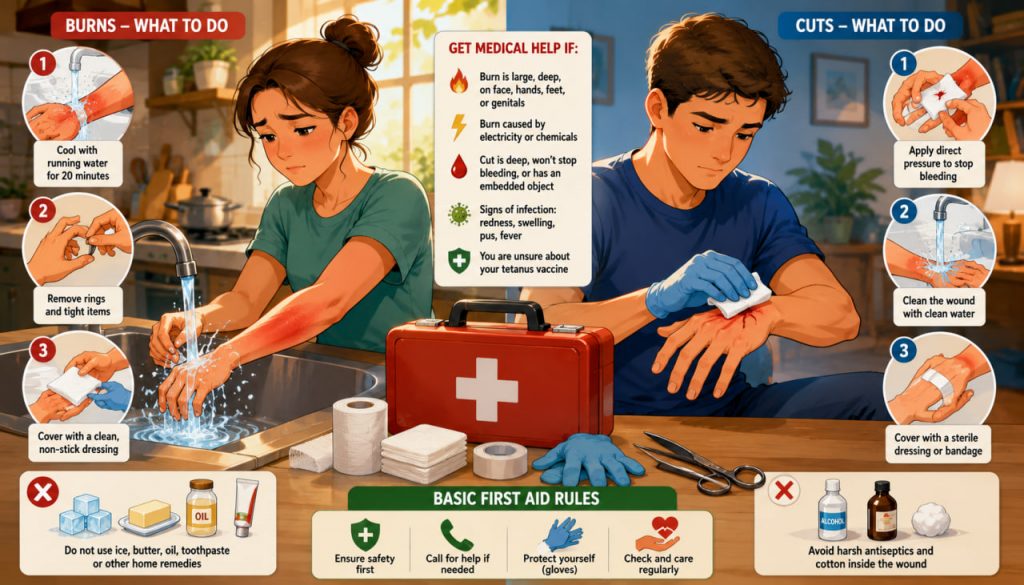
First, move the person away from the heat source. Carefully remove rings, watches, bracelets, and loose clothing near the injury before swelling develops. Do not pull away material that is stuck to burned skin.
Cool the affected area under cool or lukewarm running water for about 20 minutes. This reduces retained heat in the tissue and may limit further damage. NHS and WHO guidance recommends prompt cooling with running water rather than ice.
After cooling, loosely cover the burn with a clean, non-fluffy sterile dressing. A clean sheet of plastic film may be used over some limb burns, but it should be placed loosely rather than wrapped tightly around the body part.
Keep the rest of the person warm, particularly when cooling a large area or treating a child or older adult.
What Not to Put on a Burn
Do not apply ice or extremely cold water directly to burned skin. Excessive cold can further injure tissue and may reduce body temperature.
Avoid butter, cooking oil, toothpaste, flour, creams, alcohol, and other household remedies. Greasy substances can trap heat and make medical examination or cleaning more difficult.
Do not deliberately burst blisters. The intact skin over a blister provides some protection against contamination.
Cooling with running water is more useful than applying an improvised home remedy.
When a Burn Needs Medical Attention
Seek urgent medical care for burns that are deep, extensive, white, charred, leathery, or relatively painless despite a severe appearance.
Professional assessment is also important when a burn:
- Covers an area larger than the injured person’s hand
- Affects the face, neck, hands, feet, major joints, or genitals
- Completely surrounds a limb, finger, or toe
- Was caused by electricity or chemicals
- Involves smoke inhalation
- Occurs in a baby, very young child, frail older adult, or medically vulnerable person
- Shows increasing pain, swelling, redness, pus, fever, or unpleasant odor
Electrical burns may cause serious internal injury even when the skin mark appears small. Chemical burns require immediate removal of contaminated clothing and prolonged irrigation, while protecting the helper from exposure.
Breathing difficulty, facial burns, soot around the mouth or nose, hoarseness, confusion, or collapse after a fire require emergency assistance.
How to Stop Bleeding From a Cut
For an ordinary household cut, wash or sanitize your hands and put on gloves when possible.
Place clean gauze or a clean folded cloth over the wound and apply steady, firm pressure. Keep the pressure continuous rather than repeatedly lifting the dressing to check the injury.
If blood soaks through, place more material on top and continue pressing. Removing the original dressing may disturb developing clots.
Raise the injured part above heart level when practical, but do not delay direct pressure to do this.
For severe, life-threatening bleeding from an arm or leg, a commercial tourniquet may be appropriate when applied by someone trained to use it. Ordinary small cuts do not require a tourniquet.
Cleaning a Minor Cut
Once bleeding has stopped, rinse the cut under clean running water.
Gently wash the surrounding skin with soap, but avoid aggressively scrubbing deep tissue. Remove small, easily accessible particles with clean tweezers. Do not dig into the wound or attempt to remove deeply embedded glass, metal, or other objects.
Pat the area dry and cover it with a sterile dressing or adhesive bandage. Change the covering when it becomes wet, dirty, or loose.
CDC guidance emphasizes cleaning wounds and removing dirt or foreign material as important parts of wound care and tetanus prevention.
Should You Use Antiseptic or Antibiotic Cream?
For many minor cuts, thorough rinsing with clean water and protection with a clean dressing are the most important steps.
Strong antiseptics placed repeatedly inside a wound may irritate tissue. Follow local medical guidance and product instructions rather than assuming that more antiseptic is always better.
Antibiotics should not be used merely to prevent tetanus. CDC guidance states that tetanus prevention depends on appropriate wound care and vaccination status, not preventive topical or systemic antibiotics.
A clinician may recommend treatment when a wound is already infected or has a particularly high infection risk.
When a Cut Requires Professional Care
Seek medical assessment if a cut is deep, gaping, or continues bleeding despite sustained direct pressure.
Medical care may also be needed when:
- Fat, muscle, tendon, or bone is visible
- The wound was caused by broken glass or a contaminated object
- An object remains embedded
- The cut crosses a joint
- Movement or sensation is impaired
- The injury affects the eye, face, hand, or genitals
- It resulted from an animal or human bite
- It is a deep puncture wound
- The wound edges may require closure
- The person uses blood-thinning medication or has a bleeding disorder
- Signs of infection develop
Do not remove a deeply embedded object. Apply pressure around it, stabilize it with clean padding, and seek urgent help.
Recognizing Wound Infection
A healing cut may initially be mildly tender, but worsening symptoms can indicate infection.
Warning signs include:
- Expanding redness
- Increasing warmth or swelling
- Worsening pain
- Pus or cloudy drainage
- Red streaks extending from the wound
- Fever or chills
- Delayed healing
- A foul smell
Prompt evaluation is especially important for people with diabetes, poor circulation, weakened immunity, or reduced sensation.
Tetanus After Cuts and Burns
Tetanus bacteria can enter through damaged skin. Deep punctures, contaminated wounds, crush injuries, wounds containing dead tissue, and some burns require particular attention.
Whether a booster or additional treatment is needed depends on the wound and the person’s vaccination history. People with uncertain or incomplete vaccination records should contact a healthcare professional.
CDC guidance identifies vaccination and proper wound management as the main methods of preventing tetanus.
Do not wait for symptoms before checking tetanus protection after a high-risk wound.
Pain Relief and Ongoing Care
For a minor burn or cut, an over-the-counter pain reliever may be appropriate when used according to the label and the person’s medical circumstances.
Keep the injury clean and protected. Avoid friction, dirty water, and activities that repeatedly reopen the wound.
Check the area every day. A small injury should gradually become less painful and inflamed rather than progressively worse.
Do not remove firmly attached scabs or loose blister skin. Allow healing tissue to remain protected unless a healthcare professional advises otherwise.
Expert Perspective
The World Health Organization advises stopping the burning process, cooling thermal burns with running water, and covering the person with a clean material before appropriate medical care. It specifically warns against applying substances that may worsen the injury.
The American Red Cross places direct pressure at the center of first aid for external bleeding. Together, these recommendations highlight a practical principle: effective first aid usually relies on a few proven actions performed promptly, not complicated home treatments.
Building a Useful Home First-Aid Kit
A basic household kit should be easy to locate and protected from moisture.
Useful supplies include:
- Disposable gloves
- Sterile gauze pads
- Non-stick dressings
- Adhesive bandages in several sizes
- Medical tape
- Clean tweezers
- Blunt-ended scissors
- Saline wound-rinsing solution
- A clean emergency covering
- A thermometer
- A written list of emergency numbers
Check expiration dates and replace used or damaged items. A kit is most useful when household members also know basic first-aid procedures.
Interesting Facts
- Burn damage can continue after contact with the hot object ends because heat remains in the tissue.
- Cool running water is recommended, but ice is not.
- A serious deep burn may be less painful than a superficial burn because nerve endings can be damaged.
- Continuous direct pressure is more effective than repeatedly checking whether bleeding has stopped.
- Small cuts can sometimes require medical care when they involve tendons, nerves, joints, or contaminated objects.
- Tetanus is not caused by rust itself; the concern is contamination of a wound and inadequate immunity.
- Blisters form when fluid collects between damaged layers of skin.
- Electrical injuries may cause internal damage that is not obvious from the skin.
- Human and animal bites have a higher infection risk than many clean household cuts.
- Poorly fitted or dirty dressings can irritate a healing wound.
Glossary
- Burn — Tissue damage caused by heat, chemicals, electricity, radiation, or friction.
- Scald — A burn caused by hot liquid or steam.
- Thermal Burn — A burn caused by direct contact with heat.
- Direct Pressure — Firm pressure applied to a bleeding wound to help control blood loss.
- Sterile Dressing — A clean medical covering designed to protect a wound.
- Non-Stick Dressing — A wound covering designed to reduce adhesion to damaged tissue.
- Blister — A fluid-filled pocket that forms between layers of damaged skin.
- Puncture Wound — A narrow, deep injury caused by a pointed object.
- Embedded Object — An object lodged inside a wound that should not usually be removed during basic first aid.
- Tetanus — A serious bacterial disease that can enter through cuts or wounds and cause severe muscle stiffness.
- Tourniquet — A device used to control life-threatening bleeding from a limb.
- Antiseptic — A substance used to reduce microorganisms on skin or tissue.
- Infection — The invasion and multiplication of harmful microorganisms in body tissue.
- Humane First Aid — Immediate assistance intended to prevent further harm until recovery or professional care is available.