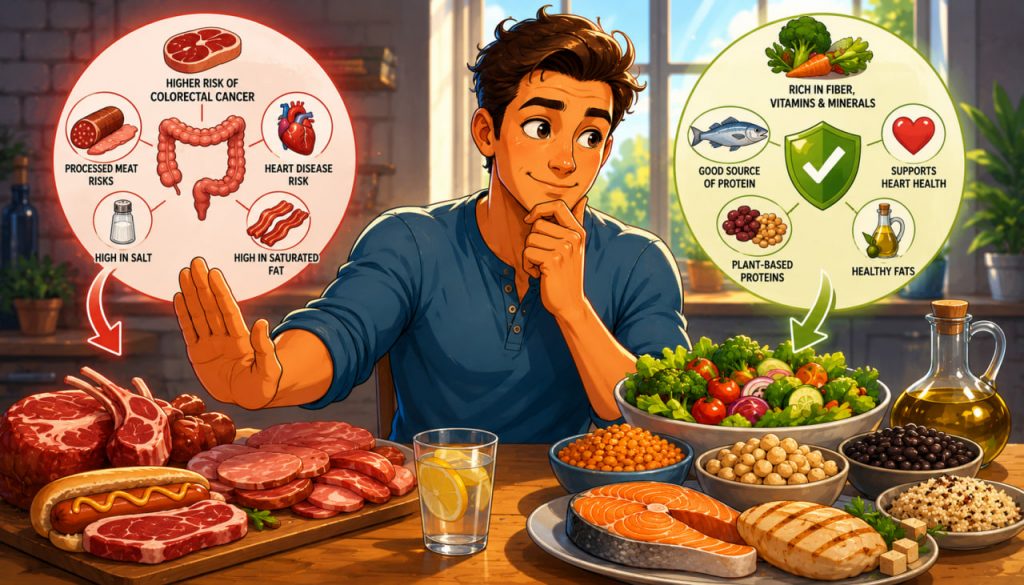
Red meat is rich in protein, iron, zinc, and vitamin B12, so it is not automatically an unhealthy food. However, many health organizations recommend limiting red meat and eating as little processed meat as possible because frequent consumption is associated with a higher risk of colorectal cancer and may contribute to cardiovascular disease.
The key words are “amount,” “type,” and “frequency.” A lean steak eaten occasionally is not nutritionally identical to bacon, sausages, or heavily charred meat eaten every day.
For most people, the evidence supports moderation rather than a universal ban on all red meat.
What Counts as Red Meat?
Red meat generally includes meat from mammals, such as:
- Beef
- Pork
- Lamb and mutton
- Veal
- Goat
- Venison
Processed meat is meat preserved or modified through smoking, curing, salting, fermentation, or the addition of preservatives. Common examples include bacon, ham, salami, hot dogs, and many sausages.
This distinction matters because the evidence against processed meat is stronger than the evidence against fresh, unprocessed red meat.
The International Agency for Research on Cancer, part of the World Health Organization, classifies processed meat as carcinogenic to humans because sufficient evidence shows that it causes colorectal cancer. Red meat is classified as probably carcinogenic, reflecting more limited evidence.
Red and Processed Meat May Increase Colorectal Cancer Risk
The most established health concern is colorectal, or bowel, cancer.
The World Cancer Research Fund concludes that there is strong evidence linking both red and processed meat consumption with colorectal cancer. It recommends eating no more than moderate amounts of red meat and little, if any, processed meat.
IARC estimated that eating 50 grams of processed meat every day was associated with an approximately 18% increase in the relative risk of colorectal cancer. This does not mean that 18 out of every 100 people who eat processed meat will develop cancer. It means the person’s existing risk is estimated to rise by 18% relative to the baseline risk.
Cancer risk is influenced by the complete dietary pattern, body weight, physical activity, alcohol consumption, smoking, age, genetics, and screening history. Red meat is therefore one risk factor among many.
Why Might Red Meat Affect Cancer Risk?
Researchers have identified several possible mechanisms.
Red meat contains heme iron, the form of iron found in hemoglobin and muscle tissue. Heme iron is easily absorbed and nutritionally valuable, but in the digestive tract it may also promote chemical reactions that damage cells or encourage the formation of potentially harmful compounds.
Processing meat through curing or smoking can generate or introduce N-nitroso compounds and polycyclic aromatic hydrocarbons. Some of these substances can damage DNA.
Cooking meat at very high temperatures—especially pan-frying, grilling, or barbecuing until the surface is burned—can also produce heterocyclic aromatic amines and polycyclic aromatic hydrocarbons.
These mechanisms do not mean that one serving directly causes cancer. The concern involves repeated exposure over many years, particularly when intake is high.
Processed Meat Can Contain Large Amounts of Salt
Bacon, sausages, ham, and cured meats are often high in sodium because salt helps preserve them and intensifies flavor.
A high-sodium diet can increase blood pressure in salt-sensitive individuals. Persistently elevated blood pressure raises the risk of heart disease, stroke, and kidney disease.
The NHS notes that processed meat may be high in salt and that excessive salt consumption can increase the risk of high blood pressure.
Even poultry-based sausages or processed deli products can be high in sodium. The word “chicken” on the package does not automatically make a processed product heart-healthy.
Fatty Red Meat Can Raise Saturated-Fat Intake
The amount of saturated fat varies considerably between cuts of meat.
Lean beef or pork may contain relatively little visible fat, while ribs, fatty mince, processed sausages, and heavily marbled steaks can contain much more.
Saturated fat can increase low-density lipoprotein cholesterol, often called LDL or “bad” cholesterol. Elevated LDL contributes to the formation of fatty deposits in arteries and increases cardiovascular risk.
The American Heart Association advises limiting saturated fat and notes that red meats generally contain more of it than fish, skinless poultry, and plant proteins. It recommends choosing lean, unprocessed cuts when eating meat.
The replacement matters. Replacing fatty meat with fish, beans, lentils, nuts, or unsaturated fats is generally more beneficial than replacing it with refined bread, sweets, or highly processed snacks.
What You Eat Instead Is Important
Simply removing red meat does not guarantee a healthier diet.
A person who replaces steak with lentils, vegetables, whole grains, or fish may increase fiber and improve fat quality. Someone who replaces it with chips, white bread, and sugary desserts may gain little benefit.
Beans, peas, chickpeas, lentils, tofu, eggs, fish, and lean poultry can all provide protein. Pulses also contain dietary fiber, which red meat does not provide.
The NHS recommends choosing lean cuts, reducing red and processed meat, and using beans and lentils as lower-fat sources of protein and fiber.
The healthiest strategy is not merely “eat less meat,” but “replace some meat with nutrient-rich foods.”
Does Everyone Need to Stop Eating Red Meat?
No major evidence-based guideline says that every healthy person must completely eliminate unprocessed red meat.
The World Cancer Research Fund recommends limiting cooked red meat to approximately 350–500 grams per week, or roughly three moderate portions, while consuming very little processed meat.
The NHS advises people consuming more than 90 grams of cooked red and processed meat per day to reduce their average intake to 70 grams.
Recommendations vary slightly between countries, but their overall message is similar:
- Keep portions moderate.
- Do not eat red meat at every meal.
- Minimize processed meat.
- Choose lean cuts.
- Avoid regularly burning or charring meat.
- Include several plant-based meals each week.
Individual requirements may differ for children, pregnant people, athletes, people with anemia, and those following medically restricted diets.
Red Meat Also Provides Valuable Nutrients
Red meat is one of the richest dietary sources of highly absorbable iron. It also provides complete protein, zinc, selenium, and vitamin B12.
These nutrients support oxygen transport, immune function, muscle maintenance, and nervous-system health.
This is why the recommendation is usually to limit red meat rather than portray it as nutritionally worthless. WCRF notes that red meat can contribute useful protein, iron, zinc, and vitamin B12 to a balanced diet.
People who remove meat completely should plan appropriate alternatives. Vitamin B12 is particularly important because reliable natural plant sources are limited. Vegans generally require fortified foods or supplementation.
Iron from plants is also less readily absorbed than heme iron. Combining beans, lentils, seeds, or leafy vegetables with vitamin C-rich foods can improve absorption.
Is Grass-Fed or Organic Red Meat Safer?
Grass-fed and organic meat may differ in farming practices, animal diet, and aspects of its fatty-acid profile. However, these labels do not remove the main concerns associated with high consumption.
Organic bacon is still processed meat. Grass-fed beef still contains heme iron, and burning an expensive organic steak can still generate high-temperature cooking compounds.
Quality, animal welfare, and environmental concerns may influence purchasing decisions, but portion size and processing remain central health considerations.
Expert Perspective
IARC expert Kurt Straif explained that the classification of processed meat was based primarily on strong evidence that it causes colorectal cancer. The classification describes the strength of the evidence that a hazard exists, not the size of the risk from an occasional serving.
WHO has clarified that its findings do not instruct everyone to stop eating processed meat entirely. Instead, they support reducing consumption to lower colorectal cancer risk.
This distinction is important: processed meat and tobacco are both classified as proven carcinogenic hazards, but they do not create risks of equal magnitude.
Practical Ways to Eat Less Red Meat
Start by reducing frequency rather than attempting a dramatic overnight change.
Replace some minced beef with lentils or mushrooms. Use beans in soups, curries, and salads. Choose fish, eggs, tofu, or poultry for several weekly meals.
When eating red meat, select lean cuts, remove visible fat, and keep the portion smaller than the vegetables and whole grains on the plate.
Cook at moderate temperatures whenever possible. Baking, stewing, or gentle roasting generally causes less surface charring than exposing meat directly to intense flames.
Processed meat is best treated as an occasional food rather than an everyday breakfast or sandwich ingredient.
Interesting Facts
- Pork is classified as red meat because the definition is based on mammalian muscle biology, not its appearance after cooking.
- Processed meat can include beef, pork, poultry, or mixtures of several meats.
- Red meat contains no dietary fiber.
- Heme iron is absorbed more efficiently than most iron found in plants.
- A carcinogen classification identifies whether something can cause cancer, not how dangerous a typical exposure is.
- The cancer evidence is strongest for processed meat and colorectal cancer.
- Cutting portion size can reduce intake without requiring complete exclusion.
- Beans and lentils provide both protein and fiber.
- Burning meat is not necessary for safe cooking; internal temperature and hygienic handling are more important.
- Lean red meat may contain considerably less saturated fat than fatty or processed cuts.
- The long-term dietary pattern matters more than one isolated meal.
Glossary
- Red Meat — Meat from mammals, including beef, pork, lamb, goat, and venison.
- Processed Meat — Meat preserved or altered through curing, salting, smoking, fermentation, or added preservatives.
- Colorectal Cancer — Cancer affecting the colon or rectum, also called bowel cancer.
- Carcinogen — An agent or exposure capable of causing cancer.
- Relative Risk — A comparison of risk between an exposed group and a reference group.
- Heme Iron — A highly absorbable form of iron found in meat and blood proteins.
- N-Nitroso Compounds — Chemicals that may form during meat processing or digestion and can include carcinogenic substances.
- Polycyclic Aromatic Hydrocarbons — Chemicals that may form when meat or other organic material is exposed to smoke or intense heat.
- Heterocyclic Aromatic Amines — Compounds formed when muscle meat is cooked at high temperatures.
- Saturated Fat — A type of dietary fat that can raise LDL cholesterol when consumed in excess.
- LDL Cholesterol — A cholesterol-carrying particle associated with plaque formation in arteries when present at high levels.
- Sodium — A mineral found in salt that can contribute to high blood pressure when consumed excessively.
- Pulses — Edible dried legumes such as beans, chickpeas, peas, and lentils.
- Vitamin B12 — A vitamin needed for red blood cell production and normal nervous-system function.
- Dietary Pattern — The overall combination of foods and drinks regularly consumed over time.