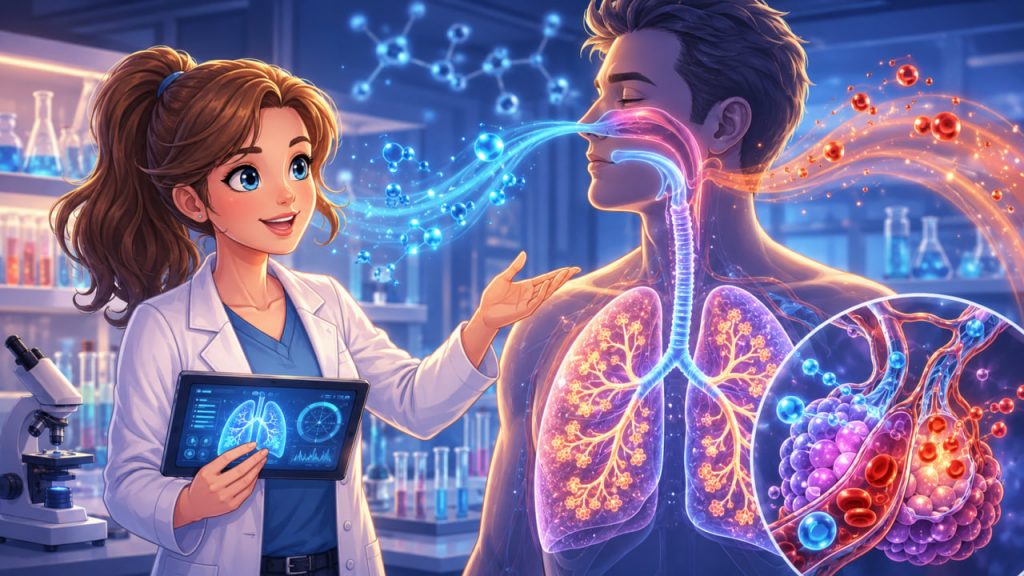
Breathing happens so automatically that we rarely notice it. Yet every breath depends on a precisely coordinated system involving the brain, airways, lungs, respiratory muscles, heart, blood vessels, and red blood cells.
The basic purpose of breathing is to bring oxygen into the body and remove carbon dioxide. Oxygen supports the chemical reactions that allow cells to release energy from nutrients, while carbon dioxide is produced as a waste gas during metabolism.
Breathing is not simply the filling and emptying of the lungs. It is a continuous exchange between the atmosphere, the blood, and every living cell in the body.
Where Breathing Begins
Air normally enters through the nose, although it can also enter through the mouth.
The nasal passages warm, moisten, and partially filter incoming air. Tiny hairs and mucus help trap dust, pollen, microorganisms, and other particles before they travel deeper into the respiratory system.
From the nose or mouth, air passes through the throat and into the trachea, commonly called the windpipe. The trachea divides into two main tubes called bronchi, one leading to each lung.
Inside the lungs, the bronchi branch repeatedly into smaller tubes known as bronchioles. This branching structure resembles an upside-down tree.
At the ends of the smallest bronchioles are microscopic air sacs called alveoli, where the most important part of respiration takes place.
What Makes Air Enter the Lungs?
The lungs do not actively pull in air by themselves. They expand because respiratory muscles change the volume and pressure inside the chest.
The principal breathing muscle is the diaphragm, a broad, dome-shaped sheet of muscle beneath the lungs.
During inhalation, the diaphragm contracts and moves downward. At the same time, the intercostal muscles between the ribs lift and expand the rib cage.
This movement enlarges the chest cavity and reduces the pressure inside the lungs relative to the surrounding atmosphere. Air then flows inward because gases naturally move from areas of higher pressure to areas of lower pressure.
We inhale because the chest expands and creates a pressure difference—not because the lungs “suck” air in like a pump.
During quiet breathing, the diaphragm performs most of the work. Additional muscles in the neck, chest, and abdomen become more active during exercise, coughing, or difficult breathing.
How Exhalation Works
During normal, relaxed exhalation, the diaphragm and intercostal muscles stop contracting.
The diaphragm rises back toward its dome-shaped resting position, the chest cavity becomes smaller, and the elastic lung tissue recoils. Pressure inside the lungs increases, causing air to flow outward.
Ordinary exhalation is therefore mostly passive. However, forceful exhalation during exercise, coughing, singing, or blowing uses abdominal and internal intercostal muscles to push air out more rapidly.
Lungs contain elastic tissue that helps them return toward their original size after expansion. Diseases that reduce this elasticity can make exhalation much more difficult.
What Happens Inside the Alveoli?
The lungs contain an enormous network of alveoli surrounded by tiny blood vessels called capillaries.
The walls of the alveoli and capillaries are extremely thin. This allows gases to move across them by diffusion.
Oxygen concentration is higher in freshly inhaled alveolar air than in the oxygen-poor blood arriving from the body. Oxygen therefore crosses the alveolar wall and enters the bloodstream.
At the same time, carbon dioxide concentration is higher in the arriving blood than in the alveoli. Carbon dioxide moves in the opposite direction, entering the alveoli before being exhaled.
This process is called gas exchange.
Healthy alveoli must remain open, thin, and closely connected to a good blood supply. Fluid, inflammation, scarring, or damage to their walls can interfere with oxygen transfer.
How Oxygen Travels Through the Body
After entering the bloodstream, most oxygen attaches to a protein called hemoglobin inside red blood cells.
The oxygen-rich blood travels from the lungs to the left side of the heart. The heart then pumps it through arteries to organs, muscles, and other tissues.
When blood reaches the smallest vessels, oxygen separates from hemoglobin and diffuses into nearby cells.
Cells use oxygen during cellular respiration—a series of chemical reactions that releases usable energy from nutrients. The brain, heart, and other active organs require a continuous oxygen supply to function normally.
After delivering oxygen, the blood collects carbon dioxide and other metabolic products before returning to the heart and lungs.
Why We Exhale Carbon Dioxide
Carbon dioxide is produced when cells release energy from carbohydrates, fats, and proteins.
It travels through the blood in several forms. Much of it is converted into bicarbonate, while smaller amounts dissolve directly in plasma or attach to blood proteins.
When this blood reaches the lungs, the reactions reverse. Carbon dioxide moves into the alveoli and leaves the body during exhalation.
Removing carbon dioxide is essential because excessive accumulation changes the acidity of the blood. The respiratory system therefore helps regulate the body’s acid–base balance as well as supplying oxygen.
The urge to breathe is usually influenced more strongly by rising carbon dioxide than by falling oxygen.
How the Brain Controls Breathing
Most breathing is automatic.
Specialized respiratory centers in the brainstem continuously send signals through nerves to the diaphragm and other breathing muscles.
Sensors in the brain and blood vessels monitor carbon dioxide, oxygen, and acidity. When carbon dioxide rises, the brain generally increases the depth or frequency of breathing so that more of it can be removed.
The brain also adjusts breathing during exercise. Muscles require more oxygen and produce more carbon dioxide, so both breathing rate and depth increase.
Although breathing is automatic, humans can temporarily control it voluntarily. We can hold our breath, speak, sing, whistle, or deliberately change our breathing rhythm. Automatic control eventually takes priority when changes in blood gases become strong enough.
Why Breathing Changes During Exercise
During physical activity, working muscles consume energy more rapidly.
The heart beats faster to deliver additional oxygenated blood, while breathing becomes deeper and more frequent. This increases ventilation and supports faster gas exchange.
You may continue breathing heavily after exercise because the body is restoring normal conditions, regulating temperature, removing carbon dioxide, and replenishing energy reserves.
Regular physical activity can strengthen respiratory muscles and improve the efficiency of the cardiovascular system. However, exercise does not dramatically enlarge healthy adult lungs; much of the improvement comes from better circulation, muscular adaptation, and oxygen use.
Why the Nose Is Usually Better Than the Mouth
During ordinary breathing, the nose offers several advantages.
It filters particles, warms cold air, and adds moisture. This protects the delicate airways and prevents excessive drying.
Nasal breathing may also slow airflow and promote a calmer, more controlled breathing pattern.
Mouth breathing becomes useful when the body needs to move large amounts of air quickly, such as during intense exercise. Persistent mouth breathing at rest, however, may be associated with nasal obstruction, allergies, enlarged tissues, or other problems that deserve medical evaluation.
Expert Perspective
The U.S. National Heart, Lung, and Blood Institute describes breathing as a coordinated process in which the diaphragm, rib muscles, lungs, nervous system, and blood vessels work together. It emphasizes that breathing must both move air and maintain effective exchange of oxygen and carbon dioxide.
Respiratory specialists also stress that shortness of breath is a symptom, not a diagnosis. It may result from lung disease, heart conditions, anemia, infection, poor physical conditioning, anxiety, or several other causes.
Sudden severe breathlessness, blue or grey lips, chest pain, confusion, fainting, or an inability to speak normally because of breathing difficulty requires urgent medical attention.
Interesting Facts
- Adults breathe thousands of times every day, usually without consciously noticing it.
- The left lung is slightly smaller because the heart occupies space on the left side of the chest.
- The right lung has three lobes, while the left lung has two.
- The lungs themselves contain relatively little muscle; respiratory muscles around them create most breathing movement.
- Normal exhalation is usually more passive than inhalation.
- A sigh helps reopen small areas of the lungs that may have become less inflated.
- Coughing protects the respiratory system by forcefully removing irritants, mucus, and foreign material.
- Speech is produced by controlled exhaled air passing through the vocal cords.
- Alveoli provide a very large total surface for gas exchange despite fitting inside the chest.
- Breathing rate changes with age, exercise, sleep, emotion, temperature, illness, and altitude.
- At higher altitudes, lower atmospheric oxygen availability causes breathing to increase.
- The respiratory and cardiovascular systems function as one closely connected oxygen-delivery network.
Glossary
- Respiration — The processes involved in taking in oxygen, removing carbon dioxide, and using oxygen within cells.
- Inhalation — Breathing air into the lungs.
- Exhalation — Breathing air out of the lungs.
- Diaphragm — The dome-shaped muscle beneath the lungs that performs most of the work of quiet breathing.
- Trachea — The windpipe that carries air from the throat toward the lungs.
- Bronchi — The two main airway branches entering the lungs.
- Bronchioles — Smaller airway branches inside the lungs.
- Alveoli — Microscopic air sacs where oxygen and carbon dioxide are exchanged.
- Capillaries — The body’s smallest blood vessels.
- Gas Exchange — The movement of oxygen into the blood and carbon dioxide out of it.
- Diffusion — The movement of particles from an area of higher concentration to an area of lower concentration.
- Hemoglobin — The oxygen-carrying protein inside red blood cells.
- Ventilation — The movement of air into and out of the lungs.
- Cellular Respiration — Chemical reactions through which cells release usable energy from nutrients.
- Intercostal Muscles — Muscles between the ribs that assist chest movement during breathing.
- Brainstem — The lower part of the brain that controls automatic functions, including breathing.
- Bicarbonate — A chemical form in which much of the body’s carbon dioxide is transported through the blood.
- Lung Elasticity — The ability of lung tissue to expand and recoil.