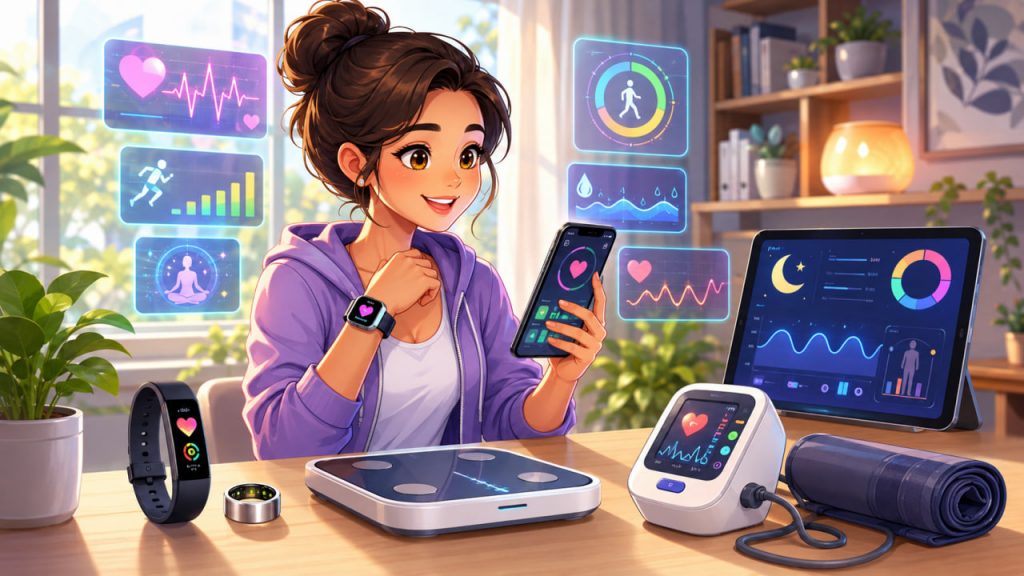
Health apps, smartwatches, fitness trackers, smart rings, sleep sensors, blood-pressure monitors, and connected scales promise to make personal health measurable. Some genuinely help people move more, monitor chronic conditions, or recognise warning signs. Others mainly generate attractive charts without improving health decisions.
The difference is not how advanced a gadget looks. A useful health technology must measure something reasonably well, encourage a beneficial action, and provide information that the user or clinician can interpret correctly.
Apps and wearables should support healthy behaviour and medical care—not replace professional diagnosis.
Fitness Trackers: Useful for Building Consistency
Fitness trackers are among the most practical consumer health gadgets because they provide immediate feedback on steps, active minutes, distance, and exercise frequency.
A 2025 systematic review found that wearable activity-tracker interventions increased physical activity among community-dwelling older adults, although the certainty of evidence was low to moderate and improvements in body composition or physical function were not clearly demonstrated.
Their greatest value is behavioural rather than diagnostic. A tracker can:
- Reveal long periods of inactivity
- Encourage regular walking
- Record workout consistency
- Support realistic weekly goals
- Show long-term trends
The step count itself is less important than whether it helps you become more active.
Calorie-burn estimates should be treated cautiously. Consumer devices use algorithms based on movement, heart rate, age, weight, and other variables, so the displayed result is still an estimate rather than a precise metabolic measurement.
Smartwatches and Heart-Rate Monitoring
Optical sensors on smartwatches estimate pulse by detecting changes in blood flow beneath the skin. They can be useful for tracking resting heart rate, exercise intensity, and unusual changes over time.
Some devices can also record a brief single-lead electrocardiogram or detect an irregular rhythm that may suggest atrial fibrillation. The American Heart Association advises users to share abnormal smartwatch rhythm alerts with a healthcare professional because they may contribute useful information during diagnosis.
However, a smartwatch alert is not the same as a confirmed diagnosis. Devices can misinterpret movement, poor skin contact, premature beats, or other rhythm patterns. Expert analysis from the American College of Cardiology notes that consumer wearables can perform well in detecting atrial fibrillation, while performing less reliably for some other arrhythmias.
Use heart data as a prompt for medical evaluation, not as permission to diagnose or treat yourself.
Home Blood-Pressure Monitors
A clinically validated upper-arm blood-pressure monitor is one of the most useful home health devices, particularly for people with hypertension, cardiovascular risk, pregnancy-related monitoring needs, or medication adjustments.
Correct technique matters. Sit quietly, support the arm, use the correct cuff size, avoid measuring immediately after exercise or caffeine, and take readings at consistent times.
Wrist and finger devices may be less reliable when positioning is incorrect. A conventional upper-arm cuff is usually the safer choice unless a clinician recommends an alternative.
A phone or smartwatch that claims to measure blood pressure without an inflatable cuff should not automatically be assumed accurate. Check whether the specific product has appropriate medical authorization and independent validation.
Smart Scales: Follow Trends, Not Daily Drama
Connected scales can conveniently record body weight and display trends over weeks or months.
Their estimates of body-fat percentage, muscle mass, body water, and other body-composition measurements are much less dependable. Hydration, meals, exercise, skin temperature, and foot contact can alter readings.
A smart scale is most useful when:
- Measurements are taken under similar conditions
- Weekly trends are reviewed
- Normal daily fluctuations are expected
- Weight is interpreted alongside health and behaviour
One morning’s number should not determine whether a health plan is working.
People with a history of eating disorders or obsessive tracking may find frequent weighing harmful rather than helpful.
Sleep Trackers: Good for Patterns, Poor for Diagnosis
Smartwatches, rings, phone apps, and mattress sensors estimate sleep through movement, heart rate, temperature, sound, or combinations of these signals.
They may help identify patterns such as irregular bedtimes, insufficient sleep duration, late-night interruptions, or changes associated with alcohol and stress.
Consumer devices cannot fully reproduce clinical polysomnography, which measures brain waves, breathing, oxygen, eye movement, muscle activity, and heart rhythm. A 2025 review found that home sleep technologies vary considerably in accuracy and should be interpreted according to their limitations.
They should not be used to rule out sleep apnoea or explain severe daytime sleepiness.
Sleep tracking can also create orthosomnia, an unhealthy preoccupation with achieving perfect sleep scores. Feeling rested and functioning well may sometimes be more meaningful than an algorithm’s rating.
Medication and Symptom-Tracking Apps
Simple reminder apps can be genuinely useful for people who forget medication, manage several prescriptions, or need to record symptoms between appointments.
Helpful features include:
- Custom reminders
- Dose histories
- Refill alerts
- Exportable reports
- Symptom diaries
- Appointment preparation
- Clear emergency instructions
The app should complement the prescription label and clinician’s instructions. It should not independently recommend changing a dose unless it is a regulated medical product being used under professional supervision.
Symptom trackers are especially valuable when they reveal timing and patterns—for example, migraine frequency, menstrual symptoms, pain triggers, asthma episodes, or medication side effects.
Mental-Health Apps
Meditation, breathing, journaling, and structured cognitive-behavioural apps may help some people manage mild stress or support habits learned in therapy.
More advanced apps may qualify as medical devices when they claim to diagnose or treat a condition. The FDA distinguishes low-risk general-wellness products from technologies intended for medical purposes.
Mental-health apps deserve extra caution when they use artificial intelligence. A chatbot may offer reflection or coping exercises, but it cannot reliably replace a therapist, perform a complete risk assessment, or manage an emergency.
Apps should clearly explain what to do during suicidal thoughts, severe panic, psychosis, abuse, or other urgent situations.
Continuous Glucose Monitors
Continuous glucose monitors are highly valuable medical devices for many people with diabetes because they display glucose trends and can warn of high or low levels.
Using one simply to “optimise” food choices without diabetes is more controversial. Glucose naturally changes after meals, and isolated spikes do not automatically indicate disease or an unhealthy food.
For people without a diagnosed condition, extensive glucose tracking may create unnecessary anxiety and restrictive eating. Testing should have a clear purpose and, ideally, professional interpretation.
Pulse Oximeters and Other Home Sensors
A pulse oximeter estimates blood-oxygen saturation and pulse rate. It can be helpful in specific medical circumstances, but readings may be affected by movement, cold hands, nail products, poor circulation, device quality, and other factors.
A normal-looking number should not override serious symptoms such as difficulty breathing, blue lips, confusion, or chest pain.
Similarly, smart thermometers, portable ECG devices, digital stethoscopes, and connected inhalers may be valuable when they answer a defined clinical question. More measurements are not automatically better.
How to Tell Whether a Health Gadget Is Trustworthy
Start with its intended purpose.
A step counter does not require the same evidence as a device claiming to detect a dangerous heart rhythm. The FDA maintains information on authorized wearable sensor-based medical devices, including watches, rings, patches, and bands, although its list is not comprehensive.
Look for:
- Medical authorization when relevant
- Independent validation studies
- Clear limitations
- Transparent subscription costs
- Reliable customer support
- Secure software updates
- Compatibility with your clinician’s systems
Avoid products promising effortless weight loss, instant diagnosis, “detoxification,” disease reversal, or clinical accuracy without published evidence.
Privacy Is a Health Issue Too
Health apps may collect sensitive information about sleep, fertility, medication, mood, location, heart rate, and medical conditions.
The Federal Trade Commission recommends examining what information an app collects, why it collects it, and whether it shares the data with other companies.
Before installing an app:
- Review its privacy policy.
- Limit unnecessary permissions.
- Use a strong password.
- Enable multifactor authentication when available.
- Avoid sharing health dashboards publicly.
- Delete accounts and stored data when abandoning a service.
Not every consumer health app is covered by the same privacy protections as a hospital or medical clinic.
Expert Perspective
The FDA’s approach separates general-wellness tools from products intended to diagnose, monitor, or treat medical conditions. This distinction matters because medical claims require stronger evidence and oversight than ordinary lifestyle features.
Research reviews reach a similarly practical conclusion: wearables can encourage physical activity and generate useful health information, but their effect on broader outcomes such as body composition, mental health, cardiometabolic risk, and quality of life remains variable.
The most useful gadget is not the one that collects the most data. It is the one that helps produce a safe and sustainable health decision.
Interesting Facts
- A wearable can support behaviour change even when its measurements are not perfectly precise.
- Smartwatch rhythm alerts may help identify possible atrial fibrillation, but medical confirmation is still required.
- Consumer sleep trackers estimate sleep stages indirectly rather than measuring brain activity directly.
- A conventional validated upper-arm cuff is usually more useful for blood-pressure monitoring than an unvalidated watch feature.
- Smart-scale body-fat readings can change with hydration even when body fat has not changed.
- Some FDA-authorized digital health technologies are delivered through wearable rings, watches, bands, and patches.
- Health-app privacy policies can matter as much as sensor accuracy.
- Collecting more data can increase anxiety when the user does not know how to interpret normal variations.
Glossary
- Wearable Device — An electronic sensor or computer designed to be worn on the body.
- Fitness Tracker — A device that records movement, activity, and related wellness measurements.
- Electrocardiogram — A recording of the heart’s electrical activity.
- Atrial Fibrillation — An irregular heart rhythm that can increase the risk of stroke and other complications.
- Continuous Glucose Monitor — A sensor that repeatedly estimates glucose levels in fluid beneath the skin.
- Pulse Oximeter — A device that estimates blood-oxygen saturation.
- Polysomnography — A comprehensive clinical sleep study measuring several physiological signals.
- Orthosomnia — Excessive concern about achieving perfect sleep data or tracker scores.
- Medical Device Authorization — Regulatory permission for a product to be marketed for a defined medical purpose.
- Independent Validation — Testing performed separately from the product manufacturer to evaluate accuracy or performance.
- Multifactor Authentication — Account security requiring more than one form of verification.