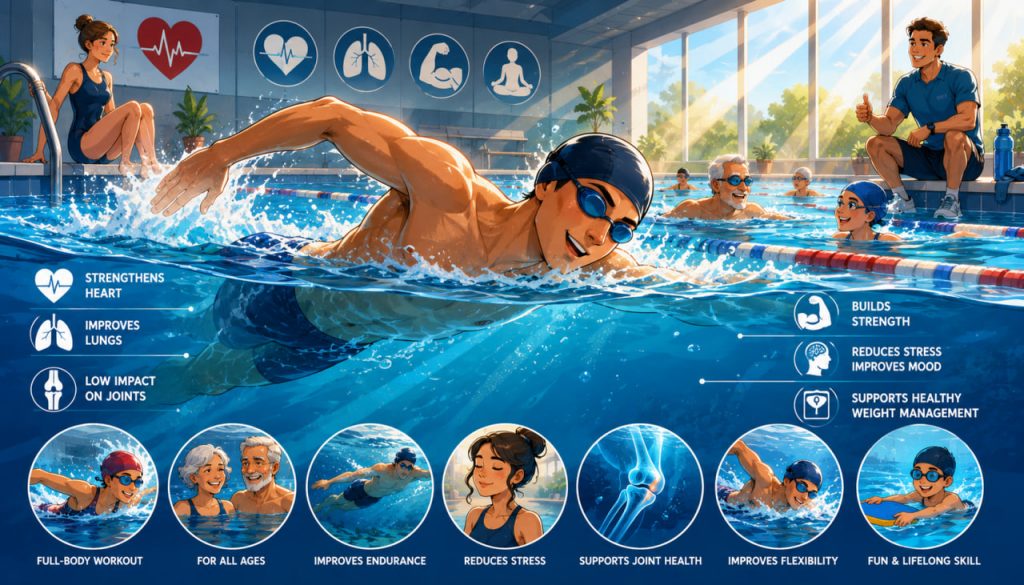
Swimming is more than a recreational skill. It is a full-body form of aerobic exercise that can improve cardiovascular fitness, muscular endurance, mobility, mood, and overall quality of life.
Because water supports much of the body’s weight, swimming often feels more comfortable than running or jumping. This makes it particularly attractive for older adults, people with joint discomfort, beginners returning to exercise, and anyone who prefers a low-impact workout.
Swimming can train the heart, lungs, muscles, and coordination at the same time without repeatedly striking the ground.
It is not perfect for everyone, and water safety remains essential. However, when practised regularly and at an appropriate intensity, swimming can become a sustainable lifelong health habit.
Swimming Is a Powerful Aerobic Exercise
Swimming raises the heart rate and increases breathing, making it an effective form of cardiovascular exercise.
During continuous swimming, the heart delivers oxygenated blood to working muscles while the lungs adapt to a controlled breathing rhythm. Over time, regular aerobic activity can improve cardiorespiratory fitness and endurance.
The American Heart Association includes swimming among aerobic activities that help maintain the health of the heart, lungs, and circulatory system. Regular aerobic exercise is also associated with a lower risk of cardiovascular disease, type 2 diabetes, and stroke.
The intensity depends on stroke, speed, technique, water temperature, and rest periods. Gentle swimming may count as moderate activity, while fast laps or interval training can become vigorous exercise.
How Swimming Supports Heart Health
Regular physical activity can help lower blood pressure, improve cholesterol levels, support blood-glucose control, and strengthen overall cardiovascular fitness.
Swimming is especially useful for people who enjoy continuous rhythmic exercise but dislike jogging, cycling, or gym machines.
A beginner does not need to swim quickly. Alternating short lengths with rest can still provide a meaningful workout. Fitness improves as the swimmer gradually extends the total distance or reduces rest time.
The most beneficial pace is one that raises your breathing rate while remaining safe and sustainable.
People with known heart disease, uncontrolled blood pressure, unexplained chest symptoms, or a long period of inactivity should discuss a new exercise programme with a qualified clinician.
A Low-Impact Option for the Joints
Water creates buoyancy, reducing the amount of body weight carried through the hips, knees, ankles, and spine.
This does not mean swimming places no stress on the body. Shoulders, neck muscles, knees, and lower back still work, and poor technique can cause overuse problems. Yet swimming generally avoids the repeated impact associated with running and many jumping exercises.
The CDC notes that water-based exercise can benefit people living with chronic conditions, including arthritis, heart disease, and diabetes. It may allow some people to exercise more comfortably while improving physical and mental health.
Water walking, gentle aqua aerobics, and supported pool exercises may be suitable alternatives for people who are not confident swimmers.
Swimming Trains the Whole Body
Swimming recruits muscles throughout the body.
The shoulders, arms, chest, and back move the body through the water. The abdominal and spinal muscles help keep it stable. The hips and legs provide propulsion and balance.
Different strokes emphasize different movement patterns:
- Front crawl develops rhythmic endurance and shoulder coordination.
- Breaststroke requires strong leg movement and timing.
- Backstroke trains the back and shoulders while keeping the face above water.
- Butterfly is highly demanding and better suited to experienced swimmers.
Swimming improves muscular endurance more than maximal strength. It does not fully replace progressive resistance training with weights, machines, or body-weight exercises.
WHO guidance recommends that adults combine aerobic activity with muscle-strengthening exercise involving the major muscle groups on at least two days each week.
Swimming is an excellent foundation, but balanced fitness also includes strength, mobility, and weight-bearing movement when appropriate.
Can Swimming Help With Weight Management?
Swimming uses energy and may support weight management when combined with sustainable nutrition and regular activity.
The amount of energy used varies widely according to body size, stroke efficiency, water temperature, speed, and session length. Calorie displays on watches or pool equipment are estimates rather than exact measurements.
Exercise provides health benefits even when body weight changes slowly or not at all. A 2026 American Heart Association scientific statement emphasized that physical activity can improve blood pressure, insulin sensitivity, cholesterol, and cardiorespiratory fitness independently of weight loss.
This means a swimming routine can still be successful when the scale does not immediately move.
Mental Health and Stress Relief
Swimming can create a focused mental rhythm. Repeated strokes, controlled breathing, and reduced external noise may help some people feel calmer and more present.
Regular physical activity can reduce symptoms of anxiety and depression, improve sleep, support brain health, and enhance general well-being.
Swimming may also provide social contact through lessons, clubs, rehabilitation groups, or shared pool sessions.
However, it should not be described as a cure for depression, anxiety, or another mental-health condition. It works best as one supportive element alongside appropriate professional care when needed.
Swimming for Older Adults
Swimming and water exercise can help older adults remain active when land-based movement feels uncomfortable.
The supported environment allows people to practise endurance and coordinated movement with reduced impact. Regular physical activity in later life can improve sleep, lower anxiety, reduce blood pressure, and help preserve independence.
Pool access must still be safe. Slippery floors, ladders, fatigue, poor vision, and difficulty entering or leaving the water can create fall risks.
Older adults should choose facilities with handrails, suitable steps, lifeguard supervision, and accessible changing areas.
How Much Swimming Is Enough?
WHO recommends that adults complete approximately 150–300 minutes of moderate-intensity aerobic activity each week, or 75–150 minutes of vigorous activity, or an equivalent combination.
Swimming can contribute to this total.
A practical beginner programme might involve two or three sessions per week, beginning with 15–25 minutes of alternating swimming and rest. More experienced swimmers may complete longer steady sessions or interval workouts.
Increase only one major factor at a time: distance, speed, session duration, or weekly frequency.
Technique Matters More Than Exhaustion
Poor technique wastes energy and can overload the shoulders or neck.
Beginner lessons can teach:
- Comfortable breathing
- Efficient body position
- Safe turning
- Stroke mechanics
- Controlled pacing
- Emergency floating
- Confidence in deeper water
A swimmer should stop when experiencing chest pain, faintness, severe breathlessness, sudden weakness, confusion, or unusual heart symptoms.
Persistent shoulder, knee, or back pain may indicate a technique problem or excessive training volume.
Open-Water and Cold-Water Swimming Require Extra Care
Swimming in lakes, rivers, and the sea creates risks that do not exist in a supervised pool.
These include currents, waves, boats, poor visibility, sudden depth changes, contaminated water, cold shock, and difficulty reaching the shore.
Cold water can trigger an involuntary gasp, rapid breathing, increased heart rate, and loss of muscle control. The American Heart Association warns that cold-water immersion can place substantial stress on the cardiovascular system, particularly in unprepared people.
Never swim alone in open water. Use an appropriate location, check conditions, wear visible equipment, enter gradually, and stay within your actual ability.
Expert Perspective
The CDC describes water-based exercise as a source of both physical and mental health benefits, including for some people with chronic illness. It also stresses that recreational water can spread infection or cause injury, making water quality and safety essential.
WHO recommends regular aerobic activity for adults while also including muscle strengthening and, for older people with reduced mobility, balance-focused exercise.
The specialist message is clear: swimming is highly valuable, but the healthiest programme combines safe technique, gradual progression, and complementary forms of exercise.
Interesting Facts
- Water supports the body, making many movements feel easier on weight-bearing joints.
- Swimming can range from gentle rehabilitation activity to intense competitive exercise.
- Front crawl, breaststroke, backstroke, and butterfly use different muscle and breathing patterns.
- Water exercise may help some people with arthritis exercise more comfortably.
- Swimming contributes to the weekly aerobic-activity targets recommended by WHO.
- Strong swimming ability does not eliminate open-water risks.
- A swimmer can improve fitness without trying to complete every session at maximum speed.
- Resistance training remains valuable because swimming does not fully replace strength or bone-loading exercise.
Glossary
- Aerobic Exercise — Activity that raises breathing and heart rate for a sustained period.
- Cardiorespiratory Fitness — The ability of the heart, lungs, blood vessels, and muscles to deliver and use oxygen during exercise.
- Buoyancy — The upward force from water that supports part of the body’s weight.
- Low-Impact Exercise — Activity that places relatively little repeated impact stress on joints.
- Muscular Endurance — The ability of muscles to continue working repeatedly or for an extended period.
- Interval Training — Alternating periods of higher effort with easier activity or rest.
- Cold Shock Response — An involuntary reaction to sudden cold-water immersion involving gasping, rapid breathing, and cardiovascular stress.
- Water-Based Exercise — Physical activity performed in a swimming pool or another body of water.
- Progressive Overload — Gradually increasing exercise demands so the body can adapt.
- Stroke Technique — The coordinated movements and breathing pattern used for a particular swimming style.