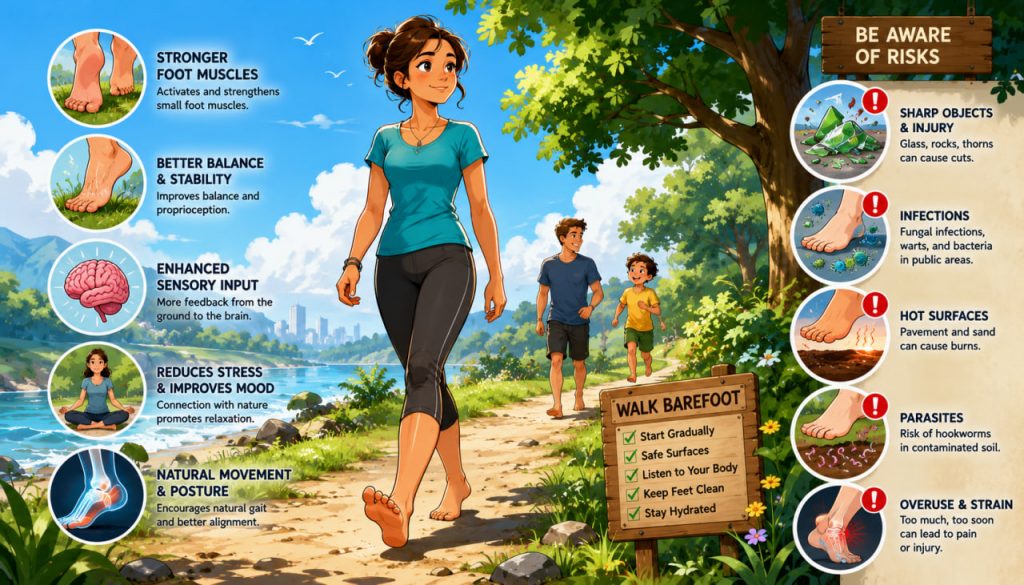
Walking barefoot can feel natural, relaxing, and surprisingly demanding. Without shoes, the feet receive more sensory information from the ground, small stabilising muscles work differently, and each step must adapt directly to the surface beneath it.
Supporters sometimes claim that barefoot walking can correct posture, eliminate pain, strengthen the entire body, or provide special health effects through contact with the Earth. The evidence supports a more practical view.
Barefoot walking may improve foot awareness and gradually challenge foot muscles, but it is not automatically healthier than wearing suitable footwear. Its value depends on the person, the surface, the duration, and how gradually the body adapts.
What Changes When You Remove Your Shoes?
Shoes influence the way the foot contacts the ground. They may provide cushioning, warmth, protection, stability, and traction, while also reducing some of the direct sensory feedback reaching the nervous system.
When barefoot, the sole can feel differences in texture, temperature, pressure, and slope. The toes may spread more naturally, and the foot must respond without the structure provided by a shoe.
Research comparing barefoot and shod walking has found differences in ankle movement, stride characteristics, loading patterns, and muscle activity. However, these changes are not automatically beneficial or harmful; they show that the body adapts its movement strategy to different footwear conditions.
Can Barefoot Walking Strengthen the Feet?
The feet contain many small muscles that help support the arches, control the toes, and stabilise the body during movement.
Walking barefoot or in flexible minimalist footwear may require these muscles to work more actively than they do inside rigid or highly supportive shoes. Studies of minimalist footwear have reported increases in foot-muscle size and strength after a gradual period of use. One six-month study found a substantial average increase in foot strength among participants using minimalist footwear regularly.
A 2025 systematic review concluded that foot exercises and minimalist footwear may increase foot strength and produce measurable biomechanical adaptations. Nevertheless, the studies varied in design, and stronger muscles do not guarantee freedom from pain or injury.
Barefoot walking can act as a form of foot training, but the training load must be introduced progressively.
Balance and Sensory Awareness
The soles of the feet contain sensory receptors that provide information about pressure and body position. This feedback helps the nervous system make rapid adjustments during standing and walking.
Barefoot movement may improve awareness of the surface and encourage more active control of the ankles and toes. Habitually barefoot populations often show different foot shapes and mechanics, including a wider forefoot, compared with habitually shod populations.
However, barefoot walking is not always the safest option for balance. Research comparing barefoot walking with minimalist shoes found that lightweight footwear could provide some similar sensory benefits while also offering protection and, in certain conditions, greater walking stability.
Does Walking Barefoot Improve Posture?
Barefoot walking changes how the feet interact with the ground, which can influence movement throughout the ankles, knees, hips, and pelvis.
That does not mean it automatically corrects posture. Posture and gait are affected by strength, mobility, pain, anatomy, previous injuries, habits, and neurological control.
A person who has spent years wearing supportive shoes may initially compensate with stiff ankles, shortened steps, or excessive tension. Another person may feel comfortable almost immediately.
There is no single “perfect natural gait” that barefoot walking restores in everyone. The useful goal is comfortable, efficient movement rather than forcing the body into a fashionable technique.
Barefoot Walking Is Not the Same as Barefoot Running
Walking produces lower forces and gives the body more time to adjust during each step. Running introduces much greater impact, speed, and loading through the feet, calves, Achilles tendons, and bones.
Someone who comfortably walks barefoot at home is not necessarily prepared to run several kilometres without shoes.
Transitioning too quickly to barefoot or minimalist running can overload tissues that have not adapted to the new movement pattern. A gradual walking programme is therefore a safer starting point than immediately changing running technique or distance.
The Main Risks
The most obvious disadvantage of going barefoot is loss of protection.
Possible hazards include:
- Broken glass, metal, stones, and thorns
- Burns from hot pavement or sand
- Slipping on wet surfaces
- Splinters and puncture wounds
- Insect bites
- Sunburn on the tops of the feet
- Fungal or viral infections in shared facilities
The American Podiatric Medical Association advises limiting barefoot walking in public areas because of injury, plantar-wart, athlete’s-foot, and other infection risks. It recommends footwear around pools, beaches, locker rooms, and hotel bathrooms.
Bare feet may also increase exposure to ringworm and related fungal infections in shared changing areas.
Soil and Parasite Exposure
In regions where soil may be contaminated with human or animal faeces, walking barefoot can expose the skin to parasite larvae.
The CDC advises avoiding barefoot contact with potentially contaminated soil in areas where hookworm is common. Certain larvae can penetrate the skin directly, while dog and cat hookworms may cause an intensely itchy skin condition called cutaneous larva migrans.
This risk is especially relevant in some tropical and subtropical regions, on contaminated beaches, and in places with inadequate sanitation.
Who Should Be Especially Careful?
Barefoot walking may be dangerous for people who cannot reliably feel or heal minor foot injuries.
This includes some individuals with:
- Diabetes
- Peripheral neuropathy
- Poor circulation
- Previous foot ulcers
- Significant balance problems
- Reduced vision
- Immune suppression
- Recent foot surgery
Diabetes-related nerve damage can make a cut or burn painless, while impaired circulation may delay healing. NHS foot-care guidance recommends that people at risk from diabetic foot complications avoid walking barefoot and examine their feet regularly.
Anyone with persistent heel pain, arthritis, major foot deformity, or a history of stress fractures should seek professional guidance before making a dramatic footwear change.
How to Start Safely
Begin on a clean, predictable surface such as a carpeted room, smooth wooden floor, maintained lawn, or safe sandy area.
Start with five to ten minutes and notice how the feet, calves, and Achilles tendons feel later that day and the following morning.
Gradually increase duration rather than changing everything at once. Avoid combining a sudden switch to barefoot walking with a major increase in exercise distance.
Inspect the ground and your feet. Stop when you develop sharp pain, persistent tenderness, skin damage, numbness, or swelling.
Minimalist footwear can offer an intermediate option. It allows more flexibility and toe movement while protecting the skin from temperature, sharp objects, and contamination.
Expert Perspective
A 2025 critical review of footwear and walking health concluded that habitually barefoot populations often have relatively healthy feet and that barefoot activity may support normal foot development. At the same time, the authors recognised that footwear provides essential protection from injury, weather, and infection.
Clinical foot-care guidance takes a more cautious position for vulnerable patients, particularly those with diabetes, sensory loss, or circulation problems.
The practical expert message is that barefoot walking can be a useful form of movement for healthy feet in a safe environment, but it should never be treated as a universal therapy.
Interesting Facts
- The human foot contains 26 bones and numerous joints, muscles, tendons, and ligaments.
- Habitually barefoot people often develop a wider forefoot than people who regularly wear narrow footwear.
- Thicker natural calluses can protect the sole without necessarily eliminating sensitivity.
- Minimalist footwear may strengthen foot muscles while still protecting against cuts and contaminated surfaces.
- Barefoot walking and barefoot running create different levels of mechanical demand.
- A small injury may become serious when diabetes or neuropathy reduces sensation and healing.
- Hookworm larvae can penetrate bare skin after contact with contaminated soil.
- Barefoot walking has not been proven to cure chronic diseases or provide unique medical benefits through “grounding.”
Glossary
- Barefoot Walking — Walking without shoes or other protective footwear.
- Minimalist Footwear — Lightweight, flexible shoes with a wide toe area and limited cushioning or heel elevation.
- Proprioception — The nervous system’s awareness of body position and movement.
- Gait — The characteristic pattern used while walking or running.
- Forefoot — The front portion of the foot containing the toes and metatarsal bones.
- Peripheral Neuropathy — Nerve damage that may cause numbness, pain, or reduced sensation, often in the feet.
- Plantar Wart — A wart on the sole of the foot caused by certain strains of human papillomavirus.
- Cutaneous Larva Migrans — An itchy skin eruption caused by hookworm larvae moving beneath the skin.
- Achilles Tendon — The strong tendon connecting the calf muscles to the heel bone.
- Biomechanics — The study of forces and movement within living bodies.