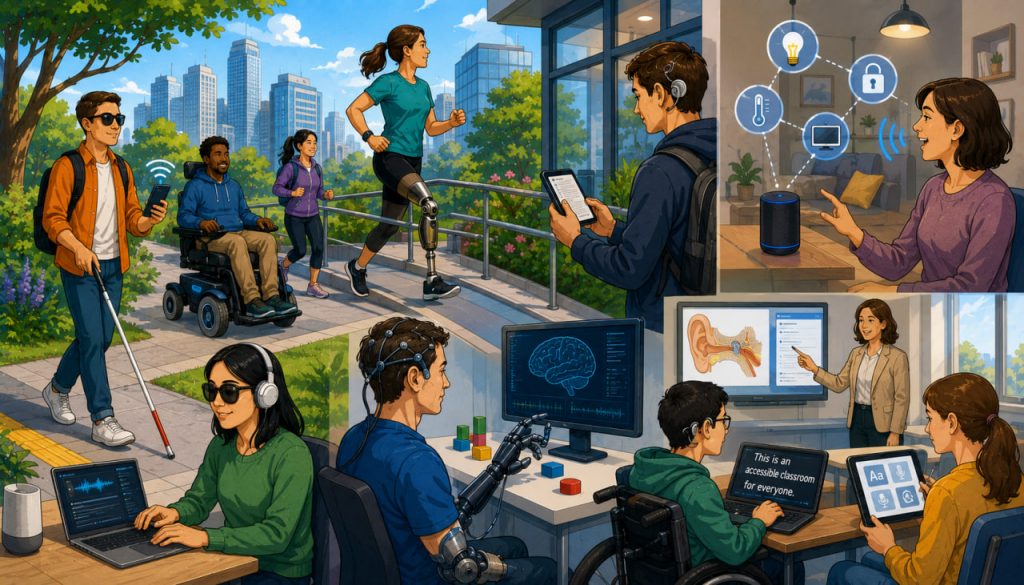
Technology has always shaped human society, but for people with disabilities, technological progress can be far more than a matter of convenience. Modern innovations are helping millions of individuals overcome barriers related to mobility, communication, education, employment, and everyday life. What once required assistance from others can increasingly be achieved independently through advanced devices, software, and intelligent systems.
From artificial limbs controlled by neural signals to smartphones that describe the world to visually impaired users, technology is redefining what accessibility means in the twenty-first century. While challenges remain, the pace of innovation suggests a future where disability creates fewer limitations than ever before.
Understanding the relationship between disability and technology reveals one of the most inspiring examples of how science can improve quality of life.
The Evolution of Assistive Technology
Assistive technology is not a new concept.
For centuries, people have used tools designed to compensate for physical limitations.
Historical examples include:
- Walking sticks
- Hearing trumpets
- Mechanical prosthetic limbs
- Braille systems
However, modern electronics, computing, and artificial intelligence have dramatically expanded what assistive devices can accomplish.
Today’s technologies are not merely compensating for disabilities; they are actively enhancing independence and participation in society.
Modern assistive technology increasingly focuses on empowering individuals rather than simply accommodating limitations.
Mobility Technologies
Mobility remains one of the most important areas of technological innovation.
Advanced wheelchairs now incorporate features such as:
- Obstacle detection
- Power assistance
- Smart navigation
- Voice controls
Some experimental systems can even climb stairs or navigate uneven terrain.
Meanwhile, prosthetic technology has evolved far beyond simple mechanical replacements.
Modern prosthetic limbs may include:
- Microprocessors
- Sensors
- Artificial joints
- Neural interfaces
These innovations allow users to perform increasingly complex movements with greater precision and comfort.
Brain-Controlled Prosthetics
One of the most remarkable developments involves brain-computer interfaces (BCIs).
These systems enable direct communication between the brain and external devices.
Researchers have demonstrated technologies that allow users to:
- Move robotic arms
- Control computer cursors
- Operate assistive devices
By interpreting neural signals, BCIs may eventually restore certain abilities lost through injury or disease.
Although still developing, this field represents one of the most exciting frontiers in accessibility technology.
Technology for Visual Impairments
Modern devices have transformed opportunities for individuals with visual impairments.
Smartphones now provide features such as:
- Screen readers
- Voice assistants
- Object recognition
- Text-to-speech systems
Artificial intelligence can identify:
- Faces
- Currency
- Products
- Street signs
- Printed documents
Specialized wearable devices may provide audio descriptions of the surrounding environment.
These tools help users navigate independently and access information that was previously difficult or impossible to obtain.
Innovations for Hearing Impairments
Technology has also revolutionized communication for people with hearing loss.
Modern hearing aids use sophisticated digital processing to:
- Reduce background noise
- Enhance speech clarity
- Automatically adjust settings
Cochlear implants represent another major breakthrough.
Unlike hearing aids, which amplify sound, cochlear implants directly stimulate the auditory nerve.
For many individuals with severe hearing loss, these devices provide access to sounds that would otherwise remain inaccessible.
Speech-to-text software further improves communication in educational and workplace settings.
Accessible Communication Technologies
Communication barriers can significantly affect independence and social participation.
Modern communication technologies help address these challenges.
Examples include:
- Eye-tracking systems
- Augmentative communication devices
- Predictive text software
- Voice synthesis systems
Individuals with conditions affecting speech or motor control can use these technologies to express thoughts, communicate needs, and participate in conversations.
Advances in artificial intelligence continue to improve both speed and accuracy.
Smart Homes and Independent Living
The rise of smart home technology has created new opportunities for independent living.
Voice-controlled systems allow users to manage:
- Lighting
- Temperature
- Security systems
- Appliances
- Entertainment devices
For individuals with limited mobility, these capabilities can significantly improve daily life.
Smart home technologies reduce dependence on physical switches and manual controls while increasing safety and convenience.
Accessibility in Education
Educational technology has become increasingly inclusive.
Students with disabilities can benefit from:
- Screen readers
- Speech recognition software
- Digital textbooks
- Captioning systems
- Adaptive learning platforms
These tools help create more equitable learning environments.
Access to education is one of the most powerful factors influencing long-term independence and employment opportunities.
Technology continues to reduce barriers that previously limited educational participation.
Employment and Workplace Accessibility
Technology has expanded employment opportunities for many people with disabilities.
Remote work platforms, accessible software, and adaptive equipment allow individuals to perform tasks that once required physical presence or specialized accommodations.
Examples include:
- Voice-controlled computing
- Alternative input devices
- Screen magnification systems
- Automated transcription services
Many workplaces are becoming increasingly accessible as technology evolves.
This shift benefits both employees and employers by expanding talent pools and increasing inclusion.
Expert Perspective
Disability rights advocate Judith Heumann frequently emphasized that technology plays a critical role in removing barriers to participation.
Throughout her career, Heumann argued that accessibility should be integrated into technology design from the beginning rather than added as an afterthought. Her perspective helped shape modern discussions about inclusive design and equal access to technology.
Today, many developers embrace this philosophy when creating new products and services.
Artificial Intelligence and the Future of Accessibility
Artificial intelligence is rapidly becoming one of the most influential accessibility technologies.
AI-powered systems can:
- Describe images
- Translate speech into text
- Generate captions
- Recognize objects
- Assist with navigation
Machine learning continues to improve the accuracy and usefulness of these tools.
As AI becomes more sophisticated, accessibility features may become increasingly personalized and adaptive.
Challenges That Remain
Despite impressive progress, significant challenges still exist.
Common obstacles include:
- High costs
- Limited availability
- Insurance coverage issues
- Digital accessibility gaps
- Unequal access across regions
Many advanced technologies remain inaccessible to those who could benefit most from them.
Addressing these barriers will require cooperation among governments, manufacturers, healthcare providers, and advocacy organizations.
The Importance of Universal Design
A growing movement within technology development focuses on universal design.
This approach aims to create products that are usable by the widest possible range of people.
Examples include:
- Voice assistants
- Closed captions
- Adjustable interfaces
- Touchscreen accessibility features
Interestingly, technologies originally developed for people with disabilities often benefit the broader population as well.
This demonstrates how accessibility can drive innovation that improves life for everyone.
Interesting Facts
- The first practical hearing aids were mechanical devices that amplified sound without electronics.
- Modern prosthetic limbs can contain microprocessors that adjust movement hundreds of times per second.
- Screen readers enable blind users to navigate computers and smartphones through synthesized speech.
- Voice recognition technology was originally developed decades before smartphones became common.
- Closed captions benefit both hearing-impaired users and people in noisy environments.
- Brain-computer interface research is advancing rapidly in both medical and assistive applications.
Glossary
- Assistive Technology — Devices or software designed to help individuals with disabilities perform tasks and participate more fully in daily life.
- Prosthetic Limb — An artificial replacement for a missing arm or leg.
- Brain-Computer Interface (BCI) — A system that allows communication between the brain and an external device.
- Cochlear Implant — An electronic device that stimulates the auditory nerve to provide a sense of hearing.
- Screen Reader — Software that converts on-screen text into speech or braille output.
- Universal Design — The practice of designing products and environments to be accessible to as many people as possible.