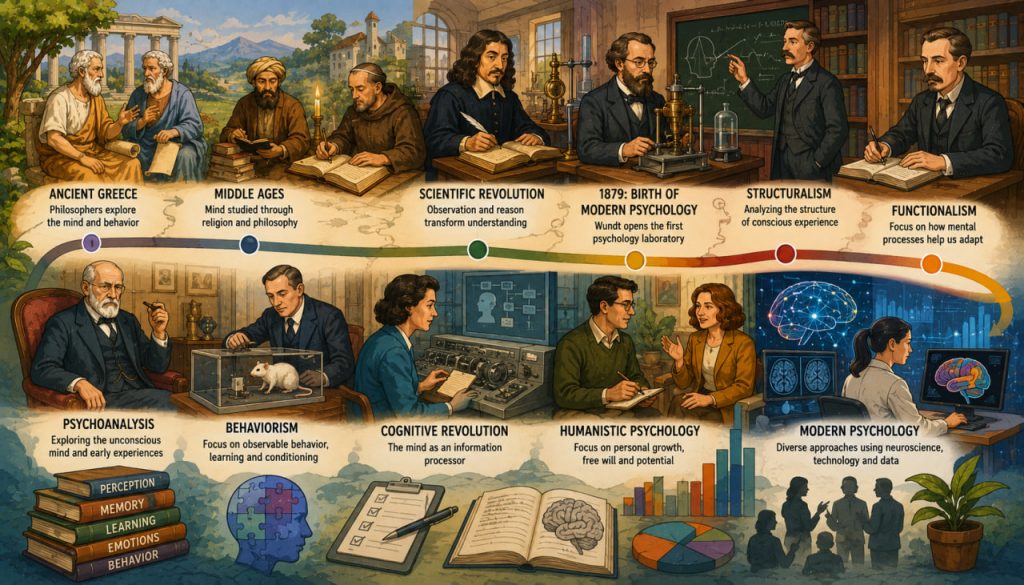
Psychology is the scientific study of the mind and behavior, but its roots stretch back thousands of years. Long before psychology became a formal scientific discipline, philosophers, physicians, and scholars sought to understand how humans think, feel, learn, and interact with the world. Today, psychology influences medicine, education, business, technology, and everyday life.
The history of psychology is a fascinating journey from philosophical speculation to evidence-based science. Understanding how psychological thought evolved helps explain why modern psychologists study the human mind the way they do.
The Ancient Origins of Psychological Thought
The earliest ideas about the mind emerged in ancient civilizations.
Ancient cultures attempted to explain:
- Emotions
- Memory
- Dreams
- Consciousness
- Human behavior
In Plato’s philosophy, the mind and body were considered separate entities. He believed knowledge was partly innate and that reason was one of humanity’s defining characteristics.
His student, Aristotle, took a more observational approach. Aristotle argued that the mind and body were closely connected and wrote extensively about perception, memory, and learning.
Although these ideas were philosophical rather than scientific, they laid important foundations for later psychological inquiry.
Psychology During the Middle Ages
During the Middle Ages, psychological questions were often explored through theology and philosophy.
Scholars sought to understand:
- Human consciousness
- Free will
- Morality
- Perception
Many thinkers viewed the mind through a religious framework.
However, important advances continued to occur, particularly in the Islamic world, where scholars studied perception, cognition, and mental health in ways that anticipated later psychological research.
These intellectual traditions helped preserve and expand knowledge that would later influence European science.
The Scientific Revolution Changes Everything
The Scientific Revolution of the 16th and 17th centuries transformed humanity’s approach to knowledge.
Observation, experimentation, and measurement became increasingly important.
One influential figure was René Descartes, who proposed that the mind and body interacted but remained distinct.
His ideas sparked centuries of debate about the relationship between mental processes and physical biology.
At the same time, scientists began studying the nervous system and sensory perception, creating the foundations for future psychological research.
The transition from philosophy to scientific investigation was one of the most important turning points in the history of psychology.
The Birth of Modern Psychology
Most historians identify 1879 as the birth year of modern psychology.
That year, Wilhelm Wundt established the first psychology laboratory at the University of Leipzig in Germany.
Wundt sought to study mental processes using scientific methods.
His laboratory investigated:
- Sensation
- Perception
- Attention
- Reaction time
This marked a major shift because psychology was no longer purely philosophical.
It had become an experimental science.
For this reason, Wundt is often called the “Father of Psychology.”
Structuralism: Analyzing Conscious Experience
One of Wundt’s students, Edward Titchener, developed a school of thought known as structuralism.
Structuralists attempted to break conscious experiences into their basic components.
They used a technique called introspection, in which participants carefully described their thoughts and sensations.
Although structuralism eventually declined, it helped establish psychology as a field concerned with understanding mental processes scientifically.
Functionalism and Adaptation
In the United States, psychologists began emphasizing a different perspective.
Functionalism focused on understanding why mental processes exist and how they help individuals adapt to their environment.
A leading figure was William James.
James argued that consciousness should be studied as an ongoing process rather than divided into isolated elements.
His influential work helped shape American psychology and inspired future research into learning, motivation, and behavior.
The Rise of Psychoanalysis
At the beginning of the twentieth century, psychology took a dramatically different direction.
Sigmund Freud introduced psychoanalysis, a theory emphasizing unconscious mental processes.
Freud proposed that hidden desires, conflicts, and childhood experiences influence behavior.
His theories included concepts such as:
- The unconscious mind
- Defense mechanisms
- Dream interpretation
- Personality structures
Many of Freud’s ideas remain controversial today, but his influence on psychology, psychiatry, and popular culture has been enormous.
Behaviorism: Psychology Becomes More Objective
By the early twentieth century, some psychologists became dissatisfied with methods that relied on subjective experiences.
Behaviorists argued that psychology should focus only on observable behavior.
Key figures included:
- John B. Watson
- B. F. Skinner
Behaviorists studied:
- Learning
- Conditioning
- Rewards
- Punishments
Their research produced important discoveries about how behavior is acquired and modified.
For several decades, behaviorism dominated psychological science.
The Cognitive Revolution
During the 1950s and 1960s, psychologists began returning to questions about thinking and mental processes.
Advances in computer science encouraged researchers to compare the human mind to information-processing systems.
This movement became known as the cognitive revolution.
Psychologists investigated:
- Memory
- Attention
- Language
- Problem-solving
- Decision-making
Modern cognitive psychology remains one of the most influential areas of the discipline today.
Humanistic Psychology
Not all psychologists agreed with behaviorism or psychoanalysis.
Humanistic psychology emerged as a response.
Prominent figures included:
- Carl Rogers
- Abraham Maslow
Humanistic psychologists emphasized:
- Personal growth
- Free will
- Creativity
- Self-actualization
Their work influenced counseling, education, and personal development practices worldwide.
Psychology in the Modern Era
Today, psychology is an incredibly diverse scientific field.
Researchers use advanced tools including:
- Brain imaging
- Artificial intelligence
- Genetic analysis
- Computer modeling
- Large-scale statistical methods
Modern psychology encompasses numerous specialties, including:
- Clinical psychology
- Cognitive psychology
- Developmental psychology
- Social psychology
- Neuropsychology
- Health psychology
The discipline continues to evolve as scientists uncover new insights into the brain and behavior.
Expert Perspective
Cognitive psychologist Steven Pinker has argued that psychology benefits from integrating insights from neuroscience, evolutionary biology, and cognitive science.
His work highlights how understanding the mind requires examining both biological mechanisms and mental processes. This interdisciplinary approach reflects the direction of much modern psychological research and demonstrates how far the field has progressed since its philosophical origins.
The Future of Psychology
Emerging technologies are opening new frontiers for psychological science.
Researchers are increasingly studying:
- Brain-computer interfaces
- Artificial intelligence
- Digital behavior
- Mental health technologies
- Human-machine interaction
As our understanding of the brain improves, psychology will likely play an even greater role in medicine, education, and technology.
Interesting Facts
- The first psychology laboratory was established in 1879 by Wilhelm Wundt.
- William James’s book The Principles of Psychology remains one of the most influential psychology texts ever written.
- Sigmund Freud originally trained as a neurologist.
- Behaviorism dominated psychology for much of the first half of the twentieth century.
- Modern brain imaging allows researchers to observe neural activity in real time.
- Psychology is considered both a social science and a biological science.
Glossary
- Psychology — The scientific study of the mind and behavior.
- Introspection — A method in which individuals examine and report their own thoughts and experiences.
- Psychoanalysis — A psychological theory emphasizing unconscious mental processes.
- Behaviorism — A school of psychology focused on observable behavior.
- Cognitive Psychology — The study of mental processes such as memory, thinking, and perception.
- Self-Actualization — The process of realizing one’s full potential and capabilities.