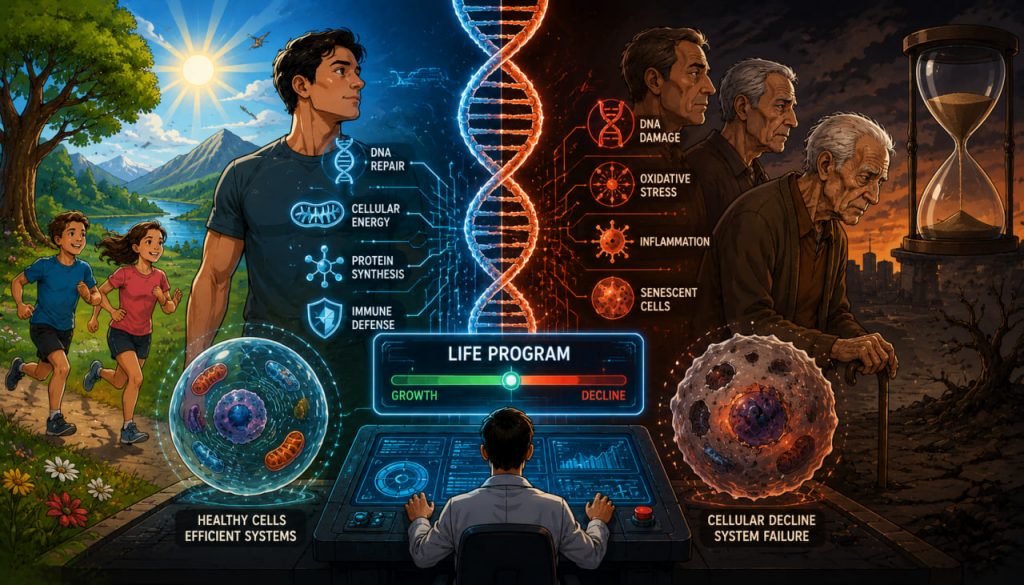
Why do living organisms age? It is one of the oldest and most fascinating questions in biology. For decades, scientists assumed that aging was simply the result of accumulated damage. Cells are constantly exposed to radiation, toxins, metabolic byproducts, and errors during DNA replication. Over time, this damage builds up, leading to the gradual decline we recognize as aging.
However, not all researchers agree that aging is merely a passive process. Some scientists have proposed a far more provocative idea: what if aging is, at least in part, programmed into our biology? This concept is known as the programmed aging theory or, more dramatically, the theory of programmed death.
According to this hypothesis, aging may not simply happen to organisms—it may be influenced by biological mechanisms that evolved over millions of years. While controversial, the theory continues to spark debate among biologists, geneticists, and longevity researchers.
The Traditional View: Aging as Accumulated Damage
Most mainstream aging theories focus on damage accumulation.
Throughout life, cells experience countless forms of stress:
- DNA mutations
- Protein damage
- Oxidative stress caused by reactive molecules
- Cellular wear and tear
- Declining repair mechanisms
Over time, the body’s ability to repair this damage becomes less effective. As a result, tissues function less efficiently, diseases become more common, and the risk of death increases.
This perspective views aging as an unintended consequence of living rather than a biological program.
What Is the Programmed Aging Theory?
The programmed aging theory proposes that certain biological processes actively contribute to aging.
According to this view, organisms possess genetic mechanisms that regulate not only growth and reproduction but also the gradual decline that follows.
Supporters argue that aging may be influenced by biological “instructions” encoded within our genes.
The theory does not suggest that there is a single “death gene.” Instead, it proposes that networks of genes and cellular pathways may gradually shift the body from maintenance and repair toward deterioration.
In this framework, aging resembles a biological process that unfolds according to an internal timetable.
Why Would Evolution Allow Aging?
One of the biggest challenges facing the programmed aging theory is explaining why evolution would favor it.
At first glance, aging appears disadvantageous. Natural selection generally favors traits that improve survival and reproduction.
However, some researchers have suggested possible explanations.
One hypothesis argues that aging may help populations adapt by making room for younger generations. Another proposes that biological systems optimized for growth and reproduction early in life may unintentionally trigger harmful effects later in life.
This concept is known as antagonistic pleiotropy—the idea that a gene can have beneficial effects during youth but harmful effects in old age.
Many scientists consider this explanation more plausible than the existence of a deliberate “death program.”
The Role of Cellular Senescence
One area of research often cited in discussions of programmed aging involves cellular senescence.
Senescent cells are cells that stop dividing but remain alive. They accumulate in tissues as organisms age.
Originally, cellular senescence serves useful purposes:
- Preventing damaged cells from becoming cancerous
- Supporting wound healing
- Helping regulate tissue repair
However, as senescent cells accumulate, they begin releasing inflammatory chemicals that can damage surrounding tissues.
Researchers have found that removing some senescent cells in laboratory animals can improve health and extend lifespan.
This discovery has intensified interest in the possibility that aging involves regulated biological processes rather than simple damage accumulation.
Genetic Pathways That Influence Lifespan
One of the strongest arguments against aging being purely random comes from genetics.
Scientists have identified several molecular pathways that influence lifespan across many species.
Examples include:
- Insulin signaling pathways
- mTOR signaling, which helps regulate growth and metabolism
- Sirtuins, proteins involved in cellular maintenance
- FOXO genes associated with stress resistance and longevity
Small changes in these pathways can dramatically alter lifespan in worms, flies, and mice.
The existence of such mechanisms suggests that aging is at least partially controlled by biological programs.
However, whether these pathways actively cause aging or merely influence it remains debated.
Expert Perspective: Is Aging Programmed?
Dr. David Sinclair, a prominent longevity scientist at Harvard Medical School, has argued that aging appears more regulated than previously believed.
His research focuses on how cells lose information over time and how some aspects of aging might potentially be reversed.
“The evidence increasingly suggests that aging is a plastic process that can be manipulated.”
While Sinclair does not claim that aging is a simple programmed countdown, his work supports the idea that aging is more biologically controllable than scientists once thought.
Many researchers now view aging as a combination of programmed biological processes and accumulated damage.
Can Aging Be Slowed or Reversed?
If aging involves biological programs, an obvious question follows: can those programs be modified?
Modern longevity research is exploring several possibilities:
- Eliminating senescent cells
- Enhancing DNA repair mechanisms
- Reprogramming cellular behavior
- Modifying metabolic pathways
- Developing drugs that target aging-related processes
Experiments in animals have produced remarkable results, including significant lifespan extensions in some species.
However, translating these findings into safe and effective human therapies remains a major challenge.
The Arguments Against Programmed Death
Despite growing interest, many biologists remain skeptical of the programmed aging theory.
Critics point out that:
- Evolution generally favors survival and reproduction.
- Damage accumulation clearly contributes to aging.
- No universal aging program has been discovered.
- Different species age in very different ways.
Some organisms, such as certain jellyfish and simple aquatic animals, exhibit negligible senescence, meaning they show little evidence of typical aging.
These examples suggest that aging may not follow a single universal mechanism.
A Middle Ground Emerging
Today, many researchers favor a hybrid perspective.
Rather than viewing aging as entirely programmed or entirely accidental, they see it as a complex interaction between:
- Genetic regulation
- Cellular maintenance systems
- Environmental influences
- Random damage accumulation
This view acknowledges that biological programs influence aging while recognizing the undeniable role of physical wear and damage.
The reality may be far more complex than either extreme theory suggests.
Conclusion
The theory of programmed aging challenges one of biology’s most fundamental assumptions. Instead of viewing aging solely as accumulated damage, it proposes that genetic and cellular mechanisms may actively shape the aging process.
Although scientists continue to debate the extent to which aging is programmed, modern research increasingly shows that lifespan and healthspan are influenced by biological pathways that can potentially be modified. Whether aging ultimately proves to be a program, a consequence of damage, or a combination of both, understanding its mechanisms could transform medicine and dramatically alter the future of human health.
Interesting Facts
- Some species of jellyfish can revert to an earlier life stage, effectively restarting part of their life cycle.
- Laboratory mice have experienced significant lifespan increases through genetic and pharmaceutical interventions.
- Certain genes that influence lifespan are remarkably similar across many species.
- Senescent cells can remain in tissues for years after they stop functioning normally.
- Calorie restriction has extended lifespan in numerous animal studies.
- Scientists are increasingly studying aging itself as a treatable biological process rather than an unavoidable consequence of life.
Glossary
- Cellular Senescence — A state in which cells stop dividing but remain alive and can influence surrounding tissues.
- Antagonistic Pleiotropy — A phenomenon where a gene provides benefits early in life but causes harmful effects later.
- mTOR — A cellular signaling pathway involved in growth, metabolism, and aging.
- Sirtuins — A family of proteins associated with cellular maintenance and stress resistance.
- Healthspan — The portion of life spent in good health, free from serious age-related disease.