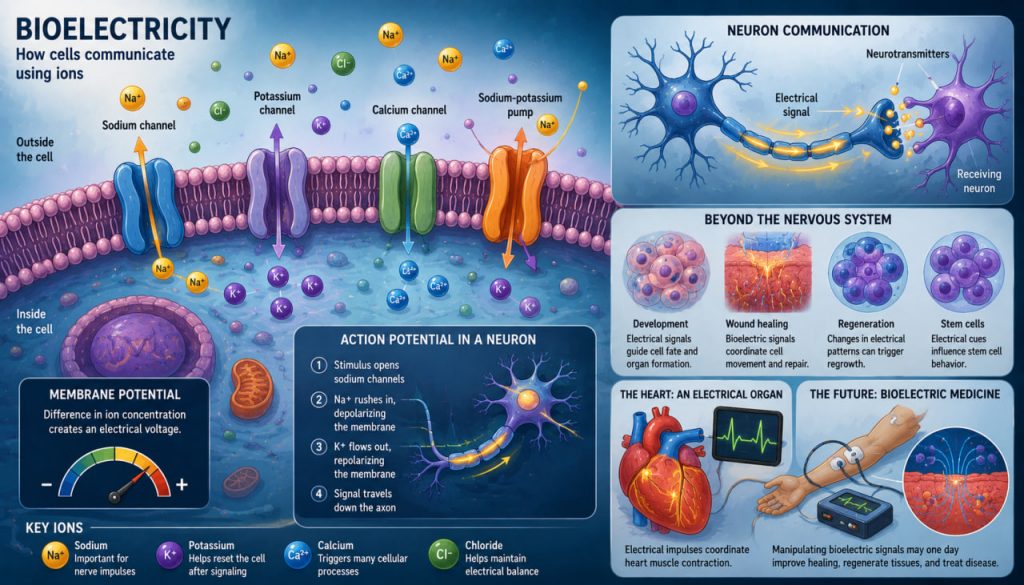
Every thought, heartbeat, muscle movement, and sensation depends on a hidden electrical language operating within the body. While most people associate electricity with wires, batteries, and electronic devices, living organisms also rely on electrical signals. In fact, bioelectricity is one of the most fundamental mechanisms that allows complex life to exist.
At the cellular level, communication often occurs through the movement of charged particles called ions. These tiny particles create electrical gradients and signals that allow cells to exchange information, coordinate behavior, and regulate vital biological processes.
Modern research has revealed that bioelectricity influences not only the nervous system but also development, wound healing, regeneration, and even the formation of organs. Scientists are increasingly discovering that life is, in many ways, an electrical phenomenon.
What Is Bioelectricity?
Bioelectricity refers to electrical phenomena generated by living cells and tissues.
Unlike household electricity, which flows through metal wires, biological electricity depends on ions moving across cell membranes.
Ions are atoms or molecules that carry an electrical charge.
Some of the most important biological ions include:
- Sodium (Na⁺)
- Potassium (K⁺)
- Calcium (Ca²⁺)
- Chloride (Cl⁻)
The controlled movement of these ions creates tiny electrical currents throughout the body.
Every cell maintains an electrical state that helps regulate its behavior and interactions with neighboring cells.
Why Are Cells Electrically Charged?
Cell membranes act as selective barriers that control the movement of ions.
Because different ions exist at different concentrations inside and outside the cell, an electrical imbalance develops.
This difference in electrical charge is called the membrane potential.
A typical human cell maintains a voltage across its membrane, much like a miniature biological battery.
Although the voltage is small, it plays an essential role in cellular communication.
Maintaining this electrical difference requires specialized proteins known as ion pumps and ion channels.
Ion Channels: The Gates of Cellular Communication
Ion channels are microscopic protein structures embedded within cell membranes.
They function like highly selective gates.
Some channels allow sodium ions to pass.
Others permit potassium, calcium, or chloride ions to move across the membrane.
When these channels open or close, electrical properties change rapidly.
Cells can use these changes to send signals, process information, and respond to their environment.
Without ion channels, complex multicellular life would not be possible.
How Nerve Cells Transmit Information
The most familiar example of bioelectricity occurs in the nervous system.
Neurons communicate using electrical impulses called action potentials.
An action potential is a rapid change in membrane voltage that travels along the neuron.
When stimulated:
- Sodium channels open.
- Positive ions rush into the cell.
- Electrical voltage changes dramatically.
- The signal propagates along the nerve fiber.
- The message reaches other cells.
This process occurs incredibly quickly.
Some nerve signals travel at speeds exceeding 100 meters per second.
As a result, the brain can coordinate complex behaviors almost instantly.
Bioelectricity Beyond the Nervous System
For many years, scientists believed bioelectricity was primarily important in neurons and muscles.
Modern research has changed that view.
Researchers now know that electrical signaling occurs throughout the body.
Bioelectric communication influences:
- Embryonic development
- Tissue repair
- Cell migration
- Organ formation
- Stem cell behavior
Even cells that do not belong to the nervous system often use electrical signals to coordinate activities.
This discovery has expanded the field of bioelectricity dramatically.
How Embryos Use Electrical Signals
One of the most fascinating areas of bioelectric research involves embryonic development.
As an embryo grows, trillions of cells must organize into highly complex structures.
Scientists have found that bioelectric signals help guide this process.
Electrical patterns can influence:
- Where organs develop
- How tissues grow
- Cell specialization
In many ways, bioelectricity acts like a biological communication network that helps cells determine where they belong and what functions they should perform.
Regeneration and Bioelectricity
Some animals possess remarkable regenerative abilities.
Salamanders can regrow limbs.
Certain worms can regenerate large portions of their bodies.
Researchers have discovered that bioelectric signals often play a central role in these processes.
Changes in electrical patterns can trigger cellular responses that promote tissue reconstruction.
This has led scientists to investigate whether manipulating bioelectric signals might someday enhance human healing and regeneration.
Although much remains unknown, the field is advancing rapidly.
The Heart: An Electrical Organ
The heart provides another striking example of bioelectric communication.
Every heartbeat begins with an electrical signal generated by specialized cells.
These signals spread through the heart muscle, coordinating contraction.
Without this electrical synchronization, the heart cannot pump blood effectively.
Doctors routinely monitor cardiac bioelectric activity using electrocardiograms, commonly known as ECGs.
These measurements provide valuable information about heart health.
Expert Perspective
Developmental biologist Michael Levin has become one of the leading researchers investigating bioelectric communication beyond the nervous system.
His work suggests that electrical signaling helps cells coordinate complex biological structures.
“Cells communicate using electrical signals in ways we are only beginning to understand.”
Research from Levin and others has helped establish bioelectricity as one of the most promising frontiers in modern biology.
Could Bioelectricity Transform Medicine?
Many scientists believe bioelectric medicine may become increasingly important in the future.
Researchers are exploring technologies that could potentially:
- Improve wound healing
- Support nerve repair
- Enhance tissue regeneration
- Treat certain disorders
- Guide stem cell behavior
Unlike conventional drug therapies that rely primarily on chemicals, bioelectric approaches seek to influence the body’s natural electrical communication systems.
This emerging field remains experimental but shows significant promise.
The Future of Bioelectric Research
Advances in imaging technology, molecular biology, and computational modeling are allowing scientists to study cellular electrical networks in unprecedented detail.
Future discoveries may reveal:
- New forms of cellular communication
- Better regenerative therapies
- Improved understanding of development
- Novel medical treatments
Many researchers believe that bioelectricity represents a fundamental layer of biological information that has only recently begun to receive the attention it deserves.
Conclusion
Bioelectricity is one of the hidden forces that makes life possible. Through the controlled movement of ions, cells generate electrical signals that allow them to communicate, coordinate behavior, and maintain complex biological functions. From nerve impulses and heartbeats to embryonic development and tissue regeneration, bioelectric signaling operates throughout the living world.
As scientists continue uncovering the secrets of cellular electrical communication, bioelectricity may provide new insights into development, healing, and medicine. What once seemed like a niche area of biology is increasingly revealing itself as one of life’s most important communication systems.
Interesting Facts
- Every human thought depends on electrical activity within billions of neurons.
- A single nerve impulse results from the movement of ions across cell membranes.
- The human heart generates electrical signals throughout a person’s lifetime.
- Some animals can regenerate lost body parts partly through bioelectric mechanisms.
- Embryos use electrical signals long before the nervous system is fully developed.
- Researchers are developing bioelectric therapies that may one day assist tissue repair and regeneration.
Glossary
- Bioelectricity — Electrical phenomena produced by living cells and tissues.
- Ion — An atom or molecule carrying a positive or negative electrical charge.
- Membrane Potential — The electrical voltage difference across a cell membrane.
- Ion Channel — A protein that allows specific ions to move through a cell membrane.
- Action Potential — A rapid electrical signal used by neurons and other excitable cells.
- Electrocardiogram (ECG) — A recording of the heart’s electrical activity.