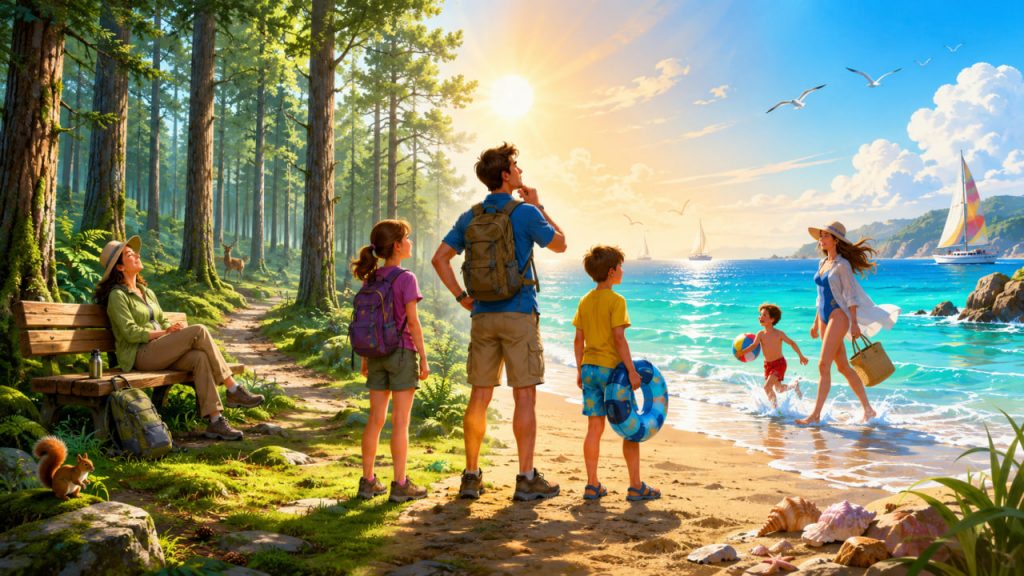
Choosing between a peaceful pine forest and a relaxing seaside vacation may seem like a simple matter of taste. In reality, each environment offers a different combination of climate, sensory experience, physical activity, and psychological restoration.
A forest retreat surrounds you with shade, natural aromas, muted sounds, and greenery. A seaside holiday offers open horizons, sunlight, rhythmic waves, swimming, and salt air.
Neither option is universally better. The right choice depends on your health, preferred activities, tolerance for heat and humidity, and the kind of recovery you currently need.
Why Natural Environments Help Us Recover
Both forests and coastal areas can reduce exposure to traffic, noise, crowded indoor spaces, and the constant mental demands of urban life.
The World Health Organization reports an overall positive relationship between access to green and blue spaces and mental health. Natural settings may support relaxation, encourage physical activity, strengthen social connection, and reduce some forms of environmental stress.
The health effect does not come from scenery alone. A person on vacation may also sleep more, walk more frequently, spend time with family, reduce screen use, and temporarily escape work-related pressure.
Nature creates favorable conditions for recovery, but personal behavior during the trip remains extremely important.
What Makes a Pine Forest Special?
A pine forest offers a sheltered and visually calm environment. Trees reduce direct sunlight, soften wind, and create a sense of enclosure that many people find comforting.
Forest landscapes may be particularly suitable for:
- Quiet walking
- Reading and reflection
- Gentle hiking
- Meditation
- Photography
- Solitude
- Escaping summer heat
- Reducing sensory overload
A systematic review of forest-based interventions found evidence of benefits for mental health and some cardiovascular measures, although the quality of the included reviews ranged from moderate to low.
Another meta-analysis found that forest bathing was associated with reduced symptoms of anxiety and depression, while effects on physiological outcomes were less consistent.
Forest Bathing and Stress Reduction
“Forest bathing,” or shinrin-yoku, does not involve swimming. It refers to spending unhurried, attentive time in a forest environment.
A forest-bathing session may include slow walking, observing leaves and light, listening to birds, noticing natural scents, and deliberately reducing phone use.
Research has associated forest exposure with short-term reductions in stress, negative mood, heart rate, and, in some studies, cortisol. However, study designs vary, and expectations may partly influence the results.
The most realistic interpretation is that a quiet forest can support relaxation, especially when the visit is slow, comfortable, and free from performance pressure.
Are Pine Aromas Therapeutic?
Pine trees release volatile organic compounds, including aromatic substances commonly called phytoncides. These compounds contribute to the recognizable smell of coniferous forests.
Laboratory and field research has examined whether forest aerosols influence stress responses or immune activity. Some studies report promising effects, but the evidence does not justify treating pine air as a medicine or claiming that it can cure disease.
The greatest benefit may come from the complete experience: clean surroundings, pleasant aromas, shade, walking, reduced noise, and psychological distance from daily obligations.
The smell of pine can enhance relaxation, but it should not be marketed as a substitute for medical treatment.
Why a Seaside Vacation Feels Different
The coast offers a more open and stimulating environment.
Large horizons, reflected sunlight, moving water, wind, and repetitive wave sounds can create a powerful sense of distance from ordinary life. Beaches also encourage swimming, walking, play, and social activity.
Research on “blue spaces” includes oceans, seas, lakes, rivers, and other visible bodies of water. Reviews suggest that exposure to aquatic environments may support mental well-being through restoration, physical activity, social interaction, and sensory experience.
Coastal settings are among the most frequently studied types of blue space, although researchers continue to investigate which benefits come from the water itself and which arise from exercise, social contact, or vacation behavior.
The Benefits of Swimming and Beach Walking
A seaside holiday can make physical activity feel less like exercise.
Swimming uses multiple muscle groups while water supports body weight. This can reduce impact on joints, although waves, cold water, and currents introduce additional risks.
Walking on a firm, level section of beach can provide moderate aerobic activity. Soft or sloped sand requires more effort and may strain the ankles, knees, calves, or lower back.
Sea bathing may feel refreshing and temporarily reduce perceived discomfort, but saltwater is not a universal treatment for skin, joint, or respiratory conditions.
The main health advantage of the sea often comes from enjoyable movement that people are willing to repeat.
Sunlight: Benefit and Risk
Coastal vacations often involve considerably more sunlight than forest stays.
Daylight exposure helps regulate circadian rhythms and supports vitamin D production in the skin. Morning light may also help stabilize sleep timing.
However, excessive ultraviolet exposure damages the skin and increases the risk of sunburn, premature aging, and skin cancer. Water, pale sand, and open skies can intensify exposure through reflection.
A seaside holiday therefore requires:
- Shade during intense midday sun
- Suitable clothing
- A broad-spectrum sunscreen
- Regular reapplication
- Extra protection for children
- Adequate hydration
A forest provides natural shade, but ultraviolet radiation can still reach the skin through open areas and between trees.
Which Environment Is Better for Sleep?
A forest may be preferable for people who sleep poorly in heat, bright morning light, nightlife, or busy resort environments.
Cooler evening temperatures, darkness, and lower noise levels can support sleep, especially when accommodation is comfortable and dry.
The seaside may improve sleep when daylight, swimming, fresh air, and physical activity help regulate the daily rhythm. However, heat, humidity, insects, nightlife, and unfamiliar sounds may have the opposite effect.
The decisive factor is usually not whether the destination contains trees or water. It is whether the accommodation provides:
- A comfortable temperature
- Low nighttime noise
- Darkness
- A supportive bed
- Good ventilation
- A predictable routine
Who May Prefer a Pine Forest?
A forest holiday may be the stronger choice for someone who:
- Feels mentally overstimulated
- Wants solitude and quiet
- Dislikes intense heat
- Prefers walking to swimming
- Needs relief from crowded resorts
- Enjoys cool mornings and shaded trails
- Wants a contemplative vacation
- Burns easily in strong sunlight
Forest walking has been associated with favorable changes in stress, mood, blood pressure, and quality of life, although the strength of evidence differs across outcomes and populations.
People with severe pollen allergies, asthma triggered by plant material, limited mobility, or fear of ticks should assess local conditions before choosing a forest destination.
Who May Prefer the Sea?
A coastal holiday may be more suitable for someone who:
- Loves swimming
- Wants an active family vacation
- Feels restored by open views
- Enjoys sunlight and warm weather
- Prefers social activities
- Wants opportunities for water sports
- Benefits from rhythmic sound and movement
- Finds forests enclosed or monotonous
Living near or visiting blue spaces has been associated with well-being, and physical activity appears to explain part of that relationship.
The sea may be less suitable for people who struggle with extreme heat, intense sunlight, crowded beaches, motion sickness, salt-sensitive skin, or unsafe swimming conditions.
Important Safety Differences
Forest and seaside environments present different risks.
In a forest, visitors should consider:
- Ticks and biting insects
- Uneven terrain
- Getting lost
- Falling branches
- Wildfire conditions
- Limited mobile coverage
- Poisonous plants or fungi
At the coast, important risks include:
- Rip currents
- Sudden depth changes
- Waves and slippery rocks
- Heat illness
- Dehydration
- Sunburn
- Storms
- Unsafe boating
Children require direct supervision in both settings. Near water, an adult should remain close enough to intervene immediately rather than relying only on flotation devices or lifeguards.
Can You Combine Both Environments?
For many people, the ideal destination is not an absolute choice.
A coastal region with pine forests, shaded cliffs, walking trails, and accessible beaches can provide both calm and variety. Morning forest walks can be combined with late-afternoon swimming after the strongest sunlight has passed.
Alternating environments may also prevent boredom. The forest offers enclosure, shade, and quiet, while the sea provides openness, movement, and bright light.
A mixed nature vacation may deliver the broadest psychological benefit because it allows the family to adapt each day to weather, energy levels, and personal preferences.
Expert Perspective
Public-health researchers do not identify one natural environment as universally superior. WHO reviews find that both green and blue spaces are positively associated with mental health, while the size and reliability of specific effects depend on accessibility, safety, quality, individual preferences, and opportunities for activity.
The most useful expert conclusion is therefore practical: choose the place where you are most likely to sleep well, move comfortably, feel safe, and spend meaningful time outdoors.
A beautiful destination offers little benefit when the heat is intolerable, the beach is overcrowded, the forest trails are inaccessible, or the travel schedule creates more stress than the vacation removes.
Interesting Facts
- Forest bathing involves attentive time in nature rather than actual bathing.
- Coastal environments are among the most frequently researched blue spaces.
- Forests and beaches may improve well-being partly because they encourage walking.
- Wave sounds can mask irregular background noise and feel calming to some people.
- A pine forest may be cooler than an exposed beach during the same summer day.
- Water and pale sand can increase ultraviolet exposure through reflection.
- Natural environments may support attention restoration after prolonged mental work.
- Enjoyment matters: people are more likely to repeat physical activity when the environment feels pleasant.
- A forest holiday can be highly social, while a seaside holiday can be solitary; destination type does not determine the experience.
- Combining woodland and coastal activities may provide more variety than choosing only one setting.
Glossary
- Green Space — A natural or designed area dominated by vegetation, such as forests, parks, and gardens.
- Blue Space — A visible aquatic environment, including seas, rivers, lakes, and coastal areas.
- Forest Bathing — Slow, mindful exposure to a forest environment for relaxation and well-being.
- Phytoncides — Volatile compounds released by plants, including trees.
- Cortisol — A hormone involved in stress responses, metabolism, and daily biological rhythms.
- Circadian Rhythm — The body’s approximately 24-hour cycle regulating sleep, alertness, hormones, and other functions.
- Ultraviolet Radiation — Invisible radiation from sunlight that can damage skin and eyes.
- Attention Restoration — Recovery from mental fatigue through exposure to environments requiring less directed concentration.
- Aerobic Activity — Sustained movement that increases breathing and heart rate.
- Rip Current — A narrow, fast-moving channel of water flowing away from the shore.
- Sensory Overload — Distress or fatigue caused by excessive noise, light, crowds, or other stimulation.
- Physiological Stress — Bodily changes associated with challenge or threat, including altered heart rate and hormone activity.