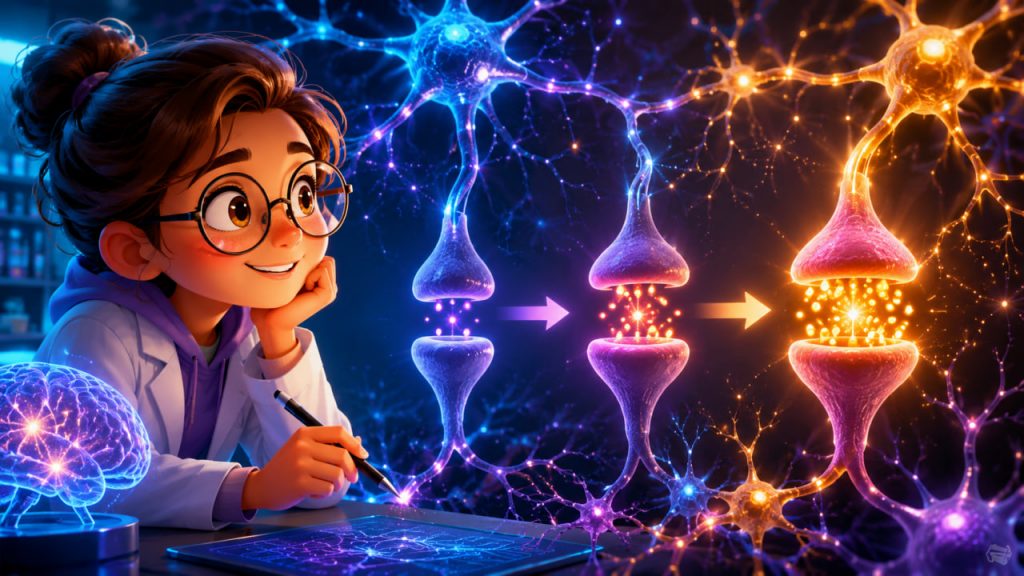
Synaptic plasticity is one of the most important mechanisms behind learning, memory, adaptation, and recovery in the nervous system. It describes the ability of synapses—the communication points between neurons—to become stronger or weaker in response to activity and experience.
The brain is not a rigid electrical machine with permanently fixed connections. Its networks are continuously adjusted by sensory input, practice, attention, sleep, stress, development, injury, and disease.
Synaptic plasticity allows past activity to influence how neurons communicate in the future. This makes it a central biological process in learning, although memory cannot be reduced to synaptic change alone.
What Is a Synapse?
A synapse is a specialized connection through which one neuron communicates with another neuron or target cell.
At most chemical synapses, an electrical signal reaches the end of the sending neuron, called the presynaptic terminal. This triggers the release of neurotransmitter molecules into a narrow space known as the synaptic cleft.
The neurotransmitter binds to receptors on the receiving, or postsynaptic, cell. Depending on the neurotransmitter, receptor, and circuit, the signal may increase or decrease the likelihood that the receiving neuron will fire.
Synaptic strength refers to how effectively activity in one neuron influences another. Plasticity occurs when that effectiveness changes over time.
How Synaptic Plasticity Works
Synaptic plasticity can involve changes on either side of the synapse.
The presynaptic neuron may release more or less neurotransmitter. The postsynaptic neuron may add, remove, or modify receptors. The synapse can also change its shape, size, protein composition, or relationship with nearby cellular structures.
Some changes last for milliseconds or minutes. Others persist for hours, days, or much longer.
Researchers generally classify plasticity according to its duration, direction, location, and biological mechanism. It is therefore more accurate to think of synaptic plasticity as a family of processes rather than a single switch inside the brain.
Short-Term Synaptic Plasticity
Short-term plasticity changes communication for brief periods, usually because of recent activity at the synapse.
When a neuron fires repeatedly, neurotransmitter release may temporarily increase. This is called facilitation. In other situations, the available neurotransmitter supply may decrease, causing temporary synaptic depression.
These rapid changes help neural circuits process timing, contrast, repetition, and changing patterns of information.
For example, a circuit may respond strongly to the beginning of a stimulus but gradually respond less as the stimulus continues. Another circuit may become increasingly responsive during a rapid sequence of signals.
Short-term plasticity does not necessarily create a lasting memory. Instead, it dynamically adjusts information processing from one moment to the next.
Long-Term Potentiation
Long-term potentiation, commonly called LTP, is a persistent increase in synaptic strength following particular patterns of activity.
It has been studied extensively in the hippocampus, a brain region strongly involved in forming certain types of memory.
In many excitatory synapses, LTP begins when presynaptic and postsynaptic neurons are active together. Glutamate activates NMDA receptors, allowing calcium ions to enter the postsynaptic neuron under the appropriate electrical conditions.
This calcium signal activates molecular pathways that can increase the number or effectiveness of AMPA receptors at the synapse. As a result, the same future input can produce a stronger postsynaptic response. Longer-lasting forms may also involve protein synthesis, gene expression, and structural changes in dendritic spines.
LTP is not a memory itself. It is an experimentally observed mechanism that can help neural circuits store information by strengthening selected connections.
Long-Term Depression
Long-term depression, or LTD, is a lasting reduction in synaptic strength.
Although the word “depression” may sound harmful, LTD is a normal and essential process. A brain that could only strengthen connections would eventually become unstable and inefficient.
LTD may help weaken outdated associations, refine neural circuits, correct errors, support flexible learning, and prevent excessive excitation.
At some hippocampal synapses, both LTP and LTD depend on NMDA receptor activation and calcium entry. A relatively large, rapid increase in postsynaptic calcium can favor potentiation, while a smaller or differently timed calcium signal can favor depression.
The exact mechanism varies between brain regions and synapse types.
The Hebbian Principle
Synaptic plasticity is often explained using the Hebbian principle, commonly summarized as neurons that are repeatedly active together tend to strengthen their connection.
This idea captures an important feature of associative learning. When one neural signal consistently predicts or accompanies another, the relevant pathway may become more effective.
However, real synapses follow more complex rules than simple repetition.
Timing matters. The order in which neurons fire can determine whether a connection strengthens or weakens. Neuromodulators such as dopamine may signal whether an event is important, surprising, rewarding, or behaviorally relevant.
Plasticity also depends on the previous state of the synapse, the surrounding network, the organism’s developmental stage, and the pattern of activity.
Homeostatic Plasticity Keeps Networks Stable
Hebbian plasticity can create a stability problem. Strong synapses may become progressively stronger, while weak synapses may continue to weaken.
The nervous system therefore uses homeostatic plasticity to keep neuronal activity within workable limits.
One form, called synaptic scaling, can adjust many of a neuron’s synapses upward or downward in a coordinated way. If activity remains unusually low, synaptic responsiveness may increase. If activity remains excessively high, responsiveness may decrease.
These negative-feedback mechanisms help preserve circuit stability while allowing individual connections to retain meaningful differences.
Learning requires change, but healthy neural networks also require balance.
Structural Plasticity
Synapses do not change only chemically. Their physical structure can also be remodeled.
Many excitatory synapses form on tiny projections called dendritic spines. During persistent plasticity, these spines may enlarge, shrink, appear, or disappear.
Axon terminals can also change, and new synaptic contacts may form while others are eliminated.
Structural remodeling is particularly important during development, when experience helps shape sensory and cognitive circuits. It also continues in adulthood, although the rate and extent vary among brain regions and circumstances. Research has linked learning with structural changes at both presynaptic and postsynaptic sites.
Synaptic Plasticity and Memory
The synaptic plasticity and memory hypothesis proposes that activity-dependent changes at appropriate synapses contribute to the encoding and storage of information.
Substantial experimental evidence supports a close connection between synaptic plasticity and learning. Interfering with key plasticity mechanisms can impair certain forms of memory, while learning can produce measurable changes in relevant neural circuits.
However, researchers do not generally claim that every memory is stored in one strengthened synapse.
Memory emerges from distributed networks involving synaptic changes, neuronal excitability, gene regulation, network dynamics, and interactions among different brain regions. Reviews of the field emphasize that non-synaptic processes may also contribute to long-term information storage.
Plasticity in Development and Recovery
Synaptic plasticity helps build the nervous system during childhood and adolescence.
Sensory experience influences which connections are preserved, strengthened, weakened, or removed. Some developmental periods are especially sensitive to particular experiences, such as visual input or language exposure.
Plasticity also contributes to adaptation after brain injury. Following a stroke or traumatic injury, surviving neural networks may reorganize and recruit alternative pathways.
Rehabilitation attempts to guide this capacity through repeated, meaningful practice. Recovery is influenced by the location and severity of damage, timing of treatment, age, health, and the remaining neural network. Neuroplasticity is therefore important for recovery, but it does not guarantee complete restoration of lost function.
When Synaptic Plasticity Becomes Maladaptive
Plasticity is not automatically beneficial.
The nervous system can learn harmful patterns as well as useful ones. Maladaptive plasticity may contribute to chronic pain, addiction, anxiety-related learning, epilepsy, and some psychiatric or neurological conditions.
For example, repeated drug exposure can alter reward-related synapses. Persistent pain can strengthen circuits that amplify pain signals even after the original tissue injury has improved.
Research also examines disrupted plasticity in depression, schizophrenia, neurodevelopmental conditions, and neurodegenerative diseases. These relationships are complex, and altered plasticity may be a cause, consequence, or compensatory response depending on the disorder.
Expert Perspective
Neuroscientists Tim Bliss and Graham Collingridge helped establish LTP as a major experimental model for studying how experience can produce lasting changes in neural circuits. Reviews by Bliss and colleagues describe LTP and LTD as durable, activity-dependent changes that remain among the leading cellular models of information storage in the central nervous system.
At the same time, experts emphasize an important limitation: demonstrating plasticity in a laboratory preparation is not identical to proving how a complete human memory is stored.
Modern neuroscience therefore combines electrical recording, imaging, molecular biology, behavioral experiments, and targeted manipulation of neural circuits to investigate how synaptic changes contribute to real learning.
Interesting Facts
- A single neuron may receive thousands of synaptic inputs.
- Synaptic strengthening and weakening can occur in the same neural circuit.
- Some plastic changes last seconds, while others persist for weeks or longer.
- Calcium can act as a key signal determining whether certain synapses strengthen or weaken.
- Long-term plasticity may require the production of new proteins.
- Dendritic spines can physically change shape after neural activity.
- Inhibitory synapses can also undergo long-term plasticity.
- Sleep is thought to interact with memory consolidation and the regulation of synaptic activity.
- Plasticity continues in adulthood and is not restricted to childhood.
- The hippocampus is widely studied, but synaptic plasticity occurs throughout the nervous system.
- Not every change in synaptic strength represents learning.
- Both excessive and insufficient plasticity may interfere with stable brain function.
Glossary
- Synapse — A specialized connection through which one neuron communicates with another cell.
- Synaptic plasticity — The ability of a synapse to change its strength or functional properties.
- Neuron — A cell specialized for receiving, processing, and transmitting information.
- Neurotransmitter — A chemical messenger released by a neuron.
- Presynaptic neuron — The neuron sending a signal across a synapse.
- Postsynaptic neuron — The neuron or cell receiving the signal.
- Long-term potentiation (LTP) — A persistent increase in synaptic strength.
- Long-term depression (LTD) — A persistent decrease in synaptic strength.
- NMDA receptor — A glutamate receptor involved in calcium signaling and many forms of plasticity.
- AMPA receptor — A glutamate receptor that mediates much fast excitatory communication in the brain.
- Dendritic spine — A small projection on a neuron that commonly receives an excitatory synapse.
- Hebbian plasticity — Activity-dependent plasticity in which correlated neural activity can strengthen connections.
- Homeostatic plasticity — Stabilizing changes that prevent neural activity from becoming persistently too high or too low.
- Synaptic scaling — Coordinated adjustment of many synapses to stabilize a neuron’s overall activity.
- Hippocampus — A brain structure important for forming and organizing certain memories.
- Neural circuit — A network of connected neurons that processes information.
- Neuroplasticity — The broader ability of the nervous system to change its structure, function, or connections.
- Neuromodulator — A chemical signal that adjusts how neurons and circuits respond.
- Dendrite — A branched part of a neuron that receives signals.
- Axon — A neuronal extension that carries signals toward other cells.