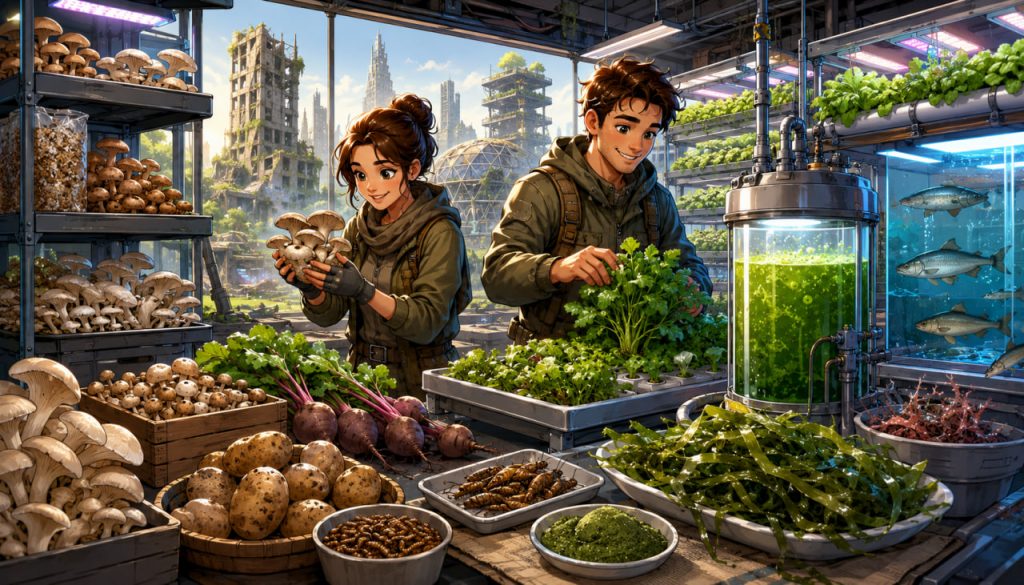
Modern civilization depends on an enormous and highly interconnected food system. Every day, farms, transportation networks, fertilizer production, refrigeration, and global trade work together to feed billions of people. Most of us rarely think about how vulnerable this system can be. Yet scientists have spent decades studying what might happen if a global catastrophe severely disrupted food production.
Scenarios such as a major asteroid impact, a supervolcanic eruption, or a large-scale nuclear war could dramatically alter Earth’s climate. In the worst cases, sunlight reaching the planet’s surface could be reduced for months or even years. Since most agriculture relies on sunlight, such an event could trigger one of the greatest food crises in human history.
The good news is that researchers believe humanity would still have ways to produce food. The challenge would be adapting quickly enough.
Why a Lack of Sunlight Is Such a Serious Problem
Most crops depend on photosynthesis, the process through which plants use sunlight to produce energy and grow. Wheat, corn, rice, and many other staple foods require large amounts of sunlight during the growing season.
If a catastrophe filled the atmosphere with dust, ash, or smoke, temperatures could fall while sunlight levels dropped significantly. Under these conditions, crop yields would decline sharply, and some regions might become unsuitable for traditional agriculture altogether.
Scientists studying nuclear winter scenarios have found that even a temporary reduction in sunlight could affect global food supplies. Because modern populations are so large, even a modest decline in agricultural output could create serious shortages.
The World’s Existing Food Supplies Would Be the First Lifeline
Immediately after a catastrophe, humanity would not suddenly run out of food. Countries, businesses, and households already store enormous quantities of grain, rice, wheat, canned products, and frozen foods.
These reserves could help bridge the gap during the first months of a crisis. Livestock feed, which is normally used to raise animals, could also be redirected toward human consumption in some cases.
However, stored food is only a temporary solution. Eventually, new methods of producing food would become essential.
Potatoes Could Become One of Humanity’s Most Important Crops
Not all plants respond to harsh conditions in the same way. Some crops are surprisingly resilient and can continue growing in cooler temperatures with less sunlight.
Potatoes are often cited by food security experts as one of the most efficient survival crops. They produce large amounts of calories per hectare and can grow in a variety of environments. Other relatively resilient crops include sugar beets, cabbage, kale, and certain root vegetables.
Because they provide significant energy from a relatively small area of land, these crops could become increasingly important if traditional grain harvests declined.
Mushrooms Could Feed Millions
One of the most promising emergency food sources is mushrooms.
Unlike plants, mushrooms do not require sunlight. Instead, they obtain nutrients from organic materials such as wood, agricultural waste, leaves, and crop residues. This means they could continue to be cultivated even during prolonged periods of darkness or reduced sunlight.
Mushrooms are also nutritionally valuable. They contain protein, fiber, minerals, and several important vitamins. Large-scale mushroom farms could potentially convert enormous amounts of otherwise unusable plant material into edible food.
Professor David Denkenberger, Executive Director of the Alliance to Feed the Earth in Disasters (ALLFED), has spent years studying catastrophe-resilient food systems.
“There are many alternative foods that could be scaled up rapidly and help feed humanity even if conventional agriculture were severely disrupted.”
His research suggests that alternative food production could dramatically reduce the risk of global famine.
Seaweed Could Become a Global Emergency Food
Another food source attracting significant attention is seaweed.
Many species grow extremely quickly and do not require fertile soil, fertilizers, or freshwater. In coastal regions, large-scale seaweed cultivation could continue even when land-based agriculture struggles.
Seaweed contains valuable minerals, carbohydrates, and, depending on the species, meaningful amounts of protein. Because oceans cover most of Earth’s surface, marine food production may play an important role in future disaster resilience strategies.
Insects Might Become More Common on the Menu
For many people, eating insects sounds unusual. However, more than two billion people already consume insects as part of their traditional diets.
Crickets, mealworms, and similar species convert feed into protein far more efficiently than cattle. They require less water, less land, and fewer resources overall.
In a severe food crisis, insect farming could provide an efficient source of protein while placing relatively little strain on available resources.
Although widespread adoption would likely require cultural adjustment in some countries, the nutritional advantages are difficult to ignore.
Food Made by Microorganisms Could Change Everything
Perhaps the most remarkable solution being explored involves microorganisms.
Researchers have developed systems that use bacteria to create edible protein from simple inputs such as electricity, water, carbon dioxide, and hydrogen. Because these systems do not rely on sunlight, they could continue operating even during extreme environmental disruptions.
Unlike traditional agriculture, microbial food production can occur inside controlled facilities, making it far less vulnerable to weather and climate conditions.
Many experts believe this technology could become one of the most important tools for protecting humanity from future food shortages.
What Would Happen to Meat and Dairy?
Animal agriculture would face major challenges after a global catastrophe. Large animals such as cattle require enormous quantities of feed, much of which comes from crops that could become scarce.
As a result, beef production would likely decline significantly. Smaller animals that convert feed into food more efficiently, such as chickens and rabbits, might become more practical sources of animal protein.
Fish farming could also remain viable in some regions, particularly if supported by controlled aquaculture systems.
Survival Would Depend on Adaptation
A global catastrophe would undoubtedly create enormous challenges for food production. However, current research suggests that humanity possesses far more options than many people realize.
Traditional agriculture would remain important wherever possible, but alternative foods such as mushrooms, seaweed, insects, microbial protein, and resilient crops could help compensate for lost production.
Rather than relying on a single solution, survival would likely depend on combining many different approaches. The more prepared societies are before a disaster occurs, the greater the chances of avoiding widespread famine.
Conclusion
When people imagine global catastrophes, they often picture a world without food. In reality, the future would probably be more complex. While conventional farming could suffer dramatically, science and innovation provide numerous alternatives that could help sustain human populations.
The question is not whether food could be produced after a global catastrophe. The real question is whether humanity could organize, adapt, and scale these solutions quickly enough to feed billions of people.
Interesting Facts
- Some mushroom species can grow entirely without sunlight using only dead plant material as a food source.
- Potatoes produce more calories per hectare than many major cereal crops.
- Certain seaweed farms can harvest multiple crops each year because of extremely rapid growth rates.
- Crickets need far less feed and water than cattle to produce the same amount of protein.
- Scientists have already produced edible protein using microorganisms powered by electricity.
- Researchers at ALLFED study food sources specifically designed for scenarios involving global catastrophes.
Glossary
- Nuclear Winter — A period of global cooling caused by smoke and soot blocking sunlight after massive fires.
- Photosynthesis — The process plants use to convert sunlight into energy for growth.
- Microbial Protein — Protein produced by microorganisms such as bacteria and used as food.
- Aquaculture — The farming of fish and other aquatic organisms in controlled environments.
- Food Security — Reliable access to sufficient, safe, and nutritious food.