
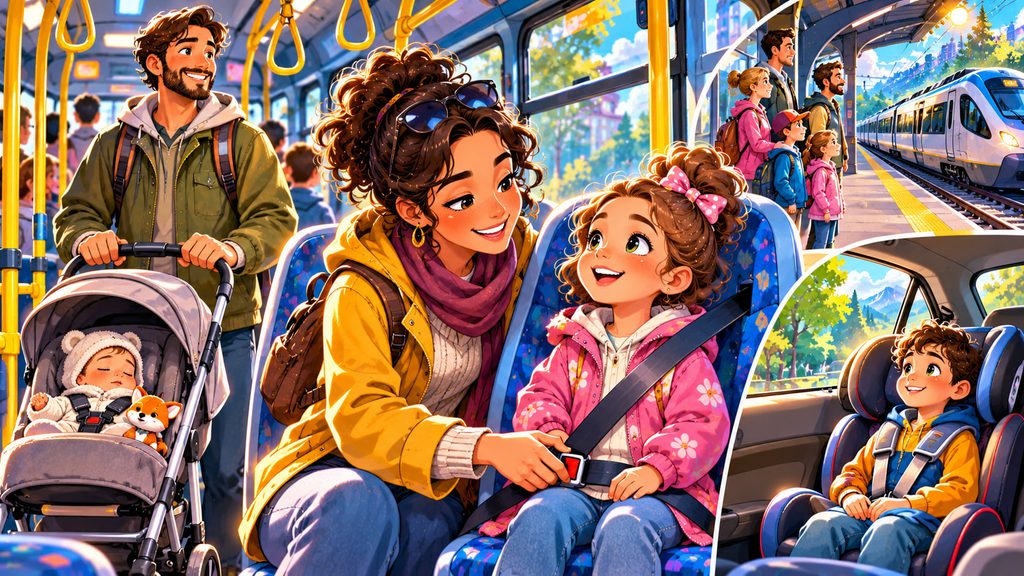
A familiar journey can change in a second. A bus brakes suddenly, a train door begins to close, or a car stops sharply at an intersection. Adults instinctively brace themselves, but young children may not have the balance, strength, or judgment to react. Keeping children safe in transport means planning for the unexpected, not simply ensuring everyone reaches their seat.
Different vehicles present different hazards. A carefully installed child seat matters in a car, while a steady grip and a clear boarding plan are important on a city train. Safety requirements also change as children grow and begin traveling independently. A few well-practiced routines can reduce risks without making every journey stressful.
Why Children Need Different Protection
In a sudden stop, passengers continue moving forward until a restraint or another surface stops them. This is inertia, a principle of physics explaining why even a short trip can cause serious injuries. Children’s heads are proportionally larger, and their developing bodies need protection suited to their size. An adult’s lap or loose embrace cannot reliably restrain a child during a collision. Correct fit and proper use matter more than expensive accessories.
Choose the Right Car Seat as Your Child Grows
Babies and toddlers should travel in a rear-facing car seat until they reach the manufacturer’s maximum height or weight limit. Facing backward distributes collision forces across the head, neck, and back. After outgrowing that limit, children transition to a forward-facing seat with a harness until its limits are reached. Only then should they move to a booster seat that positions the vehicle belt correctly.
A child is ready for an adult belt when it lies low across the upper thighs, crosses the center of the chest and shoulder, and stays correctly positioned. This often happens between ages eight and twelve, around 145 centimeters (4 feet 9 inches), but fit matters more than age. The rear seat is generally the safest place for children younger than thirteen. Local laws vary, so follow both legal requirements and the seat manufacturer’s instructions.
Why Correct Car Seat Installation Is Essential
Even a high-quality seat cannot provide intended protection if installed incorrectly. Follow both the car seat manual and vehicle manual, checking the approved anchorage system and belt routing. Harness straps should fit snugly without twists, and bulky winter coats should not be trapped beneath them. Never place a rear-facing child seat in front of an active frontal airbag.
A trained child passenger safety technician can check installation where this service is available. Avoid unapproved accessories that could alter crash performance. After a collision, follow manufacturer guidance about replacing the seat. The seat, vehicle, restraint system, and child must work together.
Taxis and Ride-Sharing Cars Are Not Exceptions
A short ride to a hotel or airport still carries collision risks. Before booking a taxi or ride-share, arrange an appropriate child restraint and confirm that it can be installed correctly. Do not assume a driver will provide one or that a legal exemption offers equivalent protection. Holding a baby on your lap does not replace a car seat.
For frequent travelers, a suitable portable seat can simplify planning. Check its limits and compatibility before departure rather than experimenting at the curb. If the vehicle cannot safely accommodate the child, arrange another ride. Convenience should never determine restraint safety.
Riding City Buses, Trams, and Metro Trains
Urban transport brings sudden acceleration, hard braking, and crowded aisles. Young children should sit whenever possible or remain closely supported by an adult when standing is unavoidable. Encourage older children to hold a secure rail before the vehicle starts moving. Keep bags and loose toys away from doors and walking areas.
Board only after passengers have exited, and never rush into closing doors. Explain that platforms are not places for running or playing. Wait behind safety markings and watch the gap when boarding a train. The transition between platform and vehicle deserves as much attention as the ride itself.
How to Travel Safely With a Stroller
A stroller can roll unexpectedly when a vehicle moves or a platform slopes. Fasten the child’s stroller harness, engage the parking brake when stopped, and maintain a firm hold. Use designated stroller spaces and any securing system required by the operator. Avoid blocking doors, aisles, or wheelchair spaces.
Operators have different rules about whether children may remain in strollers during bus trips. Check the local policy rather than assuming it is the same everywhere. Use lifts instead of escalators whenever possible, and seek assistance with steps or large gaps. Never leave a stroller unattended near a platform edge.
School Buses: Safety Begins Outside
Large school buses often use compartmentalization: closely spaced, padded, high-backed seats designed to protect passengers in a crash. Smaller buses have different restraint requirements, while lap-and-shoulder belts provide additional protection where available. Children should use provided restraints correctly and remain seated until it is time to leave. Preschool passengers may require specialized child restraint systems.
The bus stop itself can be particularly dangerous. Children should wait away from traffic, board only when the driver signals, and never walk behind a bus. If crossing in front is necessary, they should move far enough ahead to remain visible, follow the driver’s instructions, and watch for other vehicles. Teach children never to retrieve objects dropped near a bus without first alerting the driver.
Flying With Babies and Young Children
Air travel introduces the risk of unexpected turbulence. The Federal Aviation Administration advises that children younger than two are safest in their own airplane seat using an approved child restraint system rather than traveling on an adult’s lap. Check the seat’s aircraft approval and the airline’s policies before departure. An ordinary booster seat is not a substitute for an approved aircraft restraint during takeoff and landing.
Keep seat belts fastened whenever seated, even when the sign is off. Store heavy bags securely and follow crew directions during boarding and emergencies. Older children should know how to buckle and release their belts correctly. Planning ahead makes the cabin safer and less stressful.
Ferries, Boats, and Other Water Transport
On smaller boats, a correctly fitted, approved personal flotation device can be lifesaving. Select one for the child’s actual size and weight, fasten it properly, and follow local wearing requirements. Adult supervision remains essential even when a child wears a life jacket. Swimming ability alone cannot guarantee safety around moving vessels or open water.
On ferries, keep children away from railings, ramps, and loading operations. Show older children where crew members and emergency equipment are located. In rough conditions, remain seated in a protected area and follow crew instructions. Water transport requires a different safety plan from a car or train.
Teach Children What to Do if Separated
As children become more independent, simple rehearsal becomes valuable. Agree on a meeting plan and teach them to approach uniformed staff or clearly identifiable transport employees if separated. Younger children can carry a contact card discreetly in a pocket. Older children should know their route, their stop, and how to contact a trusted adult.
Avoid making children responsible for problems beyond their abilities. Practice calmly, using short scenarios rather than frightening descriptions. Encourage them to ask for help instead of leaving a station to search alone. Confidence grows through preparation and repeated experience.
Build a Routine That Prevents Common Mistakes
Adults can become distracted by phones, bags, schedules, or tiredness. Before car journeys, check that everyone is correctly restrained and all doors are secure. After arriving, check the entire vehicle: children must never be left unattended in a parked car, even briefly. Temperatures can rise dangerously, and children may become trapped.
For public transport, establish a predictable sequence: hold hands, wait back, board calmly, find a safe position, and check surroundings before exiting. Explain the reasons in child-friendly language so rules become habits. The best precautions are those families can repeat even on busy days. Which transport safety habit has made the biggest difference for your family, and what advice would you share with other parents? Tell us in the comments.
Interesting Facts
- Rear-facing seats distribute collision forces across a young child’s head, neck, and back.
- Many children need a booster seat until they are approximately 145 centimeters (4 feet 9 inches) tall.
- Large school buses use padded, closely spaced seating to provide crash protection.
- The safest way for an infant to fly is in an approved child restraint in a separate seat.
- A stroller’s brakes and a caregiver’s grip are both important on public transport.
- Parked vehicles can become dangerously hot even when a caregiver expects to return quickly.
Glossary
- Inertia — The tendency of an object to continue moving unless acted upon by a force.
- Rear-Facing Car Seat — A child restraint that supports a child facing the rear of a vehicle.
- Booster Seat — A seat that positions the vehicle’s adult belt correctly on a child.
- Compartmentalization — Crash protection provided by closely spaced, padded seats in certain buses.
- Turbulence — Irregular atmospheric motion that can produce unexpected aircraft movement.
- Personal Flotation Device — A wearable safety device designed to help keep a person afloat in water.