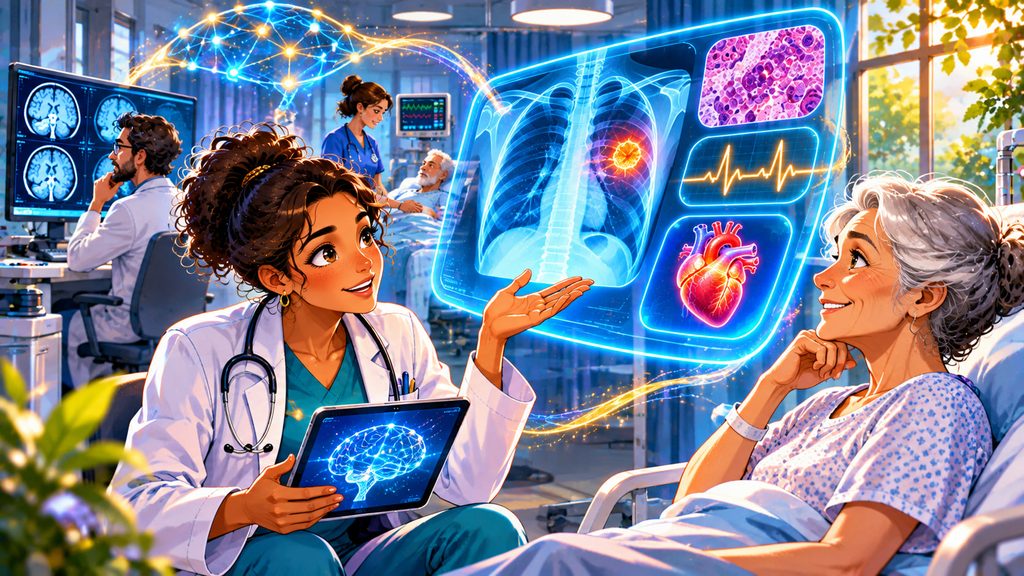
A radiologist opens a scan, and software highlights a suspicious area before the doctor begins reviewing it. Down the corridor, a nurse receives an early warning about a patient’s changing condition. Meanwhile, a physician finishes an appointment without typing every sentence into a computer. These are no longer imaginary scenes from a futuristic hospital.
Artificial intelligence is already reshaping medical work, although its influence varies widely between hospitals and specialties. The most important change is not a robot replacing a doctor, but software helping healthcare professionals notice patterns, manage information, and spend more time on difficult human decisions.
How Common Is AI in Medical Practice?
In a 2026 American Medical Association survey, 81% of responding physicians reported using AI in their practices, compared with 38% in 2023. That includes administrative and research tasks, not just diagnosis or treatment.
Modern hospitals use different forms of machine learning, systems trained to identify statistical patterns in data. Others process spoken conversations or search records for warning signs. Performance varies by purpose and setting.
Radiologists: An Extra Set of Eyes on Medical Images
Radiology is among the most established areas of medical AI. Algorithms can flag possible brain hemorrhages, identify suspicious lung nodules, measure organs, or help prioritize urgent scans. Radiologists still interpret findings alongside symptoms and medical history.
A Swedish randomized study of AI-supported mammography, with results published in 2026, found screening sensitivity of 80.5% compared with 73.8% under standard double reading. Specificity was 98.5% in both groups, while reading workload was reduced. That is a practical example of AI supporting cancer screening without eliminating specialist review.
Pathologists: Searching Tissue Samples for Cancer
Pathologists traditionally examine tissue under a microscope, looking for cellular structures that reveal disease. Digital pathology converts slides into detailed images that software can analyze. AI tools can highlight regions suspicious for prostate cancer, helping specialists direct their attention.
In 2021, the US Food and Drug Administration authorized Paige Prostate as an aid for identifying suspicious tissue. Other products have followed, but these tools support human interpretation rather than replacing the responsible pathologist. Their accuracy can also depend on the scanner and laboratory workflow used.
Gastroenterologists: Spotting Polyps During Colonoscopy
During a colonoscopy, a doctor examines the inside of the large intestine using a camera. AI-assisted systems can draw attention to possible adenomas, growths that may become cancerous over time. Unlike a retrospective image review, these tools operate during the procedure.
In the British COLO-DETECT trial involving more than 2,000 participants, adenomas were detected in 56.6% of the AI-assisted group with evaluable detection data, versus 48.4% in the standard group. The endoscopist still decides whether a highlighted area requires examination or removal. The benefit is potentially better detection.
Doctors: Less Typing, More Patient Conversation
One of the fastest-growing applications is the ambient AI scribe, software that listens to a clinical encounter with appropriate safeguards and drafts a medical note. A clinician reviews, corrects, and approves the text before it enters the electronic health record. This can reduce the distraction of constant typing during appointments.
A 2025 study across six US healthcare systems followed 263 clinicians using an ambient scribe. Among those assessed for burnout, the proportion meeting the study’s threshold fell from 51.9% before use to 38.8% after 30 days. The results are encouraging, although the before-and-after design cannot establish that software alone caused the improvement.
Nurses: Detecting Deterioration Earlier
Nurses continuously monitor vital signs, symptoms, medication responses, and changes in patients’ behavior. Some hospitals use predictive analytics to combine blood pressure, laboratory values, heart rate, and other information into early-warning scores. These systems can prompt staff to reassess a patient who may be deteriorating.
However, too many inaccurate warnings create alert fatigue, making genuinely urgent signals harder to recognize. A 2026 evaluation of a sepsis prediction model across more than 227,000 inpatient encounters found meaningful differences between hospitals and substantial alert burdens. Good nursing judgment and local testing remain essential parts of safe use.
Pharmacists: Checking Medication Risks
Hospital pharmacists review prescriptions for interactions, inappropriate doses, duplicated treatments, and risks linked to kidney or liver function. AI can help prioritize complicated medication lists or identify potential safety issues hidden in large records. Some systems also support inventory planning and forecasting drug demand.
A useful alert is not the same as a verified medication error. Drug combinations may be clinically appropriate under supervision, and algorithms do not always capture the full circumstances. Pharmacists remain responsible for interpreting warnings and helping teams choose safe treatments.
Surgeons and Cancer Teams: Planning More Precisely
AI is also changing work before a procedure begins. Imaging algorithms can help outline tumors and surrounding organs for radiotherapy planning, a task that otherwise requires substantial manual contouring. Surgeons may use computer-assisted anatomical models to understand difficult structures before operating.
Most surgical robots remain controlled by trained professionals, not autonomous algorithms. The most reliable immediate benefits come from better preparation, measurement, and visualization.
Laboratory Scientists and Hospital Administrators
Clinical laboratories increasingly use digital image analysis to help review blood cells, tissue images, or microbiology cultures. Software can sort samples and highlight results requiring specialist attention, while human experts verify clinically important findings. This changes which cases receive priority rather than eliminating laboratory expertise.
Outside clinical rooms, AI helps some hospitals estimate bed demand, predict appointment cancellations, and plan staff or equipment use. Such forecasts can affect access to care and must be monitored for errors.
What AI Still Cannot Safely Do Alone
An AI model may produce convincing but incorrect explanations, known as hallucination. Algorithms can also perform worse on patients whose characteristics are poorly represented in training data, creating risks of algorithmic bias. Privacy and cybersecurity are equally important when sensitive health information is processed.
Cardiologist and digital medicine researcher Eric Topol has argued that well-designed AI could help restore time for the human relationship at the center of care. Realizing that potential requires testing, transparency, and human supervision.
Medical AI is already changing the daily work of radiologists, pathologists, nurses, pharmacists, and many other professionals. The most valuable systems may be those that handle repetitive tasks while leaving more room for clinical expertise and empathy. Would you feel comfortable with AI helping your doctor review a scan or write medical notes, provided a qualified professional checked the result? Share your thoughts in the comments.
Interesting Facts
- In a 2026 US physician survey, 81% of respondents reported using AI in their practices.
- A Swedish randomized mammography study found higher screening sensitivity with AI support while maintaining the same specificity.
- A British colonoscopy trial detected adenomas in 56.6% of evaluable AI-assisted examinations versus 48.4% of standard examinations.
- An observational study of 263 clinicians linked AI scribe use with a decrease in measured burnout after 30 days.
- AI-assisted pathology tools can highlight potentially cancerous tissue, but current authorized products still rely on specialist interpretation.
- Early-warning algorithms may generate many false alerts, making local validation important.
Glossary
- Artificial Intelligence — Computer systems that perform tasks involving pattern recognition, language, prediction, or other capabilities associated with human intelligence.
- Machine Learning — Methods that learn statistical relationships from data to generate predictions or classifications.
- Digital Pathology — Examining high-resolution digital images of tissue samples rather than relying only on conventional microscope slides.
- Colonoscopy — A procedure using a flexible camera to examine the large intestine.
- Adenomas — Glandular growths that can sometimes develop into cancer.
- Ambient AI Scribe — Software that drafts clinical documentation from a spoken medical encounter.
- Electronic Health Record — A digital system containing a patient’s medical information and care documentation.
- Predictive Analytics — The use of data and statistical models to estimate future outcomes or risks.
- Alert Fatigue — Reduced attention to warnings when users receive too many alerts.
- Radiotherapy — Treatment that uses radiation to damage or destroy cancer cells.
- Hallucination — Incorrect or fabricated information presented by a generative AI system as if it were factual.
- Algorithmic Bias — Systematic differences in an algorithm’s results or errors across different groups or situations.