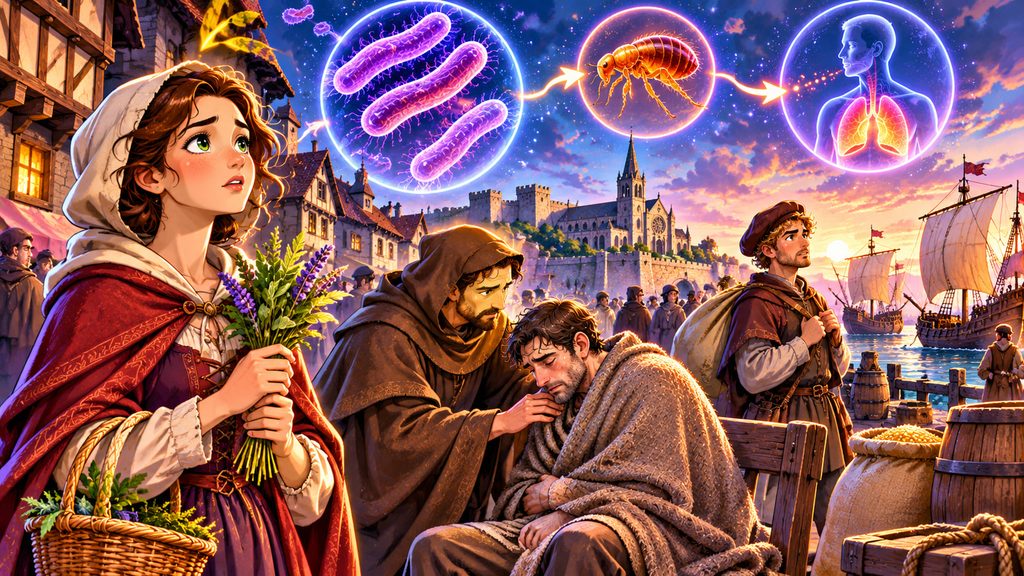
Imagine walking through a European city in 1348. Market stalls stand abandoned, church bells ring for the dead, and frightened families close their doors against an invisible threat. Within months, entire communities have lost a devastating proportion of their inhabitants.
This was the Black Death, one of the deadliest pandemics in human history. Between 1346 and 1353, plague spread across vast regions of Eurasia, North Africa, and Europe, transforming societies that had no understanding of bacteria or modern infection control. The catastrophe did more than kill millions: it reshaped medieval economies, religious beliefs, medicine, and the balance of power between ordinary people and their rulers.
What Was the Black Death?
The Black Death was a devastating outbreak of plague caused by the bacterium Yersinia pestis. The disease had existed long before the fourteenth century, but this pandemic reached an extraordinary geographical scale through interconnected trading networks.
Estimates of Europe’s mortality vary because reliable population records are incomplete. Many historians believe roughly one-third to one-half of Europeans died during the initial outbreak, although losses differed considerably between regions. Some communities experienced catastrophic mortality while others escaped relatively lightly.
Historian Monica H. Green has emphasized that the Black Death should be understood as a broader Afro-Eurasian pandemic, not merely a European disaster. This perspective helps explain why trade, ecology, and human movement were central to its history.
Where Did the Medieval Plague Originate?
For centuries, the geographical origins of the Black Death remained mysterious. A remarkable breakthrough came in 2022 when scientists analyzed ancient DNA recovered from medieval burial sites near Lake Issyk-Kul in present-day Kyrgyzstan.
Gravestones dated to 1338–1339 described an epidemic, and researchers identified plague bacteria in human remains. Genetic analysis showed that these bacteria were closely connected to the major diversification of Yersinia pestis associated with the pandemic.
The findings placed an important early stage of the outbreak in Central Eurasia. They did not identify every step of its emergence, but they offered compelling evidence linking medieval written records with modern genetics.
How Did the Black Death Reach Europe?
By the mid-1340s, plague was spreading through territories connected to the Black Sea and major Eurasian trade routes. Merchant ships carried people, goods, rodents, and potentially infected fleas between busy ports.
In 1347, plague reached Sicily and other Mediterranean trading centers. It subsequently spread through Italy, France, Spain, England, and much of the European continent. Commercial connections that had created prosperity now helped carry a deadly infection between distant populations.
The Black Death demonstrated how an interconnected world could transmit disease across enormous distances, centuries before airplanes existed. Major roads, rivers, and ports became important pathways in the unfolding disaster.
How Did the Plague Spread Between People?
The bacterium responsible for plague circulates naturally among certain wild rodents and their fleas. Infected flea bites can transmit the pathogen to humans, causing bubonic plague.
However, the precise combination of transmission routes during the medieval pandemic remains an important research question. Scientists have investigated the roles of rodents, fleas associated with humans, and other possible pathways.
The disease could also become pneumonic plague when bacteria infected the lungs. This form could spread directly between people through infectious respiratory droplets during close contact, making outbreaks especially dangerous.
What Were the Symptoms of the Black Death?
Bubonic plague often began with fever, chills, weakness, and painful swelling of the lymph nodes. These swellings, called buboes, commonly appeared in the groin, armpits, or neck.
When bacteria spread into the bloodstream, they could cause septicemic plague, a severe infection associated with shock, bleeding, and tissue damage. Pneumonic plague could produce chest pain, coughing, and rapidly worsening breathing difficulties.
Without antibiotics, these infections frequently proved fatal. Medieval physicians had no reliable treatment capable of eliminating the bacteria, and many patients died within days of developing serious symptoms.
What Was Life Like During the Epidemic?
The pandemic disrupted almost every aspect of medieval life. Farms lost workers, workshops closed, commercial activity declined, and families struggled to care for sick relatives.
The Italian writer Giovanni Boccaccio described the devastation in Florence in his famous work The Decameron. His account portrayed a society in which ordinary customs and social relationships were profoundly disturbed by fear and mortality.
Not everyone abandoned their responsibilities. Religious communities, relatives, and caregivers continued helping the sick, often at considerable personal risk. Their experiences reveal both the vulnerability and resilience of medieval society.
Why Couldn’t Medieval Doctors Stop the Plague?
Fourteenth-century physicians lacked the scientific knowledge needed to recognize bacterial infections. Many believed disease resulted from corrupted air, an explanation known as miasma theory.
People burned aromatic substances, carried herbs, prayed, or attempted treatments intended to restore bodily balance. Some physicians interpreted the disaster through astrology and prevailing theories about the four bodily humors.
The familiar bird-beaked plague doctor costume, often pictured in movies, is historically misleading in this setting. Evidence for such masks dates to the seventeenth century, long after the original Black Death.
Fear, Religious Beliefs, and Persecution
Faced with overwhelming mortality, many Europeans interpreted the plague as divine punishment. Religious processions, special prayers, and acts of repentance became common responses.
Tragically, fear also fueled violence against innocent communities. Jewish populations were falsely accused of poisoning wells and deliberately spreading disease. These accusations contributed to massacres and expulsions across parts of Europe.
Some religious authorities, including Pope Clement VI, challenged these accusations. Nevertheless, the persecution demonstrates how misinformation and existing prejudice can become especially destructive during a public health crisis.
How the Black Death Changed Europe’s Economy
The massive loss of population created an extraordinary labor shortage. Surviving agricultural workers and skilled craftspeople sometimes gained greater bargaining power because employers desperately needed their services.
In England, the Statute of Labourers of 1351 attempted to restrict wages and control labor mobility. Such measures revealed the tensions between landowners seeking to preserve established arrangements and workers demanding better conditions.
The effects were not uniform across Europe. In some regions, peasants obtained improved opportunities, while elsewhere landowners strengthened their control. Nevertheless, the pandemic profoundly altered the relationship between labor, land, and wealth.
Did the Black Death Lead to Modern Quarantine?
As repeated plague outbreaks threatened European cities, authorities gradually developed methods for limiting movement and isolating suspected infections. One important milestone occurred in 1377 in Ragusa, now Dubrovnik, Croatia.
The city introduced a thirty-day isolation requirement for certain travelers arriving from infected areas. Later systems adopted forty-day periods, contributing to the development of the term quarantine.
These measures emerged without knowledge of bacteria. They reflected an increasingly practical recognition that restricting contact and travel could help reduce the spread of disease.
How Did the Black Death Transform European Culture?
The enormous death toll influenced literature, religious expression, and visual art. Images of skeletons, mortality, and the fragility of life became prominent in later medieval culture.
The idea of memento mori, remembering that human life is temporary, acquired renewed cultural importance. Artists and writers explored how death could affect people regardless of wealth or social position.
The pandemic also disrupted traditional institutions and accelerated changes already underway. It did not single-handedly create the Renaissance or end feudal society, but its consequences contributed to Europe’s long and complicated transformation.
What Can Modern Science Tell Us About the Black Death?
Today, researchers combine archaeology, historical documents, and genetic sequencing to reconstruct the pandemic. DNA extracted from medieval teeth has confirmed the presence of Yersinia pestis in numerous plague victims.
Unlike medieval physicians, modern doctors can treat plague with antibiotics when the disease is recognized promptly. The bacterium has not disappeared, however, and still circulates in natural animal reservoirs in several parts of the world.
The Black Death remains a powerful historical lesson about the relationship between disease, scientific understanding, international connections, and human behavior. Which consequence do you find most remarkable: the enormous population loss, the transformation of medieval society, or the discoveries scientists are still making centuries later? Share your thoughts in the comments.
Interesting Facts
- The Black Death killed an estimated one-third to one-half of Europe’s population, although regional mortality varied.
- Scientists identified plague DNA in human remains from a 1338–1339 epidemic in present-day Kyrgyzstan.
- The bacterium Yersinia pestis was identified by Alexandre Yersin in 1894.
- The famous beaked plague doctor masks belong to a much later historical period, not the fourteenth-century pandemic.
- England introduced the Statute of Labourers in 1351 partly to control wages after the plague created labor shortages.
- Ragusa established a thirty-day isolation system in 1377, an important predecessor of modern quarantine.
- The Black Death was followed by recurring plague outbreaks that continued to affect Europe for centuries.
Glossary
- Yersinia pestis — The bacterium responsible for plague, including the medieval Black Death.
- Ancient DNA — Genetic material recovered from historical or prehistoric biological remains.
- Bubonic Plague — A form of plague typically involving fever and swollen lymph nodes.
- Pneumonic Plague — Plague affecting the lungs, potentially transmissible through respiratory droplets.
- Buboes — Painful, swollen lymph nodes characteristic of bubonic plague.
- Septicemic Plague — A severe form of plague involving infection of the bloodstream.
- Miasma Theory — The historical belief that disease could arise from polluted or corrupted air.
- Quarantine — The restriction of movement or separation of potentially exposed individuals to limit disease transmission.
- Memento Mori — A Latin expression meaning “remember that you must die,” associated with reflection on human mortality.