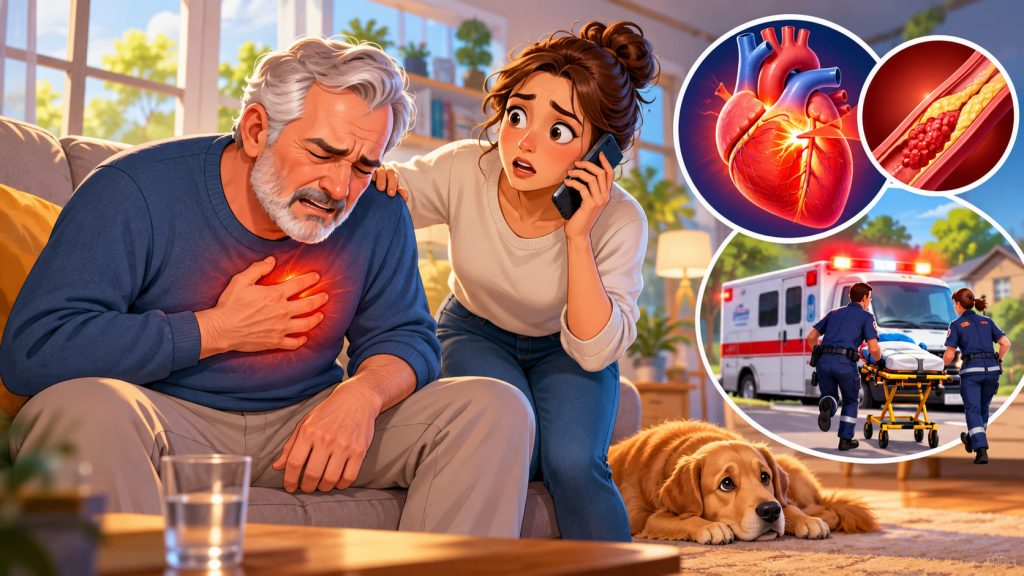
A heart attack can happen unexpectedly, at home, at work, or during an ordinary walk. Recognizing the warning signs and knowing what to do before emergency medical professionals arrive can make a life-saving difference.
Every minute matters because the heart muscle depends on a continuous supply of oxygen-rich blood.
When that supply becomes blocked, heart tissue begins to suffer damage.
Fortunately, several simple first-aid actions can improve a person’s chances of survival.
The most important rule is to call emergency medical services immediately. Never wait for symptoms to become unbearable or attempt to diagnose the problem yourself.
What Actually Happens During a Heart Attack?
A heart attack, medically known as a myocardial infarction, occurs when blood flow to part of the heart muscle becomes severely reduced or blocked.
The blockage often develops when a blood clot forms around a ruptured cholesterol-rich plaque inside a coronary artery.
Without enough oxygen, the affected heart muscle begins to suffer injury.
The longer the blockage remains untreated, the greater the potential damage.
Emergency hospital treatment focuses on restoring blood circulation as quickly as possible.
Recognizing the Warning Signs
Heart attacks do not always begin with dramatic chest pain.
Some develop gradually and produce symptoms that resemble indigestion or unusual fatigue.
Common warning signs include:
- Pressure, squeezing, heaviness, or discomfort in the chest.
- Pain spreading to one or both arms, the jaw, neck, back, or upper abdomen.
- Shortness of breath, sometimes without chest pain.
- Cold sweating, nausea, or vomiting.
- Dizziness, unusual weakness, or sudden lightheadedness.
Women, older adults, and people with diabetes may experience less typical symptoms.
Never assume a heart attack is harmless simply because the pain is mild or temporarily disappears.
First Step: Call an Ambulance Immediately
If a heart attack is suspected, activate emergency medical services without delay.
Emergency telephone numbers vary by country, including 112 throughout the European Union, 911 in the United States and Canada, and 999 in the United Kingdom.
Tell the dispatcher:
- The exact location.
- The person’s approximate age.
- The symptoms and when they started.
- Whether the person is conscious and breathing normally.
- Any known serious medical conditions.
Follow the dispatcher’s instructions and keep the telephone available.
An ambulance is preferable to private transportation because paramedics can begin emergency treatment during the journey.
Do not drive yourself to the hospital when experiencing possible heart attack symptoms.
Help the Person Rest Comfortably
Encourage the person to stop walking, exercising, or performing physical activities.
Help them sit in a comfortable supported position.
A seated position with the back supported and knees slightly bent is often suitable.
Loosen restrictive clothing around the neck or chest.
Remain nearby, provide reassurance, and observe their breathing and responsiveness.
Do not force someone experiencing dizziness or faintness to remain standing.
Avoid unnecessary movement because physical exertion increases the heart’s demand for oxygen.
Should You Give Aspirin?
Aspirin can reduce platelet aggregation, helping limit the formation and growth of certain blood clots.
Call emergency services first and follow the dispatcher’s advice about aspirin. If its safety is uncertain, wait for professional assistance rather than guessing.
What About Nitroglycerin?
Some people with diagnosed angina carry prescribed nitroglycerin tablets or spray.
This medication relaxes blood vessels and can help relieve certain types of heart-related chest discomfort.
If the person has their own prescribed medication, they may take it according to their doctor’s instructions, provided it is safe to do so.
Inform the emergency dispatcher about the medication and any recent doses.
Nitroglycerin can cause a dangerous drop in blood pressure, especially when combined with certain medications for erectile dysfunction or pulmonary hypertension.
Never give someone another person’s prescription medication.
Relief after nitroglycerin does not prove that a heart attack has been ruled out.
What If the Person Suddenly Collapses?
A heart attack can sometimes trigger cardiac arrest, a condition in which the heart stops pumping blood effectively.
Cardiac arrest and heart attack are not identical.
A person experiencing a heart attack may remain conscious and breathe normally.
During cardiac arrest, the person becomes unresponsive and stops breathing normally or only gasps.
If this happens, activate emergency services or confirm that someone has already called.
Immediately begin cardiopulmonary resuscitation (CPR).
For an adult:
- Place the person on their back on a firm, flat surface.
- Position your hands in the center of the chest.
- Push hard and fast, approximately 100–120 compressions per minute.
- Compress the chest about 5–6 centimeters, allowing it to recoil completely.
- Continue until emergency responders take over or the person begins showing signs of life.
Untrained rescuers can perform continuous hands-only CPR while following dispatcher instructions.
Why an AED Can Save a Life
An automated external defibrillator (AED) is a portable device designed to assess certain dangerous heart rhythms.
When appropriate, it delivers an electrical shock through a process called defibrillation.
AEDs are increasingly available in airports, shopping centers, workplaces, and public buildings.
If another person is present, ask them to retrieve the nearest AED while CPR continues.
Turn on the device and follow its spoken instructions.
An AED analyzes the rhythm and determines whether a shock is appropriate. It should be used as soon as available during suspected cardiac arrest.
Dangerous Mistakes to Avoid
Several common reactions can delay effective treatment.
Do not encourage the person to walk around or attempt to overcome the pain through physical activity.
Do not give alcohol, food, or unnecessary drinks.
Never attempt to make the person vomit or use unproven home remedies.
Do not leave someone with suspected heart attack symptoms alone unless necessary to obtain emergency assistance.
Most importantly, do not delay calling an ambulance while searching for medication.
Expert Perspective on Heart Attack First Aid
The American Heart Association and American Red Cross emphasize immediate emergency-service activation for adults experiencing acute chest pain.
Their first-aid recommendations also recognize carefully selected aspirin administration while waiting for professional assistance.
Their guidance distinguishes between an alert person with suspected heart attack symptoms and an unresponsive person requiring CPR.
Early recognition, rapid emergency response, and appropriate first aid are the priorities before hospital treatment begins.
What Happens When Paramedics Arrive?
Emergency medical professionals assess breathing, circulation, heart rhythm, blood pressure, and oxygen levels.
They may perform an electrocardiogram to identify signs of impaired blood flow.
At the hospital, doctors often measure troponin, a protein released into the bloodstream when heart muscle cells are injured.
Depending on the findings, treatment may include medications or an urgent procedure to reopen a blocked coronary artery.
Tell paramedics when symptoms began, what medications were taken, and whether CPR or an AED was used.
Accurate information can help the medical team make faster treatment decisions.
P.S. ATTENTION! Please take a training course or watch videos by first-aid professionals, and get some practice, before attempting to provide first aid.
Interesting Facts
- Heart attacks can occur during sleep or while resting.
- Chest discomfort may disappear and return during a developing heart attack.
- Women and older adults sometimes experience shortness of breath, nausea, or weakness without prominent chest pain.
- Aspirin works partly by reducing the ability of platelets to form clots.
- A heart attack can lead to cardiac arrest, but many heart attacks occur without cardiac arrest.
- Hands-only CPR can help maintain blood circulation until professional assistance arrives.
- AEDs are designed to guide ordinary bystanders through their use.
- Emergency treatment can restore blood flow and limit the amount of heart muscle permanently damaged.
Glossary
- Myocardial Infarction — The medical term for a heart attack caused by insufficient blood flow to heart muscle.
- Coronary Artery — A blood vessel supplying oxygen-rich blood to the heart muscle.
- Aspirin — A medication that reduces platelet aggregation and can help limit blood clot formation.
- Angina — Chest discomfort caused by inadequate oxygen delivery to the heart muscle.
- Nitroglycerin — A prescription medication that relaxes blood vessels and can relieve certain heart-related chest symptoms.
- Cardiac Arrest — A life-threatening condition in which the heart suddenly stops pumping blood effectively.
- Cardiopulmonary Resuscitation (CPR) — Emergency chest compressions, sometimes combined with rescue breaths, used to support circulation during cardiac arrest.
- Automated External Defibrillator (AED) — A portable device that analyzes heart rhythm and delivers a shock when appropriate.
- Defibrillation — Delivery of an electrical shock intended to interrupt certain dangerous abnormal heart rhythms.
- Troponin — A protein measured in blood tests to help identify injury to heart muscle.