Humanity has developed extraordinary technologies, explored distant planets, decoded the human genome, and created artificial intelligence capable of solving complex problems.
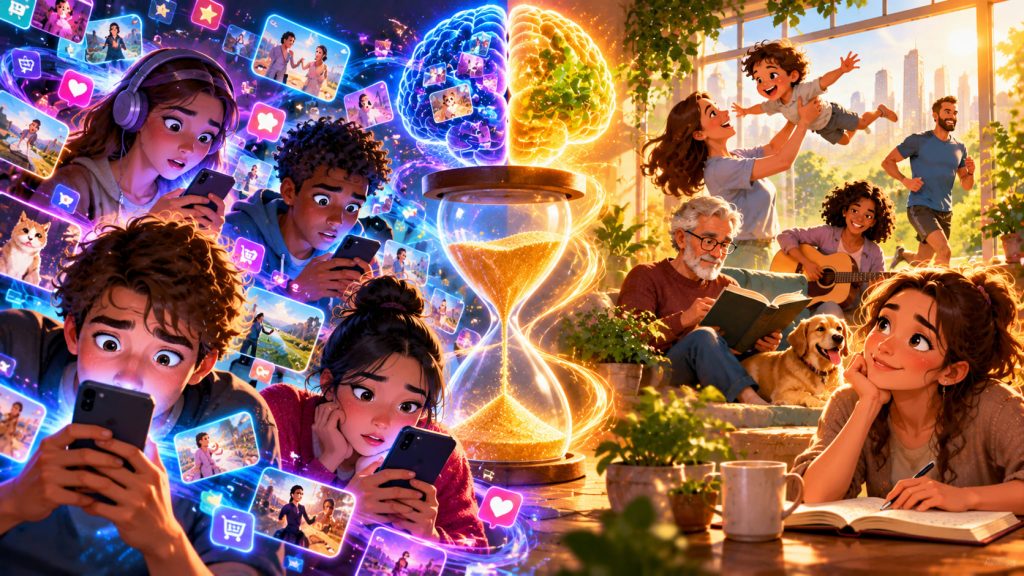
Yet millions of people begin their mornings by scrolling through strangers’ photographs, watching short videos, checking notifications, or reading arguments that have almost no influence on their lives.
Modern civilization has access to more information than any previous generation. But access to knowledge does not automatically mean that people spend their attention wisely.
Research on digital behavior, entertainment, and everyday activities reveals an uncomfortable reality.
Enormous amounts of human attention are devoted to passive entertainment, repetitive digital habits, and information that is quickly forgotten.
The most surprising question is not how much information humanity consumes, but how little of that consumption translates into meaningful action.
Where Does Human Attention Actually Go?
There is no single global measurement showing exactly how humanity distributes every hour of conscious attention.
People spend substantial time working, sleeping, eating, commuting, caring for relatives, and performing necessary activities.
However, surveys reveal striking patterns in how discretionary time is used.
The 2025 American Time Use Survey found that people aged 15 and older spent approximately 5.2 hours daily on leisure and sports activities.
Watching television accounted for approximately 2.6 hours.
Reading for personal interest occupied only about 16 minutes per day.
In this population, television received almost ten times as much daily attention as recreational reading.
This does not mean television is inherently worthless. It demonstrates how strongly passive audiovisual entertainment dominates available leisure time.
Social Media: Billions of People Competing for Attention
Digital technology has transformed human attention into an economic resource.
This system is often called the attention economy.
Social platforms, video services, advertisers, and online publishers compete for the minutes people spend looking at their screens.
The Digital 2026 Global Overview Report estimated approximately 5.66 billion active social media user identities in October 2025, although these figures are not identical to a count of unique individuals.
Research covering adult internet users found an average of approximately 18 hours and 36 minutes per week spent consuming social networks and online video feeds.
That represents more than two and a half hours every day.
A substantial portion of modern leisure is now spent watching content selected by automated systems.
Why Endless Scrolling Is So Difficult to Stop
Most major social platforms use an algorithmic feed.
Instead of displaying information in a simple chronological order, the system selects content according to predicted user interests and behavior.
Every interaction provides additional information.
Watching a video, opening a photograph, commenting, or pausing on a post can influence future recommendations.
These systems often benefit from variable rewards, where interesting or emotionally satisfying content appears unpredictably.
A dull post may be followed by something funny, surprising, or highly engaging.
This unpredictability encourages users to continue scrolling.
The result can be a sequence of small entertainment experiences without a clear stopping point.
The 47-Second Attention Problem
Research by University of California, Irvine professor Gloria Mark has revealed significant changes in digital attention patterns.
Her studies found that people in observed computer-based environments switched their attention from one screen or task after approximately two and a half minutes in 2004.
Later measurements showed averages of approximately 75 seconds, followed by about 47 seconds in more recent observations.
These findings describe particular digital working environments, not the complete attention span of every human being.
However, they illustrate how frequently modern screen users change focus.
This behavior is called task switching.
Switching between activities requires the brain to reorient itself, potentially increasing mental effort and disrupting complex work.
The problem is not simply looking at screens, but repeatedly abandoning one activity before completing it.
We Spend Hours Watching Other People’s Lives
Social media has created an enormous market for observing the everyday activities of strangers.
People follow celebrities, influencers, athletes, and internet personalities.
They watch shopping trips, vacations, personal arguments, expensive purchases, and ordinary daily routines.
Some content provides inspiration, entertainment, or useful knowledge.
Other content offers little beyond temporary curiosity.
An important psychological mechanism is social comparison.
People naturally evaluate themselves relative to others.
Constant exposure to carefully selected images of success, beauty, wealth, and happiness can influence satisfaction with one’s own life.
The irony is striking: someone may spend hours observing another person’s experiences while postponing activities that would improve their own.
News, Outrage, and Endless Arguments
Another powerful attraction is emotionally charged news.
Conflict, controversy, scandals, and alarming headlines can capture attention quickly.
The habit of repeatedly consuming negative news is commonly described as doomscrolling.
People may feel that constantly following disturbing events helps them remain informed and prepared.
Yet consuming additional updates does not always provide additional understanding.
When information cannot be converted into useful decisions or action, repeated exposure may increase stress without improving the situation.
Being informed and being continuously emotionally engaged with every controversy are not the same thing.
The Extraordinary Business of Digital Distraction
Human attention has enormous commercial value.
The Digital 2026 Global Overview Report projected worldwide social media advertising expenditure of approximately $277 billion for 2025.
This creates powerful financial incentives to attract audiences and sustain engagement.
The longer users remain on a platform, the more opportunities companies have to display advertising or encourage purchases.
Notifications, recommendations, and personalized content are not necessarily harmful.
However, their commercial purpose often differs from the user’s personal goals.
A platform may benefit from another twenty minutes of engagement even when the user gains little from those minutes.
What We Sacrifice Without Noticing
Every activity has an opportunity cost.
An hour spent doing one thing cannot be used simultaneously for another activity requiring full attention.
Consider the alternatives to an hour of unnecessary scrolling:
- Exercising or walking outdoors.
- Learning a useful skill.
- Reading a substantial chapter of a book.
- Spending uninterrupted time with family.
- Working on a creative project.
- Preparing healthier meals.
- Getting additional sleep.
The value of leisure should not be measured exclusively through productivity.
Rest, humor, entertainment, and enjoyable experiences are essential parts of life.
The real problem emerges when automatic habits repeatedly displace activities that people themselves consider more important.
Expert Perspective: Why Attention Deserves Protection
Gloria Mark, a professor of informatics at the University of California, Irvine, has spent decades studying digital attention, interruptions, and workplace behavior.
Her research emphasizes that attention is influenced by both external interruptions and the habits people develop while using technology.
She also highlights the importance of maintaining a balance between demanding mental work and restorative activities.
This suggests that protecting attention does not require eliminating entertainment.
It requires creating conditions in which people can concentrate intentionally and recover without constant disruption.
How to Take Back Control of Everyday Attention
One practical approach involves improving digital well-being, the relationship between technology use and personal health, satisfaction, and daily functioning.
Small changes can create meaningful improvements.
Disabling nonessential notifications reduces interruptions.
Keeping phones away during meals supports uninterrupted conversations.
Scheduling focused periods for important work can make complex tasks easier to complete.
Reviewing weekly screen-time reports helps reveal habits that might otherwise remain unnoticed.
Another useful strategy is intentional consumption.
Before opening an application, decide whether the purpose is learning, communication, entertainment, or completing a specific task.
Technology becomes more valuable when people choose what deserves their attention instead of allowing automatic recommendations to make every decision.
Interesting Facts
- In 2025, Americans aged 15 and older spent approximately 2.6 hours daily watching television, compared with 16 minutes reading for personal interest.
- Research on adult internet users found average social-network and online-video consumption exceeding 18 hours per week.
- Observational research on computer work found average attention shifts occurring after approximately 47 seconds.
- The typical WhatsApp Android user opened the application more than 20 times daily in August 2025, according to app-usage estimates.
- Worldwide social media advertising expenditure was projected to reach approximately $277 billion in 2025.
- Nearly 40% of adult social media users surveyed globally identified filling spare time as a major reason for using social platforms.
- Digital interruptions can occur even when no notification arrives, because users sometimes switch activities voluntarily.
- Watching educational content and actively practicing a skill are different forms of engagement with potentially different learning outcomes.
Glossary
- Attention Economy — An economic system in which businesses compete to attract and monetize people’s attention.
- Algorithmic Feed — A stream of digital content selected and arranged by software according to predicted user interests.
- Variable Rewards — Unpredictable positive outcomes that can encourage repeated behavior.
- Task Switching — Shifting attention between different activities, goals, or sources of information.
- Social Comparison — The psychological process of evaluating oneself relative to other people.
- Doomscrolling — Repeatedly consuming negative or distressing news, often through digital feeds.
- Opportunity Cost — The value of an alternative activity or opportunity sacrificed when choosing another.
- Digital Well-Being — The extent to which technology use supports a person’s health, satisfaction, and daily functioning.
- Intentional Consumption — Deliberately choosing information or entertainment according to a specific purpose rather than consuming it automatically.