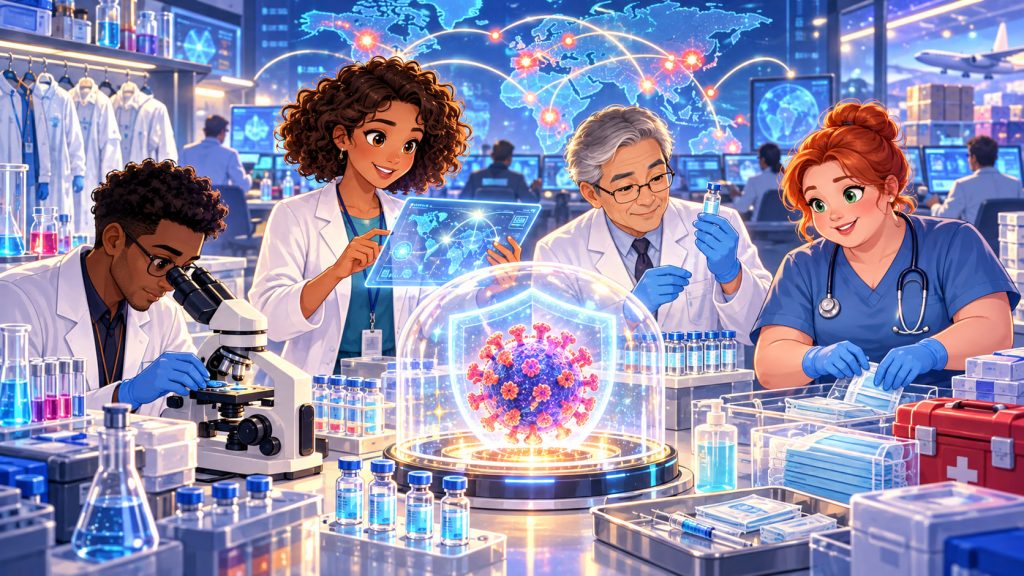
The next global pandemic is not a question of science fiction. Infectious diseases have shaped human history for centuries, and modern civilization remains vulnerable to new biological threats.
The COVID-19 pandemic demonstrated something remarkable: humanity can develop powerful medical technologies in record time, yet still struggle to coordinate an effective global response.
Today, scientists can identify dangerous viruses, sequence their genomes, and develop vaccines faster than ever before. Hospitals have improved emergency planning, and international disease-monitoring systems are more sophisticated.
But important weaknesses remain.
Humanity is better equipped to fight a pandemic than previous generations, but technological progress alone cannot guarantee protection against the next global outbreak.
What Does Pandemic Preparedness Actually Mean?
A pandemic occurs when an infectious disease spreads across multiple countries or continents, affecting large populations.
Unlike a localized outbreak, a pandemic requires coordinated responses across healthcare systems, governments, transportation networks, and international institutions.
Pandemic preparedness involves developing the capacity to detect, contain, and manage infectious threats before they cause widespread damage.
An effective preparedness system requires several essential elements:
- Early identification of emerging pathogens
- Reliable disease surveillance
- Rapid diagnostic testing
- Vaccine and treatment development
- Well-equipped hospitals
- Transparent public communication
- International scientific cooperation
The most effective pandemic response begins before the first major wave of infections.
Waiting until hospitals become overwhelmed dramatically reduces the available options.
What COVID-19 Revealed About Global Readiness
The COVID-19 pandemic became the most significant global public-health emergency in generations.
Its impact extended far beyond infections and deaths.
Healthcare systems faced extraordinary pressure, international travel was disrupted, businesses closed, and education systems moved millions of students into remote learning.
The World Health Organization estimated approximately 14.9 million excess deaths associated directly or indirectly with the pandemic during 2020 and 2021.
This figure illustrates how severely a pandemic can affect society, including people who never become infected.
However, COVID-19 also revealed impressive scientific capabilities.
Researchers rapidly identified the responsible coronavirus and shared its genetic sequence in January 2020.
By December of that year, the first COVID-19 vaccines were being administered outside clinical trials in several countries.
The pandemic exposed a striking contrast between scientific innovation and the practical challenges of delivering effective protection worldwide.
How Early-Warning Systems Have Improved
Modern pandemic detection depends increasingly on advanced monitoring technologies.
One important method is genomic surveillance, which involves analyzing the genetic material of infectious organisms.
Scientists use it to identify new variants, trace transmission patterns, and investigate emerging disease threats.
Another increasingly valuable technique is wastewater surveillance.
By analyzing sewage samples, researchers can detect genetic fragments of viruses circulating within communities.
This approach can reveal infection trends even when many infected individuals never visit a doctor or undergo testing.
Digital disease-reporting systems also make it possible to share information between laboratories and health authorities more quickly.
Nevertheless, surveillance remains uneven.
Countries with limited laboratory infrastructure may struggle to recognize unusual outbreaks before infections spread internationally.
Can Scientists Develop Vaccines Fast Enough?
Vaccine technology represents one of the greatest improvements in pandemic preparedness.
Traditional vaccine development often requires many years of research, testing, manufacturing, and regulatory review.
COVID-19 demonstrated that this process can be accelerated dramatically when scientific knowledge, financial resources, and international collaboration are available.
The development of mRNA vaccines was particularly important.
These vaccines deliver genetic instructions that allow cells to produce a harmless target protein, stimulating an immune response.
Researchers can redesign an mRNA vaccine candidate relatively quickly after identifying a new pathogen’s genetic sequence.
However, producing a vaccine is only part of the challenge.
Manufacturing capacity, distribution networks, refrigeration requirements, public confidence, and access to healthcare all influence vaccination success.
Some future pathogens may also prove substantially harder to target than SARS-CoV-2.
Rapid vaccine development is a major advantage, but it does not eliminate the possibility of a devastating pandemic.
The Biggest Weakness: Healthcare System Capacity
Even technologically advanced countries can struggle when large numbers of patients require treatment simultaneously.
During COVID-19, shortages of hospital beds, protective equipment, medical oxygen, and trained personnel complicated healthcare delivery.
A critical concept is surge capacity.
This describes a healthcare system’s ability to expand services temporarily during emergencies.
It includes additional treatment spaces, reserve supplies, flexible staffing arrangements, and coordinated patient transfers.
Simply building more hospitals is not enough.
Healthcare systems must also maintain trained workforces, reliable supply chains, and emergency operating procedures.
Hospitals become particularly vulnerable when healthcare workers themselves are infected, exhausted, or unavailable.
Why Pandemics Often Begin With Animals
Many emerging infectious diseases originate in animals before spreading to humans.
This process is known as zoonotic spillover.
The risk is influenced by interactions among wildlife, livestock, humans, and their environments.
Factors such as habitat destruction, agricultural expansion, wildlife trade, and changing land use can create new opportunities for contact between species.
Influenza viruses provide an important example.
Birds and mammals can carry influenza viruses capable of evolving and occasionally infecting humans.
A dangerous pandemic could emerge if a virus acquires the ability to spread efficiently between people who have little existing immunity.
The One Health approach recognizes that human health, animal health, and environmental conditions are closely interconnected.
Monitoring animal diseases is therefore an important component of protecting human populations.
Why International Cooperation Is Essential
Infectious diseases do not recognize national borders.
Modern aviation, international commerce, migration, and global supply chains can help pathogens reach distant populations rapidly.
Countries need dependable systems for sharing outbreak information, scientific findings, and medical resources.
An established public-health strategy is contact tracing, which involves identifying and notifying people who may have been exposed to an infected individual.
When combined with timely testing and other precautions, it can help interrupt transmission, particularly during the early stages of an outbreak.
However, successful containment becomes harder when infections spread widely or when transmission occurs before symptoms appear.
Another challenge is health equity.
Countries and communities do not have equal access to vaccines, diagnostics, medical treatment, or essential healthcare services.
Unequal protection can prolong outbreaks and increase preventable suffering.
Expert Perspective: Preparedness Requires Global Solidarity
World Health Organization Director-General Tedros Adhanom Ghebreyesus has repeatedly emphasized the importance of international cooperation, stronger health systems, and equitable access to medical countermeasures.
His public-health perspective reflects a fundamental lesson of COVID-19: national preparedness and global preparedness are deeply connected.
A country may have excellent hospitals and advanced laboratories, yet remain vulnerable if dangerous outbreaks elsewhere go undetected or uncontrolled.
Effective pandemic security requires coordinated international action rather than isolated national responses.
Long-term investment is equally important.
Preparedness systems cannot operate effectively if funding, trained personnel, and political attention disappear between major outbreaks.
Could the Next Pandemic Be Worse Than COVID-19?
The next pandemic could involve an influenza virus, a new coronavirus, or another infectious agent.
Its consequences would depend on several biological characteristics.
These include transmission efficiency, disease severity, existing population immunity, and the availability of effective medical interventions.
A highly transmissible pathogen causing relatively mild illness can generate enormous healthcare demand.
A less transmissible pathogen with a high fatality rate could create a different but equally serious emergency.
Another concern is antimicrobial resistance, which occurs when microorganisms evolve mechanisms that reduce the effectiveness of medicines used against them.
Drug-resistant bacterial infections can complicate medical treatment and increase the burden on healthcare systems.
Although antimicrobial resistance is not itself a single viral pandemic, it represents a major global infectious-disease threat.
What Humanity Must Improve Before the Next Outbreak
The greatest opportunity lies in connecting scientific progress with practical public-health capabilities.
Future preparedness requires stronger laboratory networks, dependable medical supplies, resilient hospitals, and rapid international information exchange.
Public communication also matters.
Confusing messages and declining trust can undermine even scientifically sound health measures.
Governments must communicate uncertainty clearly while making reliable recommendations accessible to different communities.
Investment in ventilation, workforce protection, research platforms, and emergency planning can provide benefits beyond pandemics.
The most resilient societies will be those that treat pandemic preparedness as a permanent responsibility, not a temporary emergency project.
Interesting Facts
- The 1918 influenza pandemic is estimated to have caused tens of millions of deaths worldwide.
- The genetic sequence of SARS-CoV-2 was shared internationally in January 2020, helping scientists begin developing diagnostic tests and vaccines.
- The first COVID-19 vaccines became available in several countries less than one year after the virus was genetically identified.
- Wastewater analysis can help detect community infection trends without testing every individual.
- Influenza viruses can infect multiple animal species, creating opportunities for genetic changes and the emergence of new strains.
- Some infectious diseases spread before obvious symptoms develop, making early containment more difficult.
- Pandemic preparedness investments can strengthen routine healthcare services, laboratory diagnostics, and emergency response capabilities.
Glossary
- Pandemic Preparedness — The planning, resources, and systems required to prevent, detect, and respond effectively to widespread infectious-disease outbreaks.
- Genomic Surveillance — Monitoring the genetic characteristics of pathogens to identify variants and understand disease transmission.
- Wastewater Surveillance — Testing sewage for biological indicators of infectious diseases circulating within communities.
- mRNA Vaccines — Vaccines that use messenger RNA instructions to stimulate an immune response against a targeted pathogen.
- Surge Capacity — The ability of a healthcare system to expand its services during periods of unusually high demand.
- Zoonotic Spillover — The transmission of a pathogen from an animal host to a human.
- One Health — An integrated approach recognizing the connections between human, animal, and environmental health.
- Contact Tracing — The process of identifying and notifying people who may have been exposed to an infectious individual.
- Health Equity — The principle that everyone should have a fair opportunity to achieve good health and access necessary healthcare.
- Antimicrobial Resistance — The ability of microorganisms to survive or multiply despite medicines previously effective against them.