The human body is one of the most complex biological systems known to science.
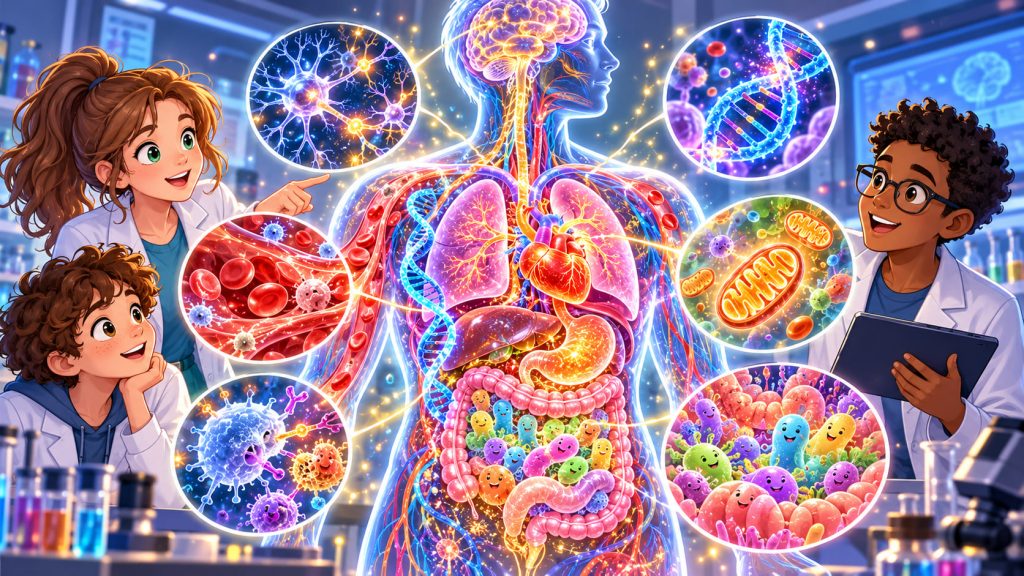
From the outside, we see skin, hair, muscles, and facial features. But beneath this familiar appearance exists an extraordinary microscopic universe filled with trillions of cells, countless molecules, electrical signals, and chemical reactions.
Every second, enormous numbers of microscopic processes keep us alive.
Cells communicate, proteins perform specialized tasks, immune defenses identify threats, and genetic instructions regulate biological activity.
Most of these processes happen automatically, without conscious awareness.
The remarkable truth is that every human being is an incredibly sophisticated living system, organized across multiple biological scales.
Understanding this hidden world reveals just how extraordinary the human body really is.
How Many Cells Are Inside the Human Body?
Scientists estimate that an average adult human contains approximately 30 trillion human cells.
These cells are not identical.
The human body contains hundreds of specialized cell types, each adapted to perform particular functions.
For example:
- Red blood cells transport oxygen.
- Neurons transmit information.
- Muscle cells generate movement.
- Immune cells defend against pathogens.
- Skin cells create protective barriers.
- Intestinal cells absorb nutrients.
Despite their differences, most cells contain essentially the same genetic information.
What makes them different is how that information is used.
A nerve cell and a muscle cell can contain the same DNA while developing completely different structures and functions.
This specialization allows the body to operate as a coordinated biological system.
The Incredible Machinery Inside a Single Cell
A typical human cell measures only a few tens of micrometers across.
Yet its interior contains an astonishing amount of organized machinery.
The cell membrane surrounds the cell and helps regulate the movement of substances into and out of it.
Inside, specialized structures called organelles perform different biological tasks.
The nucleus stores most of the cell’s DNA.
Ribosomes manufacture proteins.
The endoplasmic reticulum helps produce and process proteins and lipids.
The Golgi apparatus modifies and sorts materials for transport.
Meanwhile, mitochondria generate much of the energy required for cellular activities.
Even a single living cell is more complex than many machines built by humans.
Its components constantly interact to maintain an internal environment suitable for life.
DNA: The Biological Instructions for Building a Human
Almost every nucleated cell contains an extraordinary molecular information system.
This information is stored in DNA.
The complete genetic information of an organism is called its genome.
A single set of human chromosomes contains approximately three billion DNA base pairs.
Most human body cells contain two sets of chromosomes, one inherited from each biological parent.
If the DNA inside one typical nucleated human cell were stretched into a straight line, it would measure roughly two meters.
Yet this molecule fits inside a nucleus only a few micrometers wide.
It achieves this through sophisticated molecular packaging.
DNA contains instructions for producing proteins and regulating cellular activities.
However, DNA does not operate like a simple instruction manual.
Cells continuously control which genes are active through a process called gene expression.
This allows different cells to perform specialized functions while sharing the same underlying genetic information.
Proteins: The Molecular Workers of the Body
Proteins are among the most important molecules in human biology.
They build structures, transport substances, accelerate chemical reactions, and participate in communication between cells.
Some proteins function as molecular motors.
Others act as receptors, recognizing specific chemical signals.
Many proteins are enzymes that accelerate reactions necessary for metabolism.
For example, digestive enzymes break food molecules into smaller components that the body can absorb.
Hemoglobin transports oxygen through the bloodstream.
Collagen provides structural support to skin, tendons, and other tissues.
The human body depends on the precise cooperation of thousands of different proteins.
Their three-dimensional shapes are essential to their functions.
Even small changes in protein structure can influence cellular activity.
The Brain: A Network of Billions of Neurons
The human brain contains approximately 86 billion neurons.
These specialized cells communicate using electrical and chemical signals.
Communication between neurons occurs at specialized connections called synapses.
A single neuron can form connections with thousands of other neurons.
Together, these connections create immense networks responsible for movement, memory, emotions, learning, and perception.
When a person recognizes a familiar face, remembers a childhood event, or solves a mathematical problem, large populations of neurons coordinate their activity.
Brain cells also interact with glial cells, which provide structural, metabolic, and immune support.
Human thought emerges from the coordinated activity of vast biological networks rather than a single controlling cell.
The Immune System: Microscopic Defenders Everywhere
The human immune system operates continuously throughout the body.
Its cells patrol tissues, monitor biological signals, and respond to infections or damaged cells.
One important process is immune surveillance.
During this activity, immune cells recognize and respond to potentially dangerous changes.
Different immune cells perform specialized roles.
Macrophages engulf microorganisms and cellular debris.
T cells coordinate immune responses or destroy certain infected cells.
B cells can produce antibodies that recognize specific molecular targets.
These defenses must also distinguish harmful threats from the body’s own healthy tissues.
This balance is essential because excessive immune activity can damage normal organs.
The Human Microbiome: An Entire Ecosystem Within Us
Human biology does not involve human cells alone.
Our bodies also support enormous communities of microorganisms.
These communities, together with their genetic material and surrounding environment, are commonly described as the microbiome.
Microorganisms inhabit the intestines, skin, mouth, and other body regions.
The digestive tract contains particularly large microbial populations.
Many intestinal bacteria help break down dietary compounds that human enzymes cannot digest completely.
Some produce substances that influence intestinal health and metabolism.
Others interact with immune cells and help maintain normal biological functions.
Current estimates suggest that bacterial cells in the body are roughly comparable in number to human cells, although the ratio varies between individuals.
A human being is not simply an isolated organism but also a habitat for an extensive microscopic ecosystem.
How the Body Maintains Internal Balance
The body’s cells must operate within relatively narrow biological conditions.
Temperature, blood acidity, glucose concentration, and fluid balance all require regulation.
The process of maintaining stable internal conditions is called homeostasis.
For example, when body temperature rises, sweating helps release heat.
When blood glucose increases after eating, insulin helps regulate its concentration.
When oxygen availability changes, the respiratory and cardiovascular systems adjust their activity.
These responses depend on communication among cells, tissues, and organs.
Hormones, nerves, and local chemical signals help coordinate the adjustments.
Without this regulation, even healthy individual cells would struggle to function properly.
Expert Perspective: The Cell as a Molecular Machine
Cell biologist Bruce Alberts, a leading researcher and former president of the United States National Academy of Sciences, has emphasized the importance of understanding cells as collections of interacting molecular machines.
His scientific work and educational contributions have helped explain why proteins should be studied as components of coordinated biological systems.
This perspective highlights an essential feature of human complexity.
A protein may perform a relatively simple molecular task, but thousands of interacting proteins can produce highly sophisticated biological behavior.
The extraordinary capabilities of living organisms emerge from the organization and cooperation of their microscopic components.
Why Microscopic Complexity Matters for Human Health
Many diseases begin with changes that are invisible to the naked eye.
A mutation can alter a protein.
A malfunctioning cellular signaling pathway can disrupt tissue growth.
An infection can interfere with normal cellular activity.
Cancer, for example, develops when cells acquire changes that allow them to escape normal controls over growth and division.
Modern medicine increasingly investigates diseases at molecular and cellular levels.
Genetic testing, targeted cancer treatments, advanced imaging, and molecular diagnostics all depend on understanding this microscopic world.
The deeper scientists explore human biology, the more clearly they see that health depends on the coordinated functioning of an immense number of interconnected processes.
Interesting Facts
- The human body contains approximately 30 trillion human cells, although the number varies with body size and individual characteristics.
- Red blood cells account for the majority of human cells by number, but they lack a nucleus when mature.
- DNA from a single typical nucleated human cell would stretch approximately two meters if fully extended.
- The human brain contains around 86 billion neurons connected through extraordinarily complex networks.
- Mitochondria evolved from ancient bacteria that entered into a long-term relationship with ancestral complex cells.
- The intestinal microbiome contains microbial communities capable of performing chemical reactions that human cells cannot carry out independently.
- The body produces millions of new red blood cells every second to replace aging cells.
- A single cell can contain millions to billions of protein molecules, depending on its type and size.
- Many essential cellular processes involve proteins moving, changing shape, and interacting on extremely small spatial scales.
Glossary
- Cell Membrane — A thin, selectively permeable structure surrounding a cell and regulating its interaction with the environment.
- Organelles — Specialized structures within cells that perform essential biological functions.
- Mitochondria — Cellular structures responsible for producing much of the energy used in cellular activities.
- Genome — The complete set of genetic information contained in an organism.
- Gene Expression — The process through which genetic information is used to produce functional molecules, including proteins.
- Synapses — Specialized connections through which neurons communicate with other cells.
- Immune Surveillance — The process by which immune cells monitor tissues for infections, abnormal cells, and other potential threats.
- Microbiome — The community of microorganisms, their genetic material, and their surrounding environment within a particular habitat.
- Homeostasis — The biological regulation of internal conditions to maintain a stable environment suitable for life.