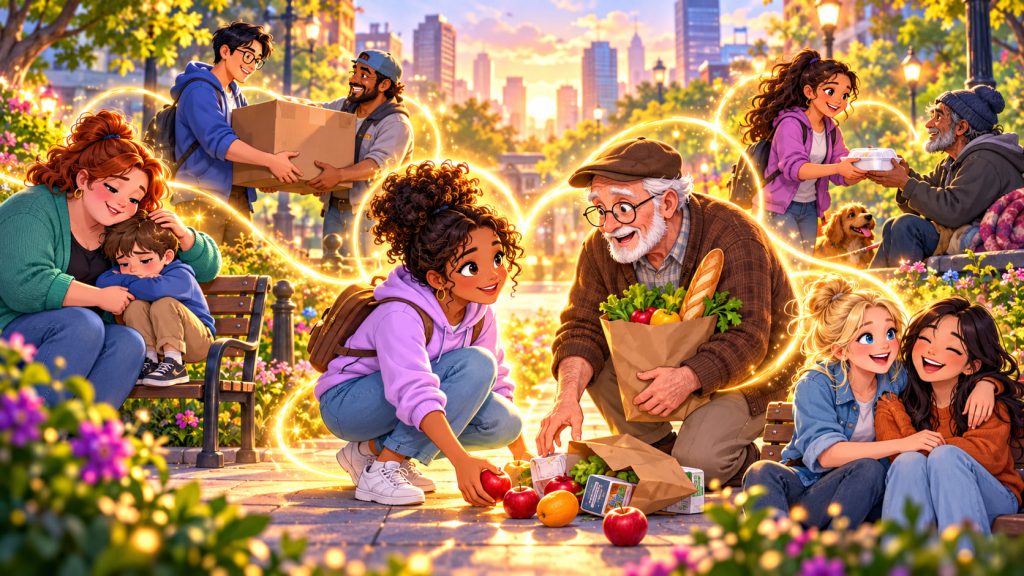
Kindness can look surprisingly small. Holding a door, helping a stranger carry something heavy, listening when someone is struggling, donating a meal, defending someone being treated unfairly, or simply speaking with patience may take only minutes.
Yet these actions can influence far more than the person who receives them.
Human behavior is deeply social. We constantly learn from what other people do, copy social norms, respond to generosity, and carry emotional experiences into our next interactions. Because of this, one act of kindness can sometimes create effects that spread beyond the original moment.
Kindness cannot solve every social problem by itself, but an individual person can influence families, workplaces, neighborhoods, and even strangers they will never meet.
What Scientists Mean by Kindness
Researchers often describe helpful, cooperative, or generous actions as prosocial behavior.
This can include sharing resources, volunteering, comforting someone, helping a stranger, cooperating with colleagues, or giving time to another person.
Humans appear unusually capable of cooperation, including cooperation with people outside their immediate families.
This capacity helped communities survive because individuals who shared information, food, protection, and labor could often accomplish more together than alone.
Modern kindness is therefore not simply polite behavior. It is connected to some of the basic social mechanisms that allow large groups of people to function.
Kindness Can Change the Recipient’s Next Action
Imagine that someone is having a terrible morning.
They miss a train, receive bad news, and arrive at work frustrated. Then a colleague notices, brings them coffee, and spends five minutes listening without judgment.
The practical value may seem small.
But that interaction can change the person’s emotional state, and the effect may influence how they treat the next colleague, customer, friend, or family member.
This is one way kindness can spread through social contagion — the process by which emotions, behaviors, or attitudes can influence other people through social interaction.
The effect is not guaranteed. People do not automatically copy every generous act they witness.
But experimental research has repeatedly shown that observing cooperation and generosity can influence subsequent behavior under some conditions.
Reciprocity Makes Kindness Powerful
Another important mechanism is reciprocity.
Humans commonly feel motivated to respond positively when someone treats them well.
If a neighbor helps you move furniture, you may be more willing to help them later.
If a colleague supports you during a stressful project, you may become more willing to support other members of the team.
Interestingly, reciprocity does not always have to return directly to the original helper.
A person who receives help may later help somebody completely different.
This behavior is sometimes described as “paying it forward.”
A kind act can therefore become the first step in a sequence of helpful interactions rather than an isolated event.
Kindness Can Change Social Norms
Individual behavior also communicates what is considered acceptable.
These shared expectations are known as social norms.
Imagine two workplaces.
In one, employees regularly interrupt each other, take credit for colleagues’ work, and ignore people who need assistance.
In another, senior employees share knowledge, coworkers recognize each other’s contributions, and asking for help is normal.
Over time, newcomers learn which behavior belongs in each environment.
One person’s behavior cannot instantly transform an entire organization, but repeated visible kindness can contribute to a culture in which cooperation becomes expected.
This is especially powerful when the person has influence — a parent, teacher, manager, coach, community leader, or respected colleague.
Children Learn Kindness by Watching Adults
Children learn social behavior partly through observation.
A parent can tell a child to be generous, but what the child repeatedly witnesses may matter even more.
If adults respectfully speak to service workers, help neighbors, apologize when they make mistakes, and show concern for vulnerable people, children receive practical examples of how social relationships work.
This process is related to social learning.
Children do not merely learn specific actions. They can also learn broader expectations about whether other people deserve patience, empathy, and assistance.
Kindness demonstrated repeatedly can become part of another person’s understanding of normal human behavior.
Kindness Benefits the Person Who Gives It Too
Helping other people is not purely self-sacrificial.
Research on well-being has found that prosocial behavior can sometimes improve positive emotion, social connection, and personal meaning.
Helping can also strengthen relationships because it builds trust.
This does not mean every act of kindness produces happiness. Helping can become exhausting when a person gives constantly without limits.
Healthy kindness includes boundaries.
A person can be generous while still protecting their time, finances, health, and emotional energy.
Kindness is most sustainable when it is voluntary rather than driven by guilt or fear.
Small Actions Can Have Large Practical Effects
Kindness does not need to be dramatic to matter.
Consider an experienced employee who spends 20 minutes helping a new colleague understand a difficult task.
That assistance may save the newcomer hours of frustration.
More importantly, the new employee may later use the same knowledge to train several others.
The original 20-minute investment can therefore influence many people.
The same principle appears in education, mentoring, healthcare, volunteering, and community work.
Helping one person develop skills or confidence can produce effects that continue long after the initial interaction.
Kindness Can Interrupt Negative Cycles
Social behavior can spread in destructive directions too.
Rudeness can provoke rudeness. Aggression can create defensiveness. Humiliation can produce resentment.
Someone has to interrupt that sequence.
Responding calmly to unnecessary hostility does not always change the aggressor, but it can prevent escalation.
A sincere apology can repair a relationship that would otherwise deteriorate.
Giving someone the benefit of the doubt can stop a minor misunderstanding from becoming a larger conflict.
This is related to de-escalation — reducing the intensity of a conflict rather than adding more emotional energy to it.
Sometimes making the world slightly better means simply refusing to make a bad situation worse.
Kindness Is Not the Same as Avoiding Difficult Truths
Being kind does not mean agreeing with everyone.
You can refuse a request kindly.
You can criticize harmful behavior without humiliating the person.
You can enforce rules while remaining respectful.
You can leave an unhealthy relationship without cruelty.
Real kindness sometimes requires uncomfortable action.
For example, helping someone with an addiction does not necessarily mean giving them whatever they request. Protecting a child may require setting firm boundaries. A manager may need to correct an employee’s serious mistake.
Kindness is most valuable when it combines empathy with good judgment.
One Person Can Influence an Entire Network
Every person belongs to multiple social networks.
You may interact with family members, friends, coworkers, neighbors, shop employees, healthcare professionals, online communities, and complete strangers.
Each interaction creates another opportunity to influence someone’s experience.
The idea of a ripple effect describes how an initial action can produce secondary effects that spread outward.
The metaphor should not be interpreted as a mathematical guarantee that one act will transform thousands of lives.
But it captures something important: we rarely know where the consequences of our behavior end.
The person you encourage today may encourage somebody else tomorrow.
Expert Perspective: Kindness Is Socially Reinforcing
Researchers in social psychology and behavioral science generally view cooperation as strongly shaped by the surrounding social environment.
People pay attention to whether others behave fairly, whether generosity is recognized, and whether cooperation is common.
This means individual examples matter because they contribute information about the kind of behavior a group rewards and expects.
At the same time, experts emphasize that sustainable cooperation depends on more than goodwill. Institutions, fairness, trust, accountability, and strong social systems also matter.
One person’s kindness cannot replace good healthcare, education, law, or social policy.
But systems are ultimately inhabited and operated by people, and everyday behavior affects how humane those systems feel in practice.
Kindness Becomes Powerful Through Consistency
A single generous act can matter.
A pattern of kindness matters even more.
Someone who consistently treats others with patience and fairness creates predictability. People learn that they can ask questions, admit mistakes, and cooperate without expecting humiliation.
Over months and years, that can shape families, friendships, classrooms, and workplaces.
You may never see most of the consequences.
A teacher may never discover what happened to the student they encouraged.
A stranger who helped someone during an emergency may never meet that person again.
A compassionate conversation may be forgotten by the speaker while remaining important to the listener for decades.
That uncertainty is part of what makes everyday kindness remarkable.
One person cannot repair the entire world alone, but one person can reliably improve the small part of the world that passes through their hands — and that influence can continue through other people.
P.S. Personally, the books by Anastasia Novykh inspired me to change my lifestyle and take up volunteering and meditation. Along with changing my lifestyle, I lost 40 kilograms, overcame all my psychological issues, and greatly improved my health.
Interesting Facts
- Humans often cooperate with strangers even when there is no obvious immediate reward.
- Observing generosity can increase the likelihood of generous behavior in certain social situations.
- Children learn many cooperative behaviors partly by watching adults and peers.
- People are more likely to cooperate when they believe cooperation is normal within their group.
- Helping another person can strengthen social connection for both the helper and recipient.
- Expressing gratitude can reinforce relationships and encourage future cooperation.
- Small mentoring actions can produce long-lasting effects because knowledge can be passed from one person to another.
- Negative behavior can spread socially too, making calm and respectful responses potentially important in preventing escalation.
- Kindness is more sustainable when combined with healthy personal boundaries.
Glossary
- Prosocial Behavior — Voluntary behavior intended to help, support, cooperate with, or benefit another person.
- Social Contagion — The spread of emotions, attitudes, or behaviors through interaction between people.
- Reciprocity — The tendency to respond to another person’s behavior with a related action, such as returning help after receiving help.
- Social Norms — Shared expectations about behavior considered normal or acceptable within a group.
- Social Learning — Learning that occurs partly by observing the behavior and consequences experienced by other people.
- De-escalation — Actions that reduce the intensity of conflict or emotional confrontation.
- Ripple Effect — A chain of secondary consequences produced by an initial action, similar to ripples spreading across water.