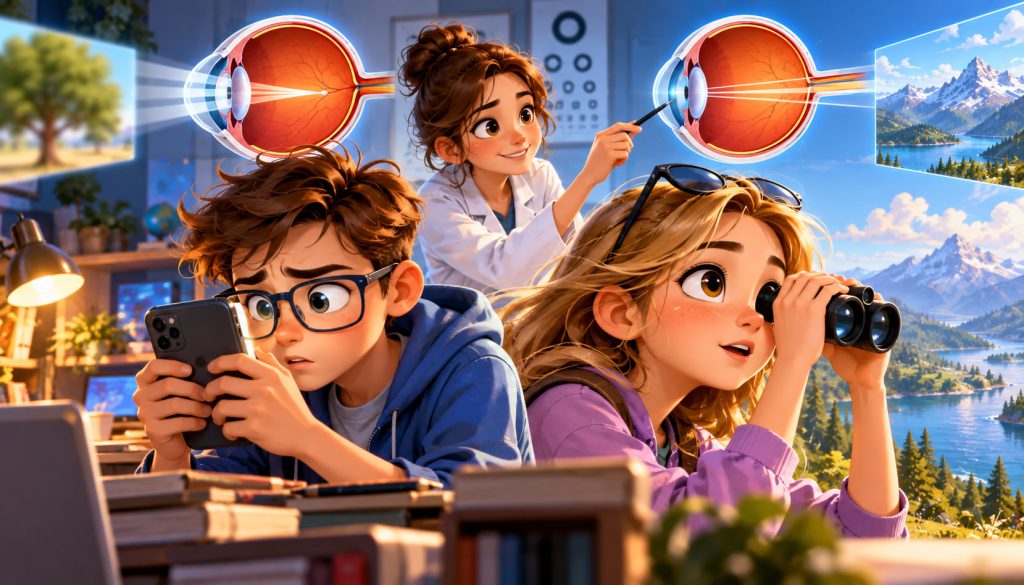
Clear vision depends on surprisingly precise optics. Light entering the eye must be focused directly onto the retina, the light-sensitive tissue at the back of the eye. When that focus falls in the wrong place, vision becomes blurred.
Two of the most common refractive errors are myopia, or nearsightedness, and hyperopia, or farsightedness. They may seem like opposite problems, but both usually result from the relationship between the eye’s shape and its focusing power.
Genetics plays an important role, but environment and visual habits can matter too—especially in childhood myopia.
What Is Myopia?
Myopia occurs when distant objects appear blurry while closer objects remain clearer.
In a myopic eye, incoming light tends to focus in front of the retina instead of directly on it. This usually happens because the eyeball is slightly too long from front to back, although the cornea or lens can also contribute.
Myopia commonly begins during childhood or adolescence and may progress while the eye is growing.
The condition can range from mild to severe. Someone with mild myopia may simply need glasses for driving or watching a screen across the room, while a person with high myopia may have very blurry distance vision without correction.
What Is Hyperopia?
Hyperopia works differently.
In a hyperopic eye, light would naturally focus behind the retina if the eye did not compensate.
This may happen because the eyeball is shorter than average or because the optical system does not bend light strongly enough.
Younger people can sometimes compensate for mild hyperopia by using the eye’s focusing muscles, a process called accommodation.
That is why someone with hyperopia may still see clearly for a time, especially at a distance.
However, prolonged near work can cause eye strain, headaches, fatigue, or difficulty reading.
Hyperopia Is Not the Same as Presbyopia
Farsightedness is often confused with presbyopia.
They are not the same condition.
Hyperopia is primarily related to the optical shape and focusing power of the eye. Presbyopia is an age-related decline in the eye’s ability to focus on nearby objects.
The natural lens inside the eye gradually becomes less flexible with age.
Presbyopia commonly becomes noticeable during the 40s, when people may begin holding menus or phones farther away to read comfortably.
A person can have myopia and presbyopia at the same time.
Who Is “Responsible” for Myopia?
There is no single cause.
Genetics clearly matters. Children with myopic parents have a greater chance of developing myopia themselves.
But genetics cannot explain everything.
Myopia has become increasingly common in many populations, particularly in highly urbanized societies where children spend substantial amounts of time studying indoors and relatively little time outdoors.
Research strongly suggests that time outdoors during childhood has a protective effect against the development of myopia.
Bright outdoor light appears to influence biological signals involved in eye growth.
Near work, including reading and screen use, may also contribute when it involves long periods at very short viewing distances with few breaks.
This does not mean smartphones alone “cause” myopia. The relationship is more complicated and involves genetics, eye growth, outdoor exposure, and visual behavior.
Why Progressive Myopia Matters
Ordinary myopia can usually be corrected very effectively with glasses or contact lenses.
However, high myopia is more than an inconvenience.
As the eye becomes longer, tissues inside it are stretched.
This can increase the lifetime risk of several eye problems, including retinal detachment, myopic macular degeneration, glaucoma, and some forms of cataract.
Controlling childhood myopia progression is therefore not simply about reducing the strength of future glasses. It may also reduce long-term eye-health risks.
Can Myopia Be Prevented?
Not every case can be prevented.
A child with strong genetic susceptibility may still develop myopia despite healthy visual habits.
However, spending more time outdoors is one of the most practical measures associated with a lower risk of developing childhood myopia.
Regular breaks during prolonged near work are also sensible.
Children should avoid holding books, tablets, or phones extremely close to their faces for long periods.
Good lighting and an appropriate working distance can reduce visual strain, even if they do not guarantee protection from myopia.
Modern Myopia-Control Treatments
Traditional glasses correct blurry vision but usually do not directly control eye growth.
Today, several strategies can be used in selected children to slow myopia progression.
These include specially designed spectacle lenses, certain multifocal contact lenses, orthokeratology lenses worn overnight, and low-dose atropine eye drops in some treatment plans.
The best option depends on the child’s age, prescription, eye health, lifestyle, and rate of progression.
Regular eye examinations are important because treatment should be monitored over time.
How Is Hyperopia Treated?
Hyperopia can also be corrected with glasses or contact lenses.
Convex lenses help move the focal point forward so that light reaches the retina correctly.
Some people with mild hyperopia may not need continuous correction when they are young because their eyes can compensate.
Others experience significant headaches, reading difficulty, or eye strain and benefit from glasses.
In children, substantial hyperopia deserves particular attention.
The effort required to focus can sometimes contribute to eye misalignment, especially inward turning of an eye.
Early eye examinations can identify these problems before they interfere with visual development.
What About Laser Eye Surgery?
Refractive surgery can correct certain cases of myopia and hyperopia.
Procedures such as LASIK reshape the cornea so that light focuses more accurately on the retina.
However, surgery does not make the eye biologically identical to an eye that never had myopia.
For example, a person who previously had high myopia may retain some of the retinal risks associated with an elongated eye even after excellent laser vision correction.
Surgery also has eligibility requirements and potential complications.
A detailed ophthalmic evaluation is essential before considering it.
Expert Perspective: Eye Shape Matters More Than “Weak Eyes”
Ophthalmologists generally describe myopia and hyperopia as refractive errors rather than signs that the eyes have become weak from use.
Reading does not simply wear the eyes out, and glasses do not make eyesight “lazy.”
Glasses correct how light is focused. They do not cause the underlying eye to deteriorate.
For children with progressive myopia, specialists increasingly focus on measuring progression and controlling excessive eye elongation rather than repeatedly increasing prescriptions without considering myopia-management options.
Do Screens Damage Vision?
Digital screens can certainly cause discomfort.
Long screen sessions can reduce blinking, contributing to dry eyes, burning, tiredness, and temporary blurred vision.
Close viewing for long periods may also be associated with myopia development or progression in children, particularly when it replaces outdoor activity.
But screen-related eye strain and permanent refractive error are not the same thing.
Practical habits include taking regular distance-viewing breaks, blinking consciously, maintaining comfortable screen distance, and spending time outdoors.
When Should You Get an Eye Examination?
Blurred vision, frequent headaches, squinting, difficulty reading, problems seeing road signs, or holding objects unusually close or far away are all reasons to have vision checked.
Children may not realize that their vision is abnormal because they have nothing to compare it with.
Regular screening is therefore particularly important during childhood.
Sudden vision loss, flashes of light, a sudden increase in floating spots, a dark curtain-like shadow, severe eye pain, or rapidly changing vision should be evaluated urgently.
Clear Vision Is Usually Manageable
Myopia and hyperopia are extremely common and usually very manageable.
Glasses and contact lenses can provide excellent correction, while refractive surgery is available for suitable adults.
For children with progressive myopia, modern treatment increasingly aims to slow eye growth rather than simply correct blur.
Genetics cannot be changed, but regular eye examinations, outdoor activity, sensible near-work habits, and appropriate treatment can significantly improve long-term visual health.
Interesting Facts
- Myopia usually develops because the eye becomes too long rather than because the lens suddenly becomes “weak.”
- Children can sometimes compensate for hyperopia so effectively that the condition remains unnoticed without an eye examination.
- Spending more time outdoors during childhood is associated with a lower risk of developing myopia.
- High myopia can increase the lifetime risk of retinal disease even when glasses provide perfectly clear vision.
- Presbyopia eventually affects almost everyone because the natural lens becomes less flexible with age.
- Glasses correct refractive error but do not make the eyes dependent on them.
- A person can simultaneously have myopia and age-related presbyopia.
- Modern myopia-control treatments can slow progression in many children, although results vary between individuals.
Glossary
- Myopia — Nearsightedness; a refractive error in which distant objects appear blurry because light focuses in front of the retina.
- Hyperopia — Farsightedness; a refractive error in which the eye would naturally focus light behind the retina.
- Presbyopia — Age-related loss of the ability to focus clearly on nearby objects.
- Retina — Light-sensitive tissue lining the back of the eye.
- Cornea — The transparent front surface of the eye that helps focus light.
- Accommodation — The eye’s ability to change focusing power for objects at different distances.
- Refractive Error — A condition in which the eye does not focus light correctly on the retina.
- Orthokeratology — The use of specially designed contact lenses, usually worn overnight, to temporarily reshape the cornea and, in some children, help control myopia progression.
- Atropine — A medication that can be used in low concentrations under professional supervision to slow childhood myopia progression.
- Retinal Detachment — Separation of the retina from underlying tissue, a potentially serious condition requiring urgent medical care.
- LASIK — A type of refractive surgery that reshapes the cornea to correct vision.
- Myopia Control — Treatments and strategies designed to slow the progression of childhood nearsightedness.