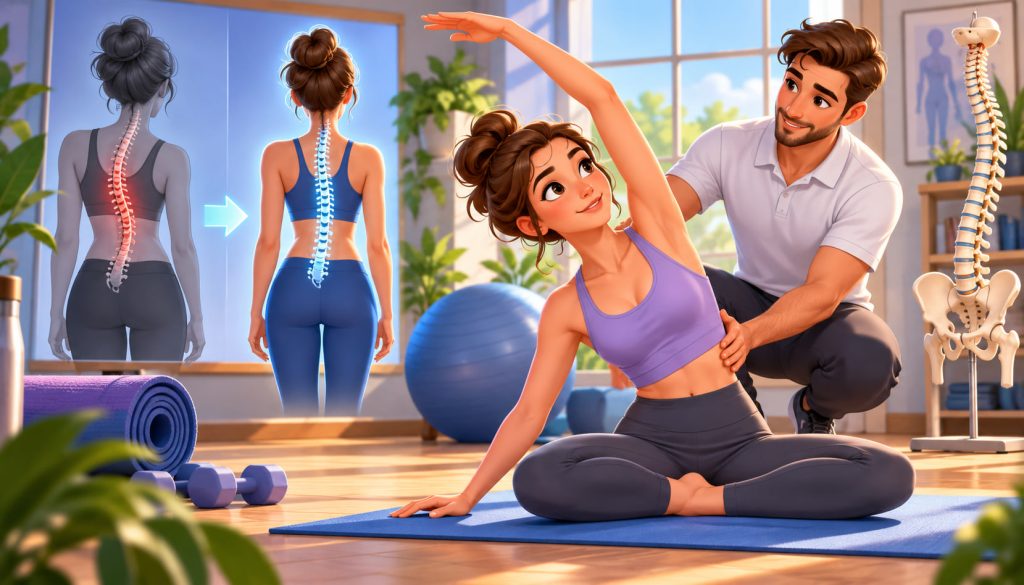
Adult scoliosis is a sideways curvature of the spine that may have been present since adolescence or developed later because of age-related changes in the discs, joints, and bones.
Many adults discover scoliosis only after developing back pain, stiffness, uneven posture, fatigue, or reduced mobility. Exercise is often one of the first treatments recommended because it can improve muscular support, balance, breathing mechanics, and everyday function.
However, expectations matter. Exercise can significantly improve symptoms and body control, but it does not usually straighten a fixed adult spinal curve completely.
The most effective programs are individualized and focus on the specific shape of the curve rather than using the same exercises for everyone.
Why Exercise Matters in Adult Scoliosis
Scoliosis changes how forces move through the spine.
Muscles on one side may become shortened or overactive, while others may become lengthened or relatively weak. The rib cage can rotate, the pelvis may become uneven, and some people unconsciously shift their body weight to one side.
These changes can increase fatigue and discomfort.
A good exercise program aims to improve:
- Core endurance
- Spinal stability
- Postural awareness
- Breathing mechanics
- Hip and shoulder strength
- Balance
- Mobility
- Ability to perform daily activities
The goal is not simply to “strengthen the back,” but to teach the body to maintain a more efficient position during movement.
Scoliosis-Specific Exercises Are Different
General fitness is useful, but scoliosis-specific exercise goes further.
Methods such as the Schroth approach use individualized posture correction, rotational breathing, muscle activation, and controlled movement.
The exercises are adapted according to the direction and location of the spinal curve.
For example, a person may be taught to lengthen the spine, shift the trunk toward a corrected position, and breathe into areas of the rib cage that move less effectively.
This is very different from simply doing symmetrical stretches.
Because scoliosis curves differ from person to person, exercises that are helpful for one individual may be inappropriate for another.
The Schroth Method
The Schroth Method is one of the best-known exercise systems for scoliosis.
It uses three-dimensional correction rather than treating scoliosis as a simple side bend.
Typical components include spinal elongation, trunk repositioning, controlled breathing, and stabilization of the corrected posture.
Adults may perform exercises while standing, sitting, lying down, or using supports.
The goal is to train the nervous system and muscles to recognize a more balanced position.
Although structural changes in adults are usually limited, Schroth-based therapy may help improve posture, muscular endurance, breathing, and pain control.
Core Stability Exercises
The deep abdominal and spinal muscles help support the trunk.
Core exercises are particularly valuable when they emphasize control rather than repeated bending or twisting.
Useful examples may include:
- Modified plank
- Side plank
- Bird-dog
- Dead bug
- Gentle abdominal bracing
- Pelvic stabilization exercises
A bird-dog, for example, involves extending the opposite arm and leg while keeping the trunk stable.
This trains the body to resist unwanted rotation.
The side plank can also improve lateral trunk strength, although the best side and duration may depend on the individual curve pattern.
Core training should create stability without forcing the spine into painful positions.
Breathing Exercises and Rib Mobility
Scoliosis frequently involves rotation of the rib cage.
One side of the chest may expand differently from the other during breathing.
Rotational breathing exercises are commonly used in scoliosis-specific rehabilitation.
A therapist may teach the patient to direct inhalation toward compressed areas of the rib cage while maintaining corrected posture.
Slow diaphragmatic breathing can also reduce unnecessary tension in the neck and upper chest.
Breathing exercises may look simple, but they can become surprisingly demanding when combined with spinal correction.
Gentle Spinal Mobility
Adults with scoliosis often become stiff because of age, pain, arthritis, or protective muscle tension.
Gentle movement can help maintain mobility.
Exercises may include controlled pelvic tilts, cat-cow movements, thoracic rotation, and gentle spinal elongation.
The important word is controlled.
Aggressive twisting or forcing the spine into extreme ranges is usually unnecessary.
Mobility exercises should leave the body feeling freer rather than more irritated.
Hip and Glute Strengthening
The pelvis provides the foundation for the spine.
Weak hip muscles can make it more difficult to maintain balance and control during walking, standing, and climbing stairs.
Exercises such as bridges, supported squats, lateral leg movements, and step-ups can strengthen the gluteal muscles.
A stronger lower body may reduce the amount of compensation required from the spine.
Hip flexibility can also matter.
Tight hip flexors or hamstrings may affect pelvic position and increase discomfort in some people.
Walking Is More Valuable Than It Looks
Walking is one of the simplest forms of exercise for adults with scoliosis.
It improves cardiovascular fitness, leg strength, joint mobility, and endurance without placing extreme forces on the spine.
Regular walking can also help reduce the physical deconditioning that often develops when chronic back pain causes people to avoid movement.
The most useful pace is generally one that can be maintained comfortably and consistently.
Frequent moderate activity is usually more helpful than occasional intense exercise followed by long periods of inactivity.
Strength Training Can Be Safe
Having scoliosis does not automatically mean avoiding weights.
Many adults can safely perform resistance training when technique and load are appropriate.
Rows, supported presses, squats, hip hinges, and resistance-band exercises can strengthen muscles that support the spine.
The priority should be controlled movement.
Heavy lifting with poor technique, sudden twisting under load, or continuing through sharp pain should be avoided.
People with advanced degeneration, osteoporosis, nerve compression, or significant pain should obtain professional guidance before beginning demanding resistance training.
Exercises That May Need Modification
There is no universal list of forbidden scoliosis exercises.
However, some movements may need modification depending on symptoms and spinal structure.
Examples include repeated deep backbends, forceful spinal twisting, high-impact exercises that provoke pain, or heavy asymmetrical lifting without proper preparation.
A movement that feels comfortable for one person may aggravate another.
Pain that becomes sharp, radiates into a leg, causes numbness, or produces weakness should not be ignored.
Expert Perspective: Individualization Matters Most
Physical therapists and specialists who treat adult spinal deformity generally emphasize that the best rehabilitation programs are based on the individual curve, symptoms, strength, balance, and medical condition rather than on a generic scoliosis routine.
A therapist trained in scoliosis-specific rehabilitation can evaluate trunk rotation, pelvic position, breathing patterns, muscle imbalance, and daily movement habits.
That assessment helps determine which exercises should be strengthened, stretched, emphasized, or avoided.
For many adults, consistency matters more than complexity.
A short program performed correctly several times per week can be more useful than a large collection of random exercises.
When Exercise Alone Is Not Enough
Some adults have scoliosis combined with spinal stenosis, disc degeneration, osteoporosis, nerve compression, or arthritis.
Exercise may still be important, but additional treatment may be necessary.
Medical evaluation is particularly important when scoliosis is associated with progressive weakness, numbness, loss of balance, severe night pain, bowel or bladder changes, or rapidly worsening symptoms.
These problems should not be treated simply as muscular stiffness.
Building a Practical Weekly Routine
A balanced program may combine several types of movement.
For example, a person might perform scoliosis-specific postural exercises several times per week, walk most days, and complete strength training two or three times per week.
Gentle mobility and breathing exercises may be practiced more frequently.
Progress should be gradual.
The best scoliosis exercise program is one that improves function and can realistically be maintained for months and years.
Interesting Facts
- Adult scoliosis may be a continuation of adolescent scoliosis or may develop later because of spinal degeneration.
- A scoliosis curve is three-dimensional and usually involves both sideways bending and spinal rotation.
- Two people with the same measured curve angle can experience very different levels of pain.
- Strong muscles do not necessarily straighten scoliosis, but they can improve stability and endurance.
- Breathing exercises are an important part of several scoliosis-specific rehabilitation methods.
- Walking is often one of the safest ways to maintain general fitness in adults with spinal problems.
- Exercise programs are usually more effective when they are adapted to the direction and location of the spinal curve.
- Adult scoliosis does not automatically prevent participation in strength training or an active lifestyle.
Glossary
- Scoliosis — A three-dimensional deformity of the spine involving sideways curvature and rotation.
- Adult Degenerative Scoliosis — Scoliosis that develops later in life because of age-related changes in spinal discs and joints.
- Schroth Method — A scoliosis-specific exercise approach using posture correction, spinal elongation, muscle activation, and rotational breathing.
- Core Stability — The ability of trunk muscles to control and support the spine during movement.
- Rotational Breathing — A breathing technique used to encourage expansion of restricted areas of the rib cage.
- Spinal Stenosis — Narrowing of spaces around the spinal cord or nerves that may cause pain, numbness, or weakness.
- Spinal Degeneration — Age-related changes in discs, joints, and other spinal structures.
- Pelvic Tilt — A change in the position or angle of the pelvis that can influence spinal posture.
- Thoracic Spine — The middle portion of the spine connected to the rib cage.
- Spinal Rotation — Twisting of the vertebrae around the vertical axis of the spine.
- Postural Correction — Deliberately adjusting body position to improve alignment and reduce unnecessary strain.