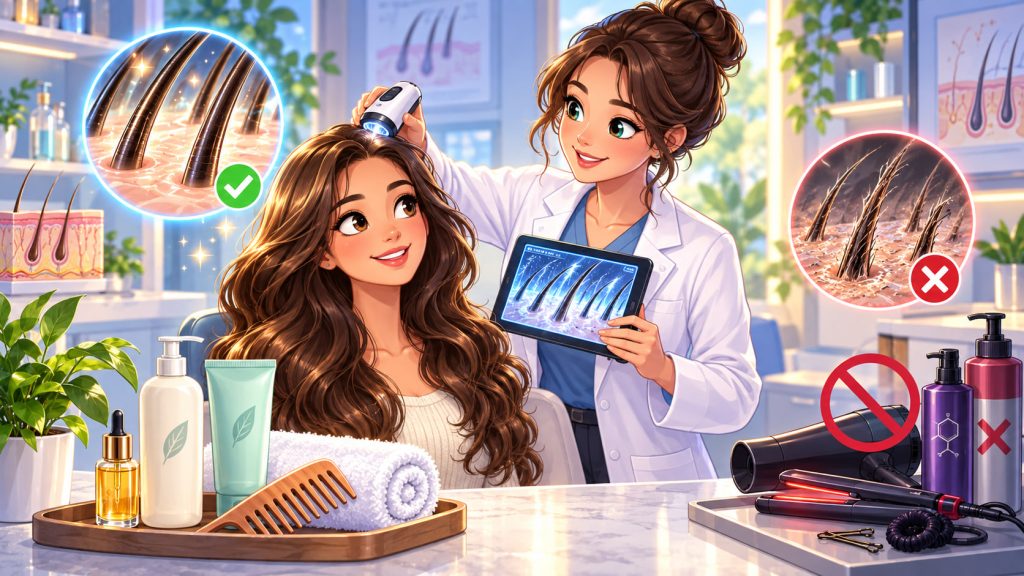
Healthy hair is often associated with expensive shampoos, masks, supplements, and complicated beauty routines. Yet dermatologists usually take a much simpler approach.
For doctors, good hair care starts with protecting the scalp, reducing unnecessary damage, maintaining adequate nutrition, and recognizing when hair changes may signal a medical problem.
The most effective hair care routine is usually gentle, consistent, and adapted to your individual hair and scalp type.
There is no single shampoo, oil, or supplement that works for everyone. Hair texture, oil production, age, hormones, genetics, styling habits, and health conditions can all influence what your hair needs.
Start With a Healthy Scalp
Healthy hair begins in the scalp, where each strand grows from a hair follicle.
Oil, dead skin cells, sweat, styling products, and microorganisms naturally accumulate on the scalp. Regular cleansing helps maintain a healthy environment for hair growth.
However, washing too aggressively can irritate the skin.
Dermatologists generally recommend choosing a shampoo according to scalp condition rather than simply following trends.
People with oily scalps may need to wash their hair frequently, sometimes even daily. Those with dry, curly, or tightly coiled hair may need much less frequent washing.
There is no medically correct number of hair washes per week for everyone.
The right frequency is the one that keeps the scalp comfortable without causing excessive dryness, itching, or irritation.
Apply Shampoo Where It Is Needed Most
Many people apply shampoo through the entire length of their hair and scrub vigorously.
Doctors usually recommend concentrating shampoo primarily on the scalp.
As shampoo is rinsed away, it naturally travels down the hair shaft and removes dirt from the lengths.
Aggressive rubbing can increase tangling and mechanical damage, especially in long, curly, bleached, or fragile hair.
Use the fingertips rather than the nails when massaging the scalp.
A gentle massage is enough to distribute shampoo and remove buildup.
Conditioner Helps Protect the Hair Shaft
Conditioner is not simply a cosmetic extra.
It can reduce friction between individual hair fibers, improve manageability, decrease static electricity, and make hair less likely to break during brushing.
People with fine or oily hair may prefer to apply conditioner mainly to the ends.
Those with dry, curly, chemically treated, or textured hair often benefit from conditioning a larger portion of the hair length.
Conditioner cannot repair a damaged strand permanently, but it can temporarily smooth and protect its surface.
Leave-in conditioners may also help people whose hair frequently becomes dry or tangled.
Wet Hair Needs Extra Care
Hair behaves differently when wet.
Water causes the hair shaft to swell slightly, and wet hair may be more vulnerable to stretching and breakage.
This is especially important for straight or chemically processed hair.
After washing, doctors generally recommend avoiding aggressive towel rubbing.
Instead, gently squeeze out excess water and use a soft towel or fabric to absorb moisture.
Detangle carefully with a wide-tooth comb, working from the ends upward.
Curly and coily hair is often easier to detangle while damp and conditioned rather than after it has completely dried.
Heat Styling Can Damage Hair
Hair dryers, curling irons, hot rollers, and straighteners expose the hair shaft to high temperatures.
Frequent heat can weaken proteins in the hair, damage the outer cuticle, increase dryness, and eventually lead to breakage.
Occasional styling is different from repeated exposure every day.
Dermatologists often recommend:
- Using the lowest effective temperature
- Limiting how often hot tools are used
- Keeping hair dryers slightly away from the hair
- Avoiding multiple passes with a straightener
- Allowing hair to partially air-dry when practical
- Using heat-protective products before styling
The combination of high temperature and frequent styling is more damaging than either factor alone.
Tight Hairstyles Can Cause Real Hair Loss
Braids, tight ponytails, buns, extensions, and similar styles can place repeated tension on hair follicles.
Over time, this may cause a condition called traction alopecia.
Early traction alopecia may improve when tension is removed.
If the pulling continues for years, however, some follicles may become permanently damaged.
Hairstyles should not regularly cause scalp pain, headaches, tenderness, or a strong pulling sensation.
Changing styles, loosening braids, and giving the scalp periods without tension can help reduce the risk.
Be Careful With Bleach and Chemical Treatments
Bleaching, permanent coloring, relaxing, and chemical straightening alter the structure of the hair.
These treatments can produce attractive results, but repeated chemical exposure often increases porosity, dryness, and breakage.
Hair that has already been heavily processed is particularly vulnerable.
Spacing chemical treatments farther apart can reduce damage.
Combining several aggressive procedures at the same time, such as bleaching followed by frequent straightening, significantly increases stress on the hair shaft.
Damaged hair cannot biologically heal because the visible hair strand is not living tissue.
The goal of hair products is therefore to protect the existing strand until new hair grows.
Nutrition Matters More Than Hair Supplements
Hair follicles are metabolically active and require adequate nutrition.
Protein, iron, zinc, certain vitamins, and essential fatty acids all play roles in normal hair growth.
However, taking extra nutrients does not necessarily make healthy hair grow faster.
Supplements are most useful when a genuine deficiency exists.
Excessive supplementation can sometimes cause problems. For example, very high intake of certain nutrients may actually contribute to hair shedding.
Doctors generally recommend obtaining nutrients through a balanced diet unless testing or medical evaluation identifies a specific deficiency.
More vitamins do not automatically mean more hair.
People experiencing unexplained hair loss should avoid relying only on supplements without investigating the underlying cause.
Stress, Illness, and Hormones Can Affect Hair
Hair follicles cycle through growth, transition, and resting phases.
Major physical or emotional stress can disrupt this cycle.
High fever, surgery, rapid weight loss, severe illness, childbirth, nutritional deficiencies, and some medications can trigger increased shedding several weeks or months later.
This type of temporary shedding is often called telogen effluvium.
Hormonal conditions can also influence hair density.
Thyroid disorders, changes in sex hormones, menopause, pregnancy, and certain endocrine conditions may affect hair growth patterns.
Hair loss is therefore not always a cosmetic issue.
Dandruff Should Not Simply Be Ignored
Mild flaking is common, but persistent dandruff can be associated with scalp inflammation.
Anti-dandruff shampoos commonly contain ingredients designed to reduce yeast growth, scaling, or inflammation.
The shampoo may need to remain on the scalp for several minutes before rinsing to work effectively.
People with severe redness, thick scales, painful lesions, or persistent itching should consider a medical evaluation because conditions such as seborrheic dermatitis, psoriasis, eczema, or fungal infections can resemble ordinary dandruff.
Expert Perspective: Dermatologists Favor Gentle Care
Dermatologists commonly emphasize that many hair problems are caused or worsened by repeated physical, chemical, or thermal damage rather than by a lack of cosmetic products.
From a medical perspective, preventing damage is usually more realistic than trying to “repair” severely damaged hair afterward.
Doctors also distinguish between breakage and true hair loss.
Breakage occurs along the hair shaft, while medical hair loss involves changes at the follicle or in the hair-growth cycle.
This difference matters because treatments are very different.
A conditioner may help reduce breakage, but it cannot correct hormonal hair loss or autoimmune disease.
When Hair Loss Needs Medical Attention
Some shedding is normal.
Most people naturally lose a certain number of hairs every day as follicles move through their normal growth cycle.
However, a dermatologist should evaluate hair loss when it becomes sudden, severe, patchy, painful, or progressively worse.
Medical attention is also useful if hair loss is accompanied by:
- Bald patches
- Scalp inflammation
- Burning or pain
- Significant itching
- Broken hairs in unusual patterns
- Eyebrow or eyelash loss
- Scarring
- Rapid thinning
- Other unexplained physical symptoms
Early diagnosis can be particularly important in conditions that may permanently damage hair follicles.
Simple Hair Care Often Works Best
An effective routine does not require dozens of products.
For many people, the essentials are appropriate cleansing, regular conditioning, gentle detangling, moderate heat, protection from excessive chemical processing, and hairstyles that do not constantly pull on the scalp.
Hair products can improve softness, shine, and manageability.
But long-term hair health depends just as much on scalp health, genetics, nutrition, hormones, medical conditions, and daily habits.
The smartest approach is not to chase every new hair trend, but to understand what your own scalp and hair actually need.
Interesting Facts
- Hair grows from follicles located beneath the skin, while the visible hair shaft itself is made mainly of keratin and is not living tissue.
- Human hair naturally cycles through growth, transition, resting, and shedding phases.
- Hair texture is strongly influenced by the shape and structure of the hair follicle.
- Hair can absorb water and temporarily swell, which is one reason wet hair requires gentle handling.
- Split ends cannot truly fuse back together permanently; trimming removes the damaged portion.
- Persistent pulling from tight hairstyles can eventually damage follicles and cause permanent hair loss.
- Sudden shedding may appear months after illness, major stress, childbirth, surgery, or rapid weight loss.
- Hair thickness and growth rate are strongly influenced by genetics.
Glossary
- Hair Follicle — A small structure in the skin from which a hair strand grows.
- Hair Shaft — The visible part of the hair that extends above the skin.
- Keratin — A strong structural protein that forms most of the hair shaft.
- Cuticle — The protective outer layer of the hair shaft.
- Traction Alopecia — Hair loss caused by repeated pulling or tension on hair follicles.
- Telogen Effluvium — Temporary increased hair shedding caused when many follicles enter the resting phase at the same time.
- Seborrheic Dermatitis — An inflammatory skin condition that commonly causes scalp flaking, redness, and itching.
- Porosity — The ability of hair to absorb and retain moisture, often influenced by damage to the cuticle.
- Hair Breakage — Damage in which the hair shaft snaps rather than falling from the follicle.
- Alopecia — A general medical term for hair loss.