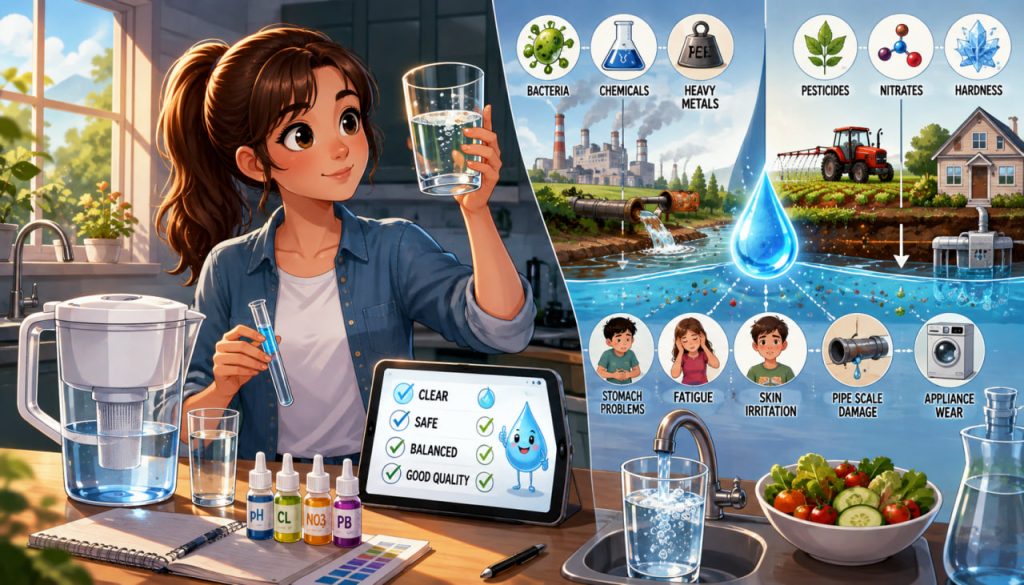
Water looks simple, but it shapes almost every part of daily life. It affects your health, energy, digestion, skin, cooking, hygiene, appliances, and even how food tastes.
Clean drinking water supports the body quietly. Poor-quality water can do the opposite. It may carry bacteria, viruses, parasites, heavy metals, agricultural chemicals, industrial pollutants, or excess minerals.
The difficult part is that bad water does not always look bad. Some of the most dangerous contaminants have no obvious color, smell, or taste.
That is why understanding drinking water quality is not just a technical topic. It is a practical life skill.
What Does “Good Drinking Water” Really Mean?
Good drinking water should be safe, clean, and suitable for regular consumption.
That means it should be free from harmful levels of biological, chemical, physical, and radiological contaminants. The World Health Organization defines safe drinking water as water that does not represent a significant health risk over a lifetime of consumption, including different sensitivities across life stages.
Good water should also be acceptable to drink. It should not have a strong unpleasant smell, strange taste, visible dirt, oil film, or unusual color.
However, appearance alone is not enough. Water can be crystal clear and still contain lead, nitrate, arsenic, pesticides, or harmful microorganisms.
Safe drinking water is not determined by looks. It is determined by testing, treatment, and reliable monitoring.
How Water Quality Affects Your Health
Drinking poor-quality water can affect the body in several ways.
The most immediate risk is infection. Water contaminated with harmful bacteria, viruses, or parasites can cause diarrhea, vomiting, stomach cramps, fever, dehydration, and more serious illness in vulnerable people.
WHO notes that contaminated water is linked not only to diarrheal disease, but also to other health hazards. Safe and sufficient water also supports hygiene, which helps prevent multiple infectious diseases.
Chemical contamination can be more silent.
Lead exposure may affect the nervous system, especially in children. Nitrate can be dangerous for infants. Arsenic exposure over time is linked with serious chronic health risks. Excess fluoride can affect teeth and bones. Some industrial chemicals and long-term contaminant exposures may increase the risk of chronic disease.
The U.S. Environmental Protection Agency states that unsafe levels of drinking water contaminants may cause gastrointestinal illness, nervous system effects, reproductive effects, and chronic diseases such as cancer.
Water Quality and Daily Comfort
Water quality does not affect only illness risk.
Hard water, which contains high levels of calcium and magnesium, can leave scale inside kettles, pipes, washing machines, and water heaters. It may make soap foam less effectively and leave spots on dishes.
Iron and manganese can stain sinks, toilets, laundry, and bathroom fixtures. Sulfur compounds can create a rotten-egg smell. Chlorine can produce a swimming-pool-like odor, especially in treated municipal water.
These problems are not always dangerous by themselves, but they reduce comfort and can damage household systems over time.
Good water improves daily life because it makes drinking, cooking, washing, and cleaning easier and safer.
Why Children and Vulnerable People Are More Sensitive
Not everyone is affected by poor water quality in the same way.
Infants, children, pregnant people, older adults, and people with weakened immune systems may be more vulnerable to contaminated water.
Children drink more water relative to their body weight than adults. Their organs and nervous systems are still developing. That makes some contaminants more concerning for them.
People with weakened immune systems may also face greater risk from microorganisms that might cause milder illness in a healthy adult.
This is why water safety is especially important in homes with babies, elderly relatives, or anyone recovering from illness.
Common Signs That Water May Be Unsafe
Some warning signs are easy to notice.
Water may be questionable if it has:
- Brown, yellow, orange, green, or cloudy appearance
- Sediment, floating particles, or oily film
- Rotten-egg, chemical, fuel-like, metallic, or sewage smell
- Bitter, salty, metallic, or earthy taste
- Stains on sinks, toilets, tubs, or laundry
- Sudden change in color, pressure, smell, or taste
- Frequent stomach problems after drinking it
- Nearby flooding, construction, pipe damage, or well damage
A sudden change matters. If your water has always tasted slightly mineral-rich, that may simply reflect local geology. But if it suddenly becomes cloudy, smells strange, or changes color, treat it seriously.
Any sudden change in drinking water should be considered a warning sign until proven otherwise.
Why Clear Water Can Still Be Dangerous
Many people trust water if it is clear. That can be a mistake.
Lead usually cannot be seen, smelled, or tasted in water. Nitrate is also usually invisible. Some bacteria and viruses may not change the appearance of water at all. Arsenic can occur naturally in groundwater without obvious sensory clues.
EPA explains that lead can enter drinking water through corrosion of plumbing materials, and it sets the health goal for lead in drinking water at zero because lead can be harmful even at low exposure levels.
This is why home water testing is important, especially for private wells, old plumbing, or homes with infants.
A filter pitcher may improve taste, but it may not remove every serious contaminant. Treatment must match the actual problem.
Tap Water vs Well Water
Municipal tap water is usually treated and monitored by a public water system. That does not make problems impossible, but it means there are standards, testing routines, and public reporting requirements.
Private wells are different.
If you use a private well, you are usually responsible for testing and maintaining it. CDC explains that private wells are not regulated, treated, or monitored by government officials in the same way public water systems are.
Private well water may be affected by nearby farms, septic systems, floods, industrial activity, old well construction, natural minerals, or damaged equipment.
CDC recommends that well owners test their water regularly for harmful germs and chemicals and seek advice from local health departments when needed.
How to Check If Your Water Is Bad
The best way to know whether water is safe is laboratory testing.
Start with these steps.
First, identify your water source. Is it municipal water, a private well, bottled water, or a shared community system?
Second, check local water reports if you use public water. Many utilities publish annual water quality reports.
Third, inspect the water visually. Look for cloudiness, color, particles, foam, or oily film.
Fourth, smell it carefully. Chemical, sewage, fuel-like, sulfur, or metallic odors are warning signs.
Fifth, test it. For a private well, basic testing should usually include coliform bacteria, nitrate, pH, total dissolved solids, and locally relevant contaminants such as arsenic, lead, iron, manganese, pesticides, or hardness.
Sixth, choose treatment based on the result. Do not guess.
Testing first and treating second is the correct order.
What Home Tests Can and Cannot Do
Home water test strips are useful for quick screening.
They can help estimate hardness, chlorine, pH, iron, nitrate, and some basic indicators. They are inexpensive and easy to use.
But they are not a full safety guarantee.
For serious concerns, use a certified laboratory. Lab testing is more accurate and can detect contaminants that simple home kits may miss.
This is especially important after flooding, pipe replacement, well repair, nearby chemical spills, unexplained illness, or a major change in water taste or smell.
When You Should Stop Drinking the Water
Stop drinking your water and use a safe alternative if:
- Local authorities issue a boil water notice
- Water smells like fuel, chemicals, sewage, or solvents
- Water suddenly changes color or contains particles
- Your well was flooded
- A lab test shows harmful contamination
- Multiple household members develop stomach illness
- There is known lead, nitrate, bacterial, or chemical contamination
Boiling can kill many germs, but it does not remove lead, nitrate, arsenic, fuel, pesticides, or many industrial chemicals. In some cases, boiling can even concentrate certain chemicals as water evaporates.
That is why official guidance matters during contamination events.
Choosing the Right Water Filter
The right filter depends on the contaminant.
Activated carbon filters can improve taste and reduce chlorine and some organic compounds.
Reverse osmosis systems can reduce many dissolved contaminants, including some metals, salts, and nitrate.
UV systems can help disinfect microbiologically contaminated water, but they do not remove chemicals.
Water softeners reduce hardness, but they are not designed to make unsafe water safe.
There is no universal filter that solves every water problem perfectly.
Always match the filter certification and treatment method to the contaminant found in your water test.
Expert Perspective
Public health agencies consistently emphasize prevention and testing rather than relying on taste or appearance. WHO describes water safety as a health-based risk management issue, while CDC stresses regular testing for private wells because owners are responsible for confirming safety.
The practical expert lesson is clear: water quality should be managed before problems become visible, not only after the water looks dirty or smells strange.
How Better Water Improves Life
Better water can improve life in visible and invisible ways.
It reduces the risk of waterborne illness. It makes drinking more pleasant. It improves cooking. It protects children and vulnerable family members. It can reduce scale buildup, staining, plumbing problems, and damage to appliances.
Most importantly, safe water creates confidence.
When you know your water is tested and properly treated, you do not have to guess every time you fill a glass.
Interesting Facts
- Some dangerous water contaminants cannot be seen, smelled, or tasted.
- Clear water can still contain lead, nitrate, arsenic, or harmful microorganisms.
- Hard water is usually more of a household comfort and appliance issue than an immediate health emergency.
- Boiling water can kill many germs but does not remove most chemical contaminants.
- Private well owners are usually responsible for testing their own drinking water.
- Rotten-egg smell often comes from sulfur compounds, but testing is still needed to confirm the cause.
- A filter that improves taste may not remove the contaminant that creates the biggest health risk.
Glossary
- Drinking Water Quality — The safety, cleanliness, chemical composition, and acceptability of water used for drinking.
- Contaminant — Any biological, chemical, physical, or radiological substance that may be present in water.
- Pathogen — A disease-causing microorganism, such as a harmful bacterium, virus, or parasite.
- Hard Water — Water with high levels of calcium and magnesium minerals.
- Lead — A toxic metal that can enter water from old pipes, solder, or plumbing fixtures.
- Nitrate — A chemical often linked to fertilizers, septic systems, and agricultural runoff.
- Coliform Bacteria — Bacteria used as indicators that water may be contaminated with fecal matter or harmful germs.
- pH — A measurement of how acidic or alkaline water is.
- Total Dissolved Solids — The amount of dissolved minerals, salts, metals, or other substances in water.
- Activated Carbon Filter — A filter that uses carbon material to reduce chlorine, odors, and some organic chemicals.
- Reverse Osmosis — A filtration process that pushes water through a membrane to reduce many dissolved contaminants.
- UV Disinfection — A treatment method that uses ultraviolet light to inactivate many microorganisms.