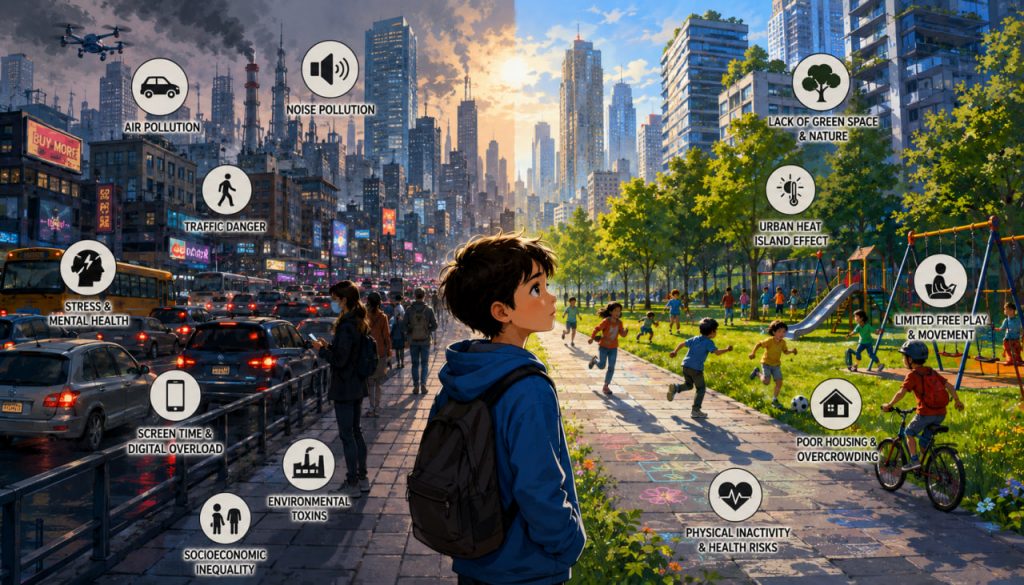
A modern megacity can be exciting for a child. It offers schools, hospitals, museums, playgrounds, technology, public transport, sports clubs, and cultural diversity. But dense urban life also brings risks that are easy to overlook because they become part of the background: traffic, air pollution, noise, lack of safe play space, heat, stress, inequality, and digital overload.
The question is not whether cities are “bad” for children. Many cities can be wonderful places to grow up. The real question is: what kind of city is the child growing up in — and whose needs was it designed around?
A child-friendly megacity is not just a smaller version of an adult city. Children breathe differently, move differently, play differently, learn differently, and depend more heavily on safe public space.
Air Pollution: The Invisible Urban Risk
Air pollution is one of the biggest environmental risks for children in large cities.
Traffic, heating systems, industry, construction dust, ports, diesel vehicles, and power generation can all contribute to polluted air. Children are especially vulnerable because their lungs are still developing, they breathe more air per kilogram of body weight than adults, and they often spend time close to road level.
The World Health Organization warns that children, pregnant women, older people, people with chronic diseases, and people in lower socioeconomic groups are among those most at risk from air pollution. WHO also links air pollution exposure with respiratory, cardiovascular, reproductive, metabolic, and other health effects.
This matters for everyday life. A child walking to school along a busy road may receive higher pollution exposure than a child walking through a quieter, greener street.
In a megacity, the route to school can become a health factor.
Traffic Danger and Road Injuries
Cars, buses, trucks, motorcycles, scooters, delivery vans, and bicycles all compete for limited street space.
For adults, traffic may feel normal. For children, it is harder to judge speed, distance, and driver behavior. Young children are also shorter, which makes them less visible to drivers and places their breathing zone closer to vehicle exhaust.
UNICEF’s global road safety work highlights road traffic crashes as a major cause of death and injury among children and adolescents worldwide. Its technical guidance states that nearly 220,000 children and adolescents aged 0–19 die every year due to road traffic injuries.
Safe crossings, traffic calming, protected sidewalks, school streets, lower speed limits, and separated cycling infrastructure are not cosmetic upgrades. They are child-health infrastructure.
A city that forces children to negotiate adult-speed traffic every day is not fully safe for childhood.
Noise Pollution and Chronic Stress
Megacities are loud.
Traffic, sirens, construction, aircraft, nightlife, railways, industrial activity, and constant human density can create chronic noise exposure. For children, this may affect sleep, concentration, learning, stress levels, and emotional regulation.
Noise is often treated as less serious than air pollution because it is familiar. But constant noise can keep the body in a state of low-level alertness.
A child does not need silence all day. Children need a balance of stimulation and recovery. When a bedroom faces a busy highway, or a school sits beside constant traffic, recovery becomes harder.
Quiet is not a luxury. For children, it is part of healthy development.
Lack of Green Space and Free Play
Children need places to move, climb, explore, run, invent games, touch plants, meet friends, and experience nature.
In many megacities, safe outdoor play has been squeezed by traffic, parking, commercial development, private property, fear of crime, and lack of public investment. The result is more indoor time, more screen time, and less independent movement.
UNICEF’s urban-planning guidance emphasizes that children should live in healthy, safe, inclusive, green, and prosperous communities, and its work on urban green space argues that access to green areas supports children’s development.
Green space matters because it supports physical activity, social interaction, cooling, cleaner air, biodiversity contact, and mental restoration.
A playground surrounded by traffic and concrete is better than nothing. But a network of shaded streets, parks, courtyards, schoolyards, trees, and safe walking routes is much better.
Urban Heat and Climate Stress
Megacities often become urban heat islands.
Concrete, asphalt, rooftops, traffic, and dense buildings absorb and store heat. Areas with fewer trees and less shade can become dangerously hot during heatwaves.
Children are more vulnerable to heat because their bodies regulate temperature differently, they may not recognize early symptoms, and they depend on adults for water, shade, and safe shelter.
WHO identifies unhealthy urban living conditions, inadequate green space, pollution, urban heat islands, and lack of space for walking and cycling as factors that can worsen noncommunicable diseases and injuries.
Climate change makes this risk more serious. Heatwaves, storms, flooding, poor air quality episodes, and water stress can all disrupt school, transport, health care, and family stability.
A hot city is not just uncomfortable. For children, heat can limit learning, sleep, play, and safety.
Inequality: The Risk Multiplier
Not all children experience the same megacity.
A wealthy child may live near a park, attend a well-ventilated school, ride in a safe vehicle, have access to health care, and spend weekends in cleaner areas. A poorer child may live near a highway, waste site, industrial corridor, overcrowded housing, or unsafe street.
This is why urban risk is often unequal.
WHO notes that poorly designed urban transport creates threats such as road traffic injuries, air and noise pollution, and barriers to safe physical activity. It also highlights inadequate green space, water and soil contamination, and unhealthy living conditions as urban health concerns.
For children, inequality can turn the same city into two different childhoods.
One child gets enrichment. Another gets exposure.
The most dangerous city is not only polluted. It is unfairly polluted.
Housing Density and Indoor Health
Dense housing can be efficient and sustainable when it is well designed. But overcrowded, poorly ventilated, damp, or unsafe housing creates risks.
Children may be exposed to mold, indoor smoke, pests, lead, chemical residues, extreme heat, poor sanitation, or lack of sleep space. High-rise living can also reduce spontaneous outdoor play if elevators, courtyards, entrances, or nearby streets feel unsafe.
The home is a child’s main environment. If housing is unhealthy, the child carries that exposure every day.
A good megacity must therefore think beyond parks and roads. It must include ventilation, safe materials, building maintenance, thermal comfort, access to daylight, and reliable basic services.
Mental Health and Urban Overload
Large cities stimulate the brain constantly.
Lights, screens, advertising, traffic, noise, crowds, social comparison, academic pressure, safety concerns, and long commutes can increase stress. Some children thrive in this energy. Others become exhausted by it.
Urban life may also reduce unstructured time. A child’s day can become school, transport, apartment, homework, screen, sleep. Without free play, social trust, and safe outdoor independence, childhood can become overmanaged.
Mental health risk does not come from density alone. It comes from density without refuge.
Children need places where they can feel safe, known, and unhurried.
Digital and Commercial Pressure
Megacities are saturated with commercial messages.
Children encounter screens, advertisements, fast food, gaming culture, influencer trends, shopping centers, and constant digital comparison. This can affect body image, attention, sleep, consumption habits, and social behavior.
The city and the smartphone now work together. A child may be physically in a neighborhood but psychologically pulled into a nonstop digital marketplace.
Parents cannot solve this alone. Urban design, school routines, public recreation, libraries, sports facilities, and safe outdoor spaces all help create alternatives to screen-based childhood.
Expert Perspective
UNICEF’s child-responsive urban guidance, developed with UN-Habitat, argues that children’s rights and interests should be integrated into urban planning, financing, administration, and public decision-making. It emphasizes access to basic services, clean air and water, safe places to play and learn, and children’s participation in decisions that affect them.
That expert perspective is essential: a city becomes safer for children when children are treated as primary users of the city, not afterthoughts.
What Makes a Megacity Safer for Children?
A healthier city for children needs practical design choices.
It needs cleaner air, fewer cars near schools, safe crossings, shaded sidewalks, protected cycling, reliable public transport, parks within walking distance, clean water, safe housing, noise reduction, and strong local communities.
It also needs child-focused data. Cities should measure pollution near schools, traffic injuries near playgrounds, heat exposure in poor districts, access to green space, and the safety of walking routes.
The solution is not to remove children from cities. The solution is to rebuild cities around human development.
A child-friendly city is usually better for everyone: parents, older adults, workers, people with disabilities, and the climate.
Interesting Facts
- Children breathe more air per kilogram of body weight than adults, which can increase pollution exposure.
- Road traffic injuries remain one of the most serious urban risks for children and adolescents.
- Green spaces can support play, movement, cooling, social contact, and mental restoration.
- Children experience cities at a lower physical height, so cars, exhaust pipes, barriers, and crossings look different to them.
- Noise pollution can affect sleep, concentration, and stress levels.
- Urban heat islands are often worse in neighborhoods with less tree cover and more asphalt.
- A school’s location can strongly influence a child’s exposure to traffic pollution.
- Many child-friendly city improvements also help older adults and people with disabilities.
Glossary
- Megacity — A very large city, commonly defined as having more than 10 million residents.
- Air Pollution — Harmful particles or gases in the air, often from traffic, industry, heating, and fires.
- Particulate Matter — Tiny airborne particles that can enter the lungs and affect health.
- Urban Heat Island — A city area that becomes hotter than surrounding areas because of buildings, asphalt, and limited vegetation.
- Green Space — Parks, trees, gardens, natural areas, and planted public spaces.
- Child-Friendly City — A city planned to support children’s safety, health, learning, movement, and participation.
- Traffic Calming — Street design that slows vehicles and improves pedestrian safety.
- Cumulative Exposure — The combined effect of multiple environmental risks over time.
- Overcrowding — A housing condition where too many people share too little living space.
- Environmental Justice — Fair distribution of environmental benefits and harms across communities.
- Noise Pollution — Unwanted or harmful sound from traffic, industry, construction, or other sources.
- Active Mobility — Walking, cycling, scooting, or other human-powered movement.