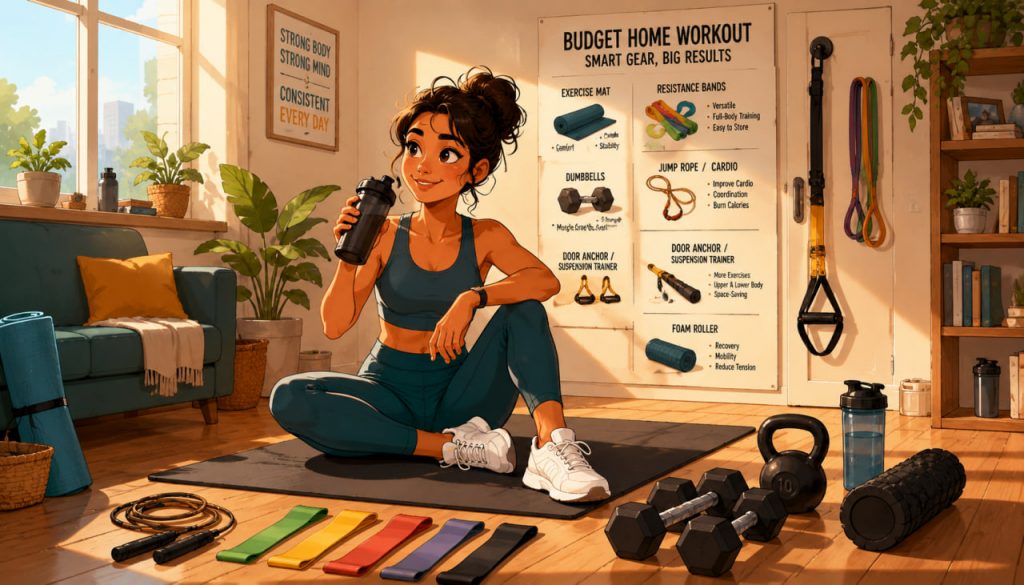
Building a home workout setup does not require an expensive treadmill, a wall of dumbbells, or a full garage gym. For most people, the smartest budget setup is small, flexible, and easy to use consistently.
The goal is not to copy a commercial gym at home. The goal is to buy a few tools that help you train strength, mobility, balance, and cardio without wasting money or space.
The best budget home gym is the one you will actually use three to five times per week.
Start With the Basics: What Does a Good Workout Need?
A complete fitness routine should cover several movement types:
- Pushing
- Pulling
- Squatting
- Hip-hinging
- Lunging
- Core stability
- Cardio
- Mobility
You can train many of these with body weight alone. Push-ups, squats, lunges, planks, glute bridges, step-ups, and mountain climbers require almost no equipment.
But a few inexpensive tools can make home workouts much better. They add resistance, protect your joints, improve comfort, and make progress easier to measure.
Health guidelines also support this approach. The NHS recommends adults do strengthening activities for all major muscle groups at least two days per week, alongside weekly aerobic activity.
First Buy: A Good Exercise Mat
An exercise mat is the simplest useful purchase.
It makes floor exercises more comfortable, protects knees and elbows, reduces slipping, and defines your workout space. You will use it for stretching, mobility, Pilates-style exercises, core work, push-ups, yoga, warm-ups, and cooldowns.
Choose a mat that is thick enough for comfort but stable enough for balance. Very soft mats can feel nice for stretching but unstable for lunges or standing movements.
For beginners, a mat is often the highest-value purchase because it removes friction. If getting on the floor feels uncomfortable, many people skip half their workout.
Second Buy: Resistance Bands
Resistance bands are one of the best budget fitness tools.
They are cheap, lightweight, portable, and useful for almost every muscle group. Mayo Clinic Press describes resistance bands as a strong option for beginners because they are relatively easy to use, safe, affordable, and usable almost anywhere.
With bands, you can train:
- Rows
- Chest presses
- Shoulder raises
- Biceps curls
- Triceps extensions
- Squats
- Glute bridges
- Lateral walks
- Deadlift patterns
- Face pulls
- Core anti-rotation work
There are two main types.
Loop bands are good for glutes, hips, squats, warm-ups, and lower-body activation.
Tube bands with handles are better for rows, presses, curls, and full-body strength exercises.
For the best value, buy a set with several resistance levels. This lets you progress without buying new equipment immediately.
Third Buy: Adjustable Dumbbells or Two Fixed Dumbbells
If the budget allows, dumbbells are the next major upgrade.
Resistance bands are excellent, but dumbbells feel more natural for many strength exercises. They work well for goblet squats, Romanian deadlifts, shoulder presses, rows, floor presses, lunges, curls, and loaded carries.
Harvard Health notes that beginners can save money by choosing a few basics such as comfortable shoes plus hand weights or resistance bands instead of investing heavily in machines.
Adjustable dumbbells are more expensive upfront but save space. Fixed dumbbells are cheaper if you buy only one or two pairs.
For beginners, a practical start is:
- Light pair for shoulders and arms
- Medium pair for rows, lunges, and presses
- One heavier dumbbell or kettlebell for squats and hip-hinge movements
If you can buy only one strength tool, choose resistance bands. If you can buy two, add dumbbells.
Fourth Buy: A Jump Rope or Cardio Alternative
Cardio at home does not require a machine.
A jump rope is cheap, compact, and highly effective. It improves coordination, rhythm, footwork, and cardiovascular fitness.
However, it is not ideal for everyone. People with knee, ankle, pelvic floor, or balance issues may prefer lower-impact options.
Low-cost cardio alternatives include:
- Step-ups on a sturdy step
- Marching intervals
- Shadow boxing
- Dance workouts
- Low-impact HIIT
- Brisk walking outdoors
- Stair climbing
- Stationary bodyweight circuits
The best cardio tool depends on your joints, space, and neighbors. In an apartment, jump rope may be noisy. In that case, low-impact circuits are more practical.
Fifth Buy: A Door Anchor or Suspension Trainer
A door anchor can turn resistance bands into a much more useful training system.
It allows you to attach bands at different heights for rows, pulldowns, chest presses, face pulls, wood chops, and assisted mobility work.
A suspension trainer is another powerful option. It uses body weight and adjustable straps for rows, squats, lunges, push-ups, hamstring curls, and core exercises.
The downside is installation and safety. You need a strong door, beam, or anchor point. Poor setup can be dangerous.
For most budget users, a simple resistance-band door anchor is enough.
What You Probably Do Not Need at First
Many home fitness purchases look exciting but are unnecessary for beginners.
You probably do not need:
- A treadmill
- A large exercise bike
- A rowing machine
- A full barbell rack
- Heavy machines
- Smart mirrors
- Expensive vibration platforms
- Random “ab gadgets”
- Huge sets of cheap accessories
These items can be useful for specific people. But they cost more, take space, and often become unused furniture.
Buy equipment after your routine proves you need it, not before.
Best Budget Setup by Price Level
For a very small budget, start with a mat and resistance bands. This is enough for strength, mobility, stretching, and beginner workouts.
For a stronger setup, add dumbbells. This creates a real home strength-training system.
For a more complete setup, add a jump rope or cardio option, a door anchor, and perhaps a foam roller.
A practical home workout kit looks like this:
- Exercise mat
- Resistance band set
- One or two dumbbell pairs or adjustable dumbbells
- Jump rope or low-impact cardio plan
- Door anchor
- Foam roller or massage ball if recovery work helps you stay consistent
This setup is compact, affordable, and suitable for many fitness levels.
Expert Perspective
The American College of Sports Medicine describes resistance training as exercise against external resistance such as free weights, machines, resistance bands, water, or body weight. Its resistance-training guidance also recommends a training frequency of two to three days per week for novices.
That expert perspective supports a simple home strategy: you do not need advanced equipment to start strength training. You need progressive resistance, safe technique, and consistency.
Harvard Health makes the same practical point: for home strength training, resistance bands or tubes are ideal for beginners because they are affordable, versatile, and easy to use.
How to Choose Equipment Without Wasting Money
Before buying anything, ask five questions.
Will I use this at least twice a week?
Can I store it easily?
Does it train more than one exercise?
Can I progress with it over time?
Is it safe for my current fitness level?
If the answer is no, skip it.
A kettlebell may be excellent, but not if you do not know how to use it safely. A treadmill may be useful, but not if it destroys your budget and fills half the room. A smart fitness device may be motivating, but not if the subscription becomes another unused bill.
The best equipment is simple, versatile, durable, and matched to your current habits.
A Simple Beginner Home Workout
A budget setup can support a complete full-body workout.
Try this structure two or three times per week:
Warm up for five minutes with marching, arm circles, hip hinges, and easy squats.
Then perform:
- Squats or chair squats
- Push-ups or wall push-ups
- Band rows
- Glute bridges
- Dumbbell Romanian deadlifts
- Plank or dead bug
- Band pull-aparts
- Step-ups or low-impact cardio intervals
Start with one to three sets. Keep the first weeks easy. Add repetitions, resistance, or sets gradually.
Strength training works best when it progresses slowly. Pain, dizziness, sharp discomfort, or unusual symptoms are signs to stop and seek professional advice.
Interesting Facts
- Bodyweight training can build strength, especially for beginners.
- Resistance bands become harder as they stretch, creating a different resistance curve than dumbbells.
- A 10-minute workout is often better than skipping exercise completely.
- Dumbbells are more versatile than most single-purpose fitness gadgets.
- A sturdy chair can be used for squats, step-ups, incline push-ups, and supported balance work.
- Many people quit home workouts because their setup is too complicated, not because it is too simple.
- Consistency usually matters more than owning expensive equipment.
Glossary
- Home Workout — Exercise performed at home without needing a commercial gym.
- Resistance Training — Exercise where muscles work against resistance from weights, bands, machines, or body weight.
- Resistance Band — An elastic band used to create resistance during strength exercises.
- Dumbbell — A handheld weight used for strength training.
- Adjustable Dumbbell — A dumbbell whose weight can be changed.
- Bodyweight Exercise — An exercise using your own body as resistance.
- Progressive Overload — Gradually increasing difficulty so the body adapts and becomes stronger.
- Mobility — The ability to move joints through a useful range of motion with control.
- Core Stability — The ability of the trunk muscles to support posture and movement.
- Low-Impact Cardio — Cardiovascular exercise with reduced stress on joints.
- Suspension Trainer — Straps used to perform bodyweight exercises at adjustable angles.
- Door Anchor — An attachment that secures resistance bands to a door for more exercise options.