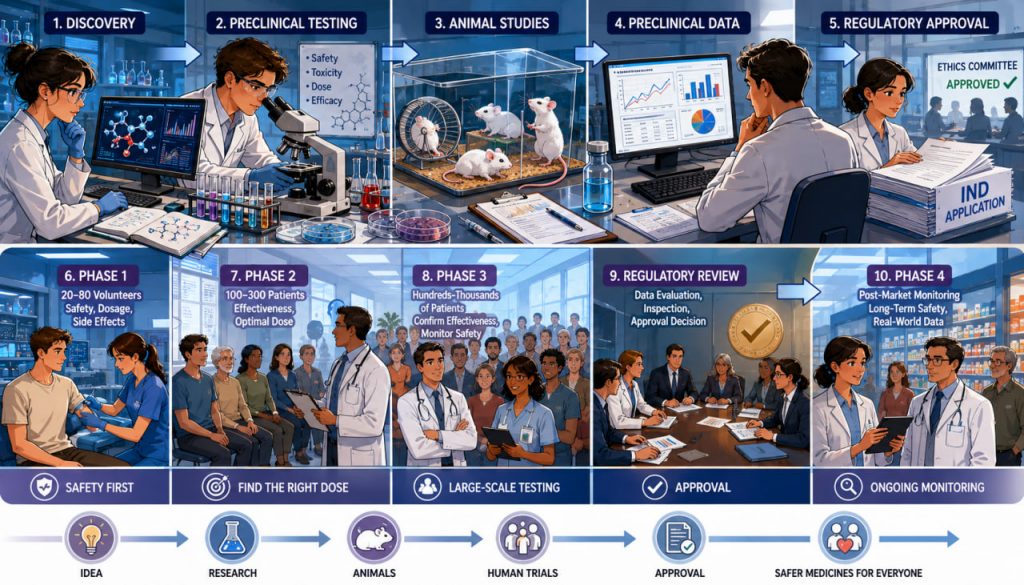
Every new medicine begins with an idea: a biological target, a promising molecule, an unexpected laboratory result, or a new way to treat an existing disease.
Turning that idea into an approved therapy is a long, tightly controlled process. Researchers must determine how the compound works, whether it causes toxic effects, what dose may be appropriate, and whether its benefits outweigh its risks.
The familiar phrase “from mice to humans” describes only part of the journey. Modern drug development also uses computer models, isolated cells, engineered tissues, chemical analysis, carefully designed human trials, regulatory review, and years of safety monitoring.
Animal experiments do not prove that a drug will work in people. They provide evidence that helps researchers decide whether carefully controlled human testing may be justified.
Drug Discovery Begins With a Biological Target
Scientists usually begin by identifying a process involved in disease. This could be an enzyme, receptor, gene, immune pathway, bacterium, virus, or abnormal type of cell.
Researchers then search for substances that can influence that target. Thousands of compounds may be screened using laboratory tests, computational methods, or automated systems.
Promising candidates are modified to improve characteristics such as potency, stability, absorption, selectivity, and ease of manufacturing. Most candidates fail during these early stages because they are ineffective, unstable, excessively toxic, or unsuitable for use as medicines.
The FDA describes drug development as a sequence covering discovery, preclinical research, clinical research, regulatory review, and post-market safety monitoring.
What Happens Before Animal Testing?
Early studies often use in vitro systems, meaning experiments performed outside a living organism.
Scientists may expose cultured cells to a candidate drug to examine whether it reaches the intended target, damages healthy cells, or changes a disease-related biological process.
Researchers also study how the compound dissolves, interacts with other molecules, and breaks down under different conditions. Computer models may predict toxicity, molecular binding, or how the drug could behave inside the body.
These methods can eliminate unsuitable candidates before animal studies begin. However, isolated cells cannot fully reproduce digestion, blood circulation, metabolism, immune responses, or interactions between multiple organs.
Why Animals Are Used in Preclinical Research
Animal studies are generally conducted to answer questions that cannot yet be resolved adequately with isolated cells or computer simulations.
Researchers investigate how the drug is absorbed, distributed through the body, metabolized, and eliminated. They also look for harmful effects on organs, reproduction, development, behavior, and other biological functions.
FDA guidance divides preclinical work broadly into laboratory-based and living-organism research. Its central goal is to determine whether a candidate could cause serious harm and whether the available evidence supports initial testing in humans.
Different species may be used because biological responses vary. Rodents are common, but certain studies may require a second species whose metabolism or physiology provides additional information.
The purpose is not to demonstrate perfect safety. No experiment can do that. The goal is to identify major risks and establish a scientifically defensible starting point for human research.
Why Results in Mice Do Not Always Translate to People
Mice share many biological mechanisms with humans, but they are not miniature human beings.
They differ in body size, lifespan, immune function, metabolism, genetics, and disease development. An experimental treatment may cure a deliberately induced condition in mice yet fail against the more complicated human disease.
Animal studies may also involve genetically similar animals kept under controlled conditions. Human patients are much more diverse in age, ancestry, health, diet, medication use, and environmental exposure.
Researchers therefore interpret successful animal results cautiously. A positive mouse study means that further investigation may be worthwhile—not that an effective human medicine has been discovered.
Permission to Begin Human Trials
Before administering a new drug to people, developers must submit extensive evidence to the relevant regulator.
In the United States, this generally involves an Investigational New Drug application. It includes preclinical pharmacology and toxicology data, manufacturing information, proposed clinical protocols, investigator qualifications, and plans for protecting participants.
The FDA evaluates whether initial studies would expose people to unreasonable risks. The application also requires informed-consent procedures and review by an institutional review board.
European clinical trials are similarly subject to regulatory and ethical authorization. The European Medicines Agency states that the system is intended to protect participants’ rights, safety, and well-being while ensuring that study results are credible.
Phase 1: Can the Drug Be Given Safely?
Phase 1 is usually the first stage of human testing.
These trials commonly involve a small number of participants and focus primarily on safety, side effects, dosage, and how the body processes the drug. NIH guidance describes Phase 1 studies as first-in-human testing, often involving approximately 20–80 participants.
Healthy volunteers may participate when this is ethically appropriate. In areas such as cancer treatment, the medicine may instead be tested in patients because exposing healthy people to a potentially toxic drug would be unjustified.
Researchers may begin with a very low dose and gradually increase it in later groups. Blood tests, heart monitoring, physical examinations, and other assessments help identify adverse effects.
Phase 1 does not prove that the treatment works. Its main purpose is to learn whether further human testing can continue responsibly.
Phase 2: Does the Treatment Show Real Benefit?
Phase 2 trials usually include patients who have the condition the medicine is intended to treat.
Researchers begin evaluating effectiveness while continuing to study safety and determine the most appropriate dose. NIH describes these trials as typically involving a larger group—often around 100–300 participants.
The drug may be compared with a placebo, standard treatment, or different dose. Participants are frequently assigned to groups randomly to reduce systematic differences.
Blinding may prevent participants, researchers, or both from knowing which treatment has been given. This helps reduce the influence of expectations on reported symptoms, medical decisions, and data interpretation.
Many apparently promising medicines fail during Phase 2 because they do not provide enough clinical benefit.
Phase 3: Large-Scale Confirmation
Phase 3 trials test the treatment in much larger and often more diverse patient populations.
These studies compare the new medicine with existing care or another appropriate control. Researchers examine whether the benefit is clinically meaningful and continue collecting information about common adverse effects.
EMA explains that Phase 3 trials involve larger numbers of patients with the target condition and are used to compare the investigational medicine with other treatments.
Because Phase 3 studies may take place at many hospitals and in several countries, researchers can assess whether results remain consistent across different populations and healthcare settings.
These trials are expensive and complex. They require standardized protocols, reliable data collection, participant follow-up, safety reporting, quality checks, and statistical plans established before results are known.
How Placebos and Control Groups Work
A placebo resembles the experimental treatment but does not contain its active ingredient.
Placebos help researchers distinguish the treatment’s specific effects from natural recovery, fluctuating symptoms, patient expectations, and other influences.
However, placebo use is not always ethical. When an effective standard therapy exists, the new medicine may need to be tested against that treatment rather than leaving patients without appropriate care.
Some trials add the experimental medicine or placebo to standard treatment so that every participant continues receiving accepted medical care.
Informed Consent and Participant Protection
Participants must receive understandable information about the study’s purpose, procedures, foreseeable risks, possible benefits, alternatives, and their right to withdraw.
Signing a consent form does not remove the researchers’ responsibilities. Safety must be monitored throughout the trial, and serious unexpected problems may require protocol changes, suspension, or termination.
Independent ethics committees or institutional review boards assess whether the trial is scientifically justified and whether participant protections are adequate. FDA IND requirements explicitly include informed consent and independent review.
Clinical-trial volunteers are not laboratory materials. They are people whose autonomy, privacy, safety, and dignity must remain central to the entire process.
Regulatory Review and Approval
After successful trials, the developer submits the complete evidence package to a medicines regulator.
Reviewers examine trial results, statistical analyses, manufacturing quality, labeling, dosage recommendations, contraindications, and risk-management plans. Approval is granted only when the evidence supports a favorable balance between expected benefits and known risks for a defined use.
Regulators may request additional analyses, manufacturing changes, new studies, or more information about specific groups.
Approval does not mean that a medicine is risk-free. It means that its expected benefits are judged to outweigh its risks under the approved conditions of use.
Phase 4 and Safety Monitoring After Approval
Some adverse effects are too rare to become visible in trials involving a few thousand participants. Other problems may emerge only after long-term use or use alongside many different medications.
Phase 4 research and post-market monitoring therefore continue after approval. NIH defines Phase 4 as research performed once a medicine or device has entered approved use.
Doctors, patients, manufacturers, researchers, and regulators may report suspected adverse reactions. Large healthcare databases and observational studies can identify patterns that were impossible to detect before widespread use.
Regulators may update warnings, restrict use, require additional studies, or withdraw a product when new evidence changes its benefit-risk balance.
Expert Perspective
The FDA describes preclinical studies as a foundation for deciding whether a drug is reasonably safe to enter human trials—not as final proof of safety or effectiveness.
The EMA emphasizes that clinical-trial regulation must protect participants while producing dependable scientific evidence.
Together, these principles explain the entire development pathway: each stage reduces uncertainty, but no single experiment can answer every question about a new medicine.
Interesting Facts
- Most experimental compounds never become approved medicines.
- Phase 1 trials mainly study safety and dosage rather than proving therapeutic effectiveness.
- Phase 0, or early Phase 1, may involve very small doses designed to study how a compound behaves in the body.
- A drug may appear promising in animals but fail because human biology processes it differently.
- Rare adverse reactions may become visible only after a medicine is used by a very large population.
- Trial participants can withdraw their consent, although researchers may retain data already collected according to the approved protocol and applicable rules.
- Clinical trials may compare several drugs or diseases within a shared master protocol to reduce duplicated infrastructure and accelerate evidence generation.
- An approved medicine may still be considered investigational when studied for a different disease, dose, combination, or route of administration.
Glossary
- Drug Candidate — A substance being investigated as a potential medicine.
- Preclinical Research — Laboratory and animal research conducted before routine human testing.
- In Vitro — Studied outside a living organism, usually in cells or laboratory systems.
- In Vivo — Studied inside a living organism.
- Toxicity — The capacity of a substance to cause biological harm.
- Pharmacokinetics — The study of how a drug is absorbed, distributed, metabolized, and eliminated.
- Investigational Drug — A medicine that is still being evaluated and is not yet approved for the proposed use.
- Clinical Trial — A prospective study in which human participants receive an intervention to evaluate health-related outcomes.
- Protocol — The detailed plan describing how a clinical trial will be conducted.
- Placebo — An inactive treatment designed to resemble the experimental intervention.
- Randomization — Assignment of participants to study groups by chance.
- Blinding — Withholding treatment assignments from participants, researchers, or both.
- Informed Consent — A voluntary decision to participate after receiving relevant information about the research.
- Adverse Event — An unwanted medical occurrence during treatment, whether or not the treatment caused it.
- Benefit-Risk Balance — The comparison between a medicine’s expected advantages and its known or potential harms.