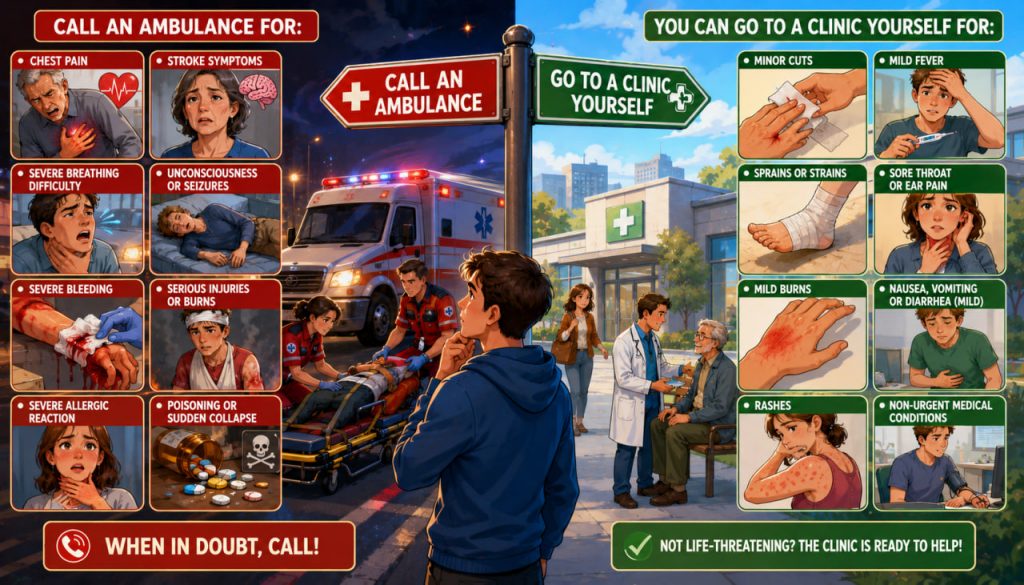
Knowing whether to call an ambulance or arrange your own medical transport can be difficult, especially when symptoms appear suddenly. People often worry about overreacting, while others delay emergency care because they hope the problem will improve.
The most important distinction is not whether the condition feels unpleasant. It is whether there is a serious risk to life, breathing, circulation, brain function, or permanent disability.
Call an ambulance when a person may deteriorate quickly, requires treatment during transport, or cannot travel safely without medical supervision. A clinic, urgent care center, or same-day doctor is more appropriate when the person is stable and the condition is not immediately life-threatening.
Emergency numbers and healthcare systems differ by country, so use the official emergency number and urgent medical advice service available where you live.
Call an Ambulance for Breathing Emergencies
Severe breathing difficulty always requires urgent attention.
Call an ambulance when someone is gasping, choking, unable to speak in complete sentences, turning pale or blue, or struggling visibly to breathe. Sudden swelling of the lips, mouth, tongue, or throat may indicate a severe allergic reaction and can rapidly block the airway.
Other warning signs include unusually noisy breathing, extreme drowsiness, confusion, or collapse.
Do not attempt to drive a person with severe breathing problems yourself. Their condition may worsen during the journey, and ambulance professionals can assess the airway, provide oxygen, begin emergency treatment, and alert the receiving hospital. Official emergency guidance lists severe breathing difficulty, choking, and major allergic reactions among reasons to request an ambulance.
Suspected Heart Attack Requires Emergency Services
Call an ambulance for pressure, squeezing, heaviness, or pain in the center of the chest, particularly when it lasts several minutes or repeatedly returns.
Pain may spread to one or both arms, the back, shoulders, neck, jaw, or stomach. Other possible symptoms include shortness of breath, nausea, sweating, dizziness, unusual weakness, or a rapid or irregular heartbeat.
Heart attacks do not always produce dramatic chest pain. Women, older adults, and people with diabetes may experience less typical symptoms, including unexplained breathlessness, nausea, back discomfort, or extreme fatigue.
The American Heart Association advises calling emergency services immediately for suspected heart-attack symptoms because emergency medical teams can begin treatment before arrival at the hospital.
Do not drive yourself when a heart attack is possible. You could lose consciousness or develop a dangerous heart rhythm while driving.
Recognize the Signs of Stroke
A stroke is a medical emergency because brain tissue can be damaged rapidly.
Use the FAST warning signs:
- Face: One side of the face droops or feels numb.
- Arms: One arm becomes weak or cannot remain raised.
- Speech: Speech becomes slurred, confused, or difficult to understand.
- Time: Call emergency services immediately.
Other sudden signs may include vision loss, severe dizziness, difficulty walking, confusion, numbness on one side of the body, or an unusually intense headache.
Do not wait to see whether the symptoms disappear. A temporary improvement may still represent a transient ischemic attack or another serious neurological emergency.
Stroke organizations advise calling an ambulance immediately for even one sudden stroke warning sign.
Unconsciousness, Seizures, and Sudden Confusion
Call an ambulance when someone is unconscious, cannot be awakened normally, suddenly collapses, or develops unexplained severe confusion.
A seizure requires emergency help when it lasts several minutes, repeatedly returns without full recovery, happens in water, causes serious injury, affects a pregnant person, or is the person’s first known seizure.
Stay with the person, protect their head, move dangerous objects away, and note the seizure’s starting time. Do not restrain their movements and do not place anything in their mouth.
Sudden confusion can be caused by stroke, infection, low blood sugar, poisoning, head injury, oxygen deprivation, or other serious conditions. Emergency ambulance guidance includes unconsciousness, acute confusion, and seizures that do not stop among situations requiring an emergency call.
Severe Bleeding and Major Injuries
Call an ambulance when bleeding is heavy, spurting, soaking through dressings, or not controlled by firm direct pressure.
While waiting, press firmly on the wound using clean gauze or cloth. Do not repeatedly lift the material to inspect the injury. Add more material on top if blood soaks through.
Emergency transport is also appropriate for:
- Serious head injuries
- Falls from significant height
- Major road collisions
- Suspected spinal injuries
- Crushed limbs
- Open fractures
- Large or deep burns
- Electrical or chemical burns
- Amputation or near-amputation
- Multiple serious injuries
Do not move a person with a possible neck or spinal injury unless they are in immediate danger.
Official emergency-care guidance identifies severe blood loss, major trauma, serious head injury, and severe burns as ambulance emergencies.
Other Situations That Need an Ambulance
Emergency services should also be called for suspected poisoning with severe symptoms, drowning, severe hypothermia, heatstroke, rapidly worsening illness, or suicidal behavior with an immediate danger of self-harm.
Pregnancy-related emergencies include heavy bleeding, severe abdominal pain, collapse, seizures, breathing difficulty, or an urgent birth when there is no safe way to reach maternity care.
For babies and young children, call urgently when there is difficulty breathing, reduced responsiveness, blue or unusually pale skin, a seizure, or a rapid and concerning deterioration.
Trust significant warning signs rather than trying to make a precise diagnosis at home. Ambulance call handlers can assess the situation and may advise a different care pathway if emergency transport is unnecessary. Calling emergency services does not automatically mean an ambulance will always be dispatched.
When You Can Travel to a Clinic Yourself
A clinic, urgent treatment center, or same-day medical service is usually suitable when the person is stable, alert, breathing normally, and able to travel safely.
Examples may include:
- Minor cuts that have stopped bleeding
- Small burns without deep tissue damage
- Sprains and strains
- Suspected minor fractures without severe deformity or circulation problems
- Mild infections
- Ear or throat pain
- Skin rashes without breathing difficulty
- Vomiting or diarrhea without severe dehydration
- Fever in an otherwise alert and responsive person
- Mild abdominal discomfort
- Minor eye problems
- Insect bites without severe allergic symptoms
Urgent treatment centers commonly manage cuts, bruises, sprains, minor burns, suspected simple fractures, infections, fever, vomiting, and diarrhea.
The person should preferably be accompanied when pain, weakness, medication, or anxiety could interfere with safe travel.
When to Contact a Doctor the Same Day
Some conditions are not ambulance emergencies but should not wait several days.
Seek same-day medical advice for worsening infection, persistent fever, repeated vomiting, dehydration, a painful urinary infection, moderate asthma symptoms that respond to prescribed medication, a wound that may need stitches, or a new symptom in someone who is medically vulnerable.
The same applies when symptoms are persistent, unusual, or progressively worsening even though the person is currently stable.
Where available, telephone triage or an official urgent medical advice service can assess symptoms and direct you to a clinic, urgent care center, emergency department, or ambulance. The NHS, for example, advises using its urgent advice service when someone needs prompt care but the situation is not life-threatening.
Do Not Drive Yourself in a Potential Emergency
Self-transport is dangerous when there is a risk of collapse, loss of consciousness, severe pain, heavy bleeding, stroke, heart attack, or serious breathing difficulty.
A private vehicle does not provide monitoring, oxygen, resuscitation equipment, medication, or trained personnel. Driving while frightened, dizzy, weak, or in severe pain can also endanger other road users.
When the condition may become critical during the journey, the ambulance is not merely transportation—it is the beginning of emergency medical care.
What to Tell the Emergency Dispatcher
Give the exact location first, including the address, building entrance, floor, and access code when relevant.
Describe what happened, the person’s age, whether they are conscious and breathing, and the main symptoms. Mention serious allergies, pregnancy, major medical conditions, and medications when known.
Follow the dispatcher’s instructions and do not end the call until told to do so. Unlock the door, secure pets, gather medical documents, and send someone outside to guide the ambulance when possible.
Expert Perspective
Emergency-care organizations consistently separate life-threatening emergencies from urgent but stable medical problems. NHS guidance reserves ambulance services and emergency departments for conditions such as heart attack, stroke, choking, seizures, severe bleeding, major trauma, and serious breathing difficulty. Stable injuries and illnesses can often be treated through urgent care or primary-care services.
The practical rule is straightforward: call an ambulance when delay or unsupervised transport could threaten life or cause permanent harm. Travel to a clinic when the patient is stable and can complete the journey safely.
Interesting Facts
- Ambulance crews can begin assessment and treatment before a patient reaches the hospital.
- A person having a heart attack or stroke may worsen suddenly even when initially able to speak and walk.
- Chest discomfort can disappear and return during a heart attack.
- A single FAST symptom is enough to treat a possible stroke as an emergency.
- Calling an emergency number does not guarantee that an ambulance will be sent; the dispatcher may recommend another appropriate service.
- Urgent care centers can often perform tests such as X-rays, blood tests, and electrocardiograms.
- Severe allergic reactions can progress from mild symptoms to airway obstruction within a short period.
- Someone with serious symptoms should not be left alone while help is being arranged.
Glossary
- Ambulance — A medically equipped vehicle staffed by trained emergency personnel.
- Emergency Department — A hospital department providing immediate care for serious illness and injury.
- Urgent Care — Medical treatment for conditions that require prompt attention but are not immediately life-threatening.
- Triage — The process of assessing how urgently a patient needs medical care.
- Heart Attack — Damage to heart muscle caused by interrupted blood flow.
- Stroke — Brain injury caused by blocked blood flow or bleeding in the brain.
- FAST — A method for recognizing stroke through facial weakness, arm weakness, speech problems, and the need for immediate action.
- Anaphylaxis — A severe and potentially life-threatening allergic reaction.
- Seizure — A sudden episode of abnormal electrical activity in the brain.
- Major Trauma — A serious injury that may threaten life or cause permanent disability.
- Direct Pressure — Firm pressure applied to a bleeding wound to reduce blood loss.
- Medical Dispatcher — A trained operator who assesses emergency calls and provides instructions while help is arranged.