The human brain does not simply receive information from the body. It continuously builds an internal model of the body, predicts movement, interprets sensation, and adjusts its neural networks through experience.
This ability to change is called neuroplasticity. It helps people learn new skills and recover after injury, but it can also contribute to persistent pain or abnormal movement patterns.
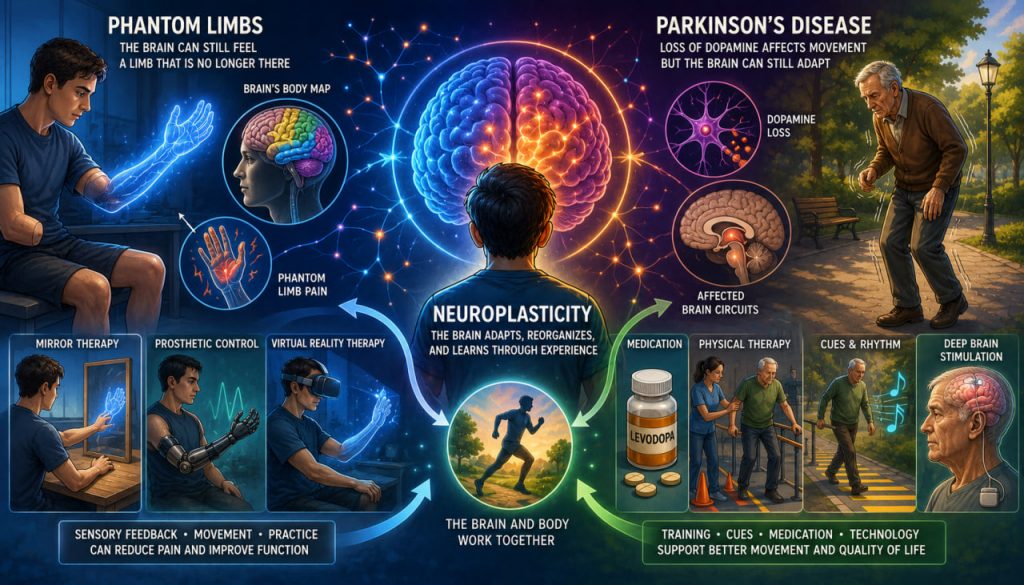
Phantom limb sensations and Parkinson’s disease reveal two different sides of the same principle: the brain remains adaptable, yet its adaptations are not always beneficial or sufficient to overcome disease.
What Is Neuroplasticity?
Neuroplasticity is the nervous system’s ability to change its structure, activity, and connections in response to experience, learning, injury, disease, or altered sensory input.
These changes can occur at several levels. Individual synapses may become stronger or weaker, networks may change how they communicate, and regions of the brain may adjust their roles when normal input disappears.
Plasticity is essential for:
- Learning and memory
- Motor-skill development
- Adaptation to sensory loss
- Rehabilitation after neurological injury
- Adjustment to prosthetic devices
- Compensation for some disease-related changes
However, neuroplasticity should not be described as unlimited self-repair. The brain’s capacity to adapt depends on age, health, the type of damage, training intensity, medication, motivation, and many other biological factors.
Why a Missing Limb Can Still Feel Present
After an amputation, many people continue to feel that the missing arm, hand, leg, or foot is still present.
The phantom may seem to occupy a normal position, move voluntarily, feel unusually short, or become stuck in an uncomfortable posture. Sensations can include pressure, warmth, itching, tingling, movement, or touch.
A phantom sensation is not imaginary in the everyday sense. It is a genuine sensory experience generated by the nervous system even though the physical limb is absent.
The brain retains a representation of the body, sometimes called a body map. Nerves, the spinal cord, and brain regions involved in touch and movement may continue producing or interpreting signals associated with the missing limb.
A 2025 NIH-supported study found that the brain can preserve a stable representation of a missing hand for years after amputation, challenging the simplest idea that neighboring body regions merely erase and replace the lost limb’s cortical map.
Phantom Sensation and Phantom Limb Pain Are Different
Not every phantom experience is painful.
Phantom limb sensation refers to any perception that the absent limb remains present. Phantom limb pain refers specifically to painful experiences such as burning, crushing, stabbing, twisting, or electric-shock sensations.
Pain may be influenced by several interacting mechanisms:
- Changes in damaged peripheral nerves
- Abnormal activity in the spinal cord
- Altered sensory and motor processing
- The brain’s persistent model of the missing limb
- Stress, sleep disruption, and previous pain
- A mismatch between intended movement and missing sensory feedback
Research has linked phantom limb pain with changes in sensorimotor networks, but the relationship is more complicated than the claim that cortical reorganization alone causes the pain.
This explains why no single treatment works for every person.
How Mirror Therapy Uses the Brain’s Flexibility
Mirror therapy places a mirror beside the intact limb so that its reflection appears to replace the missing one.
When the person moves the intact limb while watching the reflection, the brain receives visual information suggesting that both limbs are moving normally. For some people, this may reduce a painful sense that the phantom is clenched, twisted, or trapped.
The technique attempts to correct a conflict between motor intention and sensory feedback.
Virtual-reality systems and myoelectric technologies extend the same idea. Sensors detect muscle activity in the residual limb and use it to control a digital or virtual limb, creating more convincing visual feedback. Early studies are promising, but outcomes vary and phantom limb pain often requires multidisciplinary care.
Treatment may also involve medication, rehabilitation, psychological support, prosthetic training, nerve procedures, or specialist pain management.
What Happens in Parkinson’s Disease?
Parkinson’s disease is a progressive brain disorder affecting movement and many non-motor functions.
It is strongly associated with the gradual loss of dopamine-producing neurons in brain circuits that help select, initiate, and regulate movement.
Common motor symptoms include:
- Slowness of movement
- Muscle rigidity
- Resting tremor
- Walking difficulties
- Reduced balance
- Changes in speech and handwriting
Non-motor symptoms can include sleep disorders, depression, anxiety, cognitive changes, constipation, pain, fatigue, and altered smell.
The World Health Organization notes that Parkinson’s disease worsens over time and has no cure, although medication, rehabilitation, and other therapies can reduce symptoms and improve quality of life.
Dopamine, Movement, and Neural Networks
Dopamine is not simply a chemical that “creates movement.” It helps brain networks evaluate actions, regulate effort, learn from outcomes, and choose appropriate movement patterns.
When dopamine becomes insufficient, routine actions may require greater conscious effort. Starting to walk, turning, getting out of a chair, or coordinating hand movements can become slow and difficult.
Medication such as levodopa can restore dopamine-related signaling and improve symptoms for many people. Deep brain stimulation can also provide substantial motor benefit for carefully selected patients by modifying abnormal activity within movement circuits.
These treatments manage network dysfunction but do not fully reverse the underlying neurodegenerative process.
Can Neuroplasticity Help People With Parkinson’s?
Parkinson’s disease does not eliminate the brain’s ability to learn.
Repeated physical therapy, balance exercises, strength training, dance, rhythmic movement, speech therapy, and occupational therapy can help patients develop more effective strategies for performing daily activities.
External cues are particularly useful. A person who struggles to begin walking may move more easily when following:
- A rhythmic beat
- Lines marked on the floor
- Counting
- Music
- Visual targets
- Deliberate large movements
These cues can help the brain recruit alternative pathways and shift movement away from impaired automatic processes toward more conscious control.
Research into action-observation therapy and virtual-reality rehabilitation suggests that structured sensory feedback and repeated practice may promote useful motor learning in Parkinson’s disease. However, these approaches supplement rather than replace established medical treatment.
Adaptive and Maladaptive Plasticity
Neuroplasticity is often presented as entirely positive, but the brain can learn patterns that cause problems.
Adaptive plasticity improves function. It may help someone control a prosthetic arm, compensate for reduced balance, or develop a new strategy for walking.
Maladaptive plasticity reinforces unhelpful patterns. It may contribute to chronic pain, involuntary movements, excessive muscular compensation, or avoidance of movement.
In phantom limb pain, persistent nerve signals and altered body representation may maintain pain even after tissues have healed.
In Parkinson’s disease, repeated movement difficulties can lead a person to become less active. Reduced activity then causes weakness, stiffness, and loss of confidence, making movement even harder.
Rehabilitation attempts to guide plasticity in a more useful direction through accurate feedback, repetition, meaningful tasks, and gradual progression.
The Brain and Body Work as One System
Neither phantom limbs nor Parkinson’s disease can be understood by looking at the brain alone.
Muscles, joints, peripheral nerves, vision, hearing, balance organs, emotional state, attention, and the environment continuously influence neural activity.
A prosthesis becomes more useful when the brain learns to incorporate it into movement and body perception. Parkinson’s symptoms may improve when medication, exercise, environmental cues, and emotional support work together.
The body changes the brain through experience, and the brain changes how the body is perceived and controlled.
Expert Perspective
Modern neuroscience increasingly treats the brain as a dynamic prediction system rather than a fixed collection of isolated centers.
NIH research on phantom limbs suggests that representations of the missing body part can remain surprisingly stable after amputation. At the same time, rehabilitation research shows that sensory feedback, practice, and purposeful movement can modify how neural networks function.
The most accurate interpretation is that neuroplasticity preserves, reorganizes, and compensates—but it does not guarantee complete recovery or automatically produce beneficial change.
Interesting Facts
- A person may feel movement, temperature, itching, or pain in a limb that is no longer present.
- Phantom sensations can also occur after the loss of other body parts, not only arms and legs.
- The brain may preserve a missing hand’s representation for many years after amputation.
- Mirror therapy uses the reflection of an intact limb to create visual feedback for the phantom limb.
- Parkinson’s disease affects sleep, mood, digestion, cognition, and pain as well as movement.
- Some people with Parkinson’s walk more easily when following music or visual floor markings.
- Repetition strengthens neural patterns, whether those patterns are helpful or unhelpful.
- Physical exercise can support mobility, balance, cardiovascular health, and emotional well-being in Parkinson’s disease.
- A prosthetic limb requires both mechanical fitting and neurological learning.
- Neuroplastic changes can occur throughout life, although their speed and extent vary.
Glossary
- Neuroplasticity — The nervous system’s ability to change its connections, activity, and organization.
- Phantom Limb — The sensation that an amputated or missing limb is still present.
- Phantom Limb Pain — Pain perceived as coming from an absent body part.
- Body Map — The brain’s internal representation of different body regions.
- Sensorimotor System — Neural networks involved in sensation, movement, and their coordination.
- Dopamine — A neurotransmitter involved in movement, motivation, learning, and several other functions.
- Parkinson’s Disease — A progressive neurological disorder affecting movement and multiple non-motor functions.
- Levodopa — A medication converted into dopamine in the brain and commonly used to treat Parkinson’s symptoms.
- Deep Brain Stimulation — Treatment using implanted electrodes to modify activity in selected brain circuits.
- Mirror Therapy — A rehabilitation method using a mirror reflection to create visual feedback about a missing or impaired limb.
- Myoelectric Control — The use of electrical signals from muscles to operate a prosthetic or virtual limb.
- Adaptive Plasticity — Neural change that improves function or compensation.
- Maladaptive Plasticity — Neural change that contributes to pain, dysfunction, or harmful behavioral patterns.
- Neurodegeneration — Progressive deterioration or loss of nerve cells.