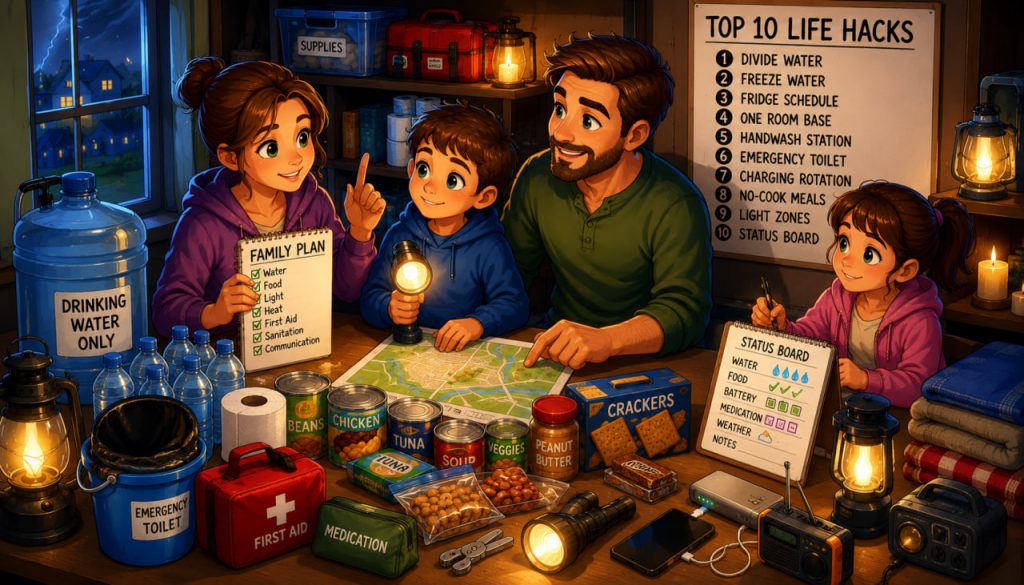
Long-term water and electricity outages can disrupt almost every part of daily life. Refrigerators stop cooling, taps may run dry, electronic payments can fail, toilets become difficult to use, and mobile devices gradually lose power.
The most useful outage strategies are not complicated survival tricks. They are simple household systems that conserve essential resources, reduce health risks, and help a family remain organized.
These ten practical life hacks can make an extended utility outage safer and more manageable.
1. Divide Your Water Supply by Purpose
Do not use all stored water from the same container for every household task.
Create three clearly separated categories:
- Drinking and cooking water
- Washing water
- Toilet-flushing water
The cleanest water should be reserved for drinking, preparing food, brushing teeth, and taking medication. Less valuable water can be used for cleaning, while rainwater or other approved non-potable water may be suitable for flushing toilets.
The CDC recommends storing at least one gallon, or approximately 3.8 liters, per person per day for a minimum of three days. A two-week supply is preferable when storage space allows.
Separating water by purpose prevents a family from accidentally using valuable drinking water for low-priority tasks.
2. Freeze Water Containers Before an Outage
When severe weather or planned maintenance may interrupt electricity, freeze containers of water in advance.
The frozen containers provide several benefits:
- They keep the freezer cold longer.
- They can be moved into the refrigerator.
- They become drinking water after thawing.
- They reduce unused air inside the freezer.
Do not fill rigid containers completely because water expands as it freezes. Leave enough empty space to prevent cracking.
A full freezer can generally hold a safe temperature for about 48 hours when kept closed, compared with approximately 24 hours for a half-full freezer.
3. Create a Refrigerator Opening Schedule
Every unnecessary refrigerator opening allows cold air to escape.
Instead of allowing family members to check the refrigerator throughout the day, agree on specific opening times. Before opening the door, decide exactly which items are needed and remove them together.
An unopened refrigerator generally keeps food cold for only about four hours during a power failure. Perishable foods such as meat, fish, eggs, milk, and leftovers may need to be discarded after that period unless they have remained at 4°C or below.
Use refrigerated food first, frozen food second, and shelf-stable supplies last.
4. Turn One Room Into the Family Base
During extreme heat or cold, do not try to maintain comfortable conditions throughout the entire home.
Choose one room as the family base. It should ideally have:
- Limited exterior walls
- Good ventilation when temperatures are high
- Doors that can be closed when temperatures are low
- Space for sleeping
- Easy access to emergency supplies
Move lanterns, blankets, water, medications, power banks, and communication equipment into this room.
Closing unused rooms can help retain warmth in winter. During hot weather, block direct sunlight with curtains and use the coolest safe area of the home.
Concentrating people and resources in one room simplifies supervision, lighting, temperature management, and communication.
5. Build a Handwashing Station
When taps stop working, ordinary handwashing becomes difficult.
A simple station can be created using:
- A container with a small tap or controlled spout
- A basin to catch wastewater
- Soap
- Paper towels or a clean reusable towel
- Hand sanitizer
Releasing a small controlled stream uses much less water than pouring from an open bottle.
Place the station near the toilet or food-preparation area, but keep clean water containers separated from wastewater. Safe hand hygiene becomes especially important when sewage systems, rubbish collection, or refrigeration are disrupted.
6. Use a Two-Bag Emergency Toilet System
A toilet may stop functioning when water is unavailable, building pumps fail, or the sewage system is damaged.
A sturdy bucket or existing toilet bowl can be lined with two heavy-duty waste bags. Add absorbent material such as cat litter, sawdust, shredded paper, or commercially produced toilet absorbent.
After use:
- Add another layer of absorbent material.
- Tie the inner bag securely.
- Place it inside a second sealed bag.
- Store it away from food, water, children, and animals.
Follow local disposal instructions as soon as they become available. Never flush manually when authorities warn that the sewage system is blocked or damaged.
7. Make a Daily Charging Rotation
Instead of charging every device whenever power becomes briefly available, prioritize equipment.
A practical order is:
- Medical devices
- One primary family phone
- Emergency radio
- Lighting
- Secondary phones
- Entertainment devices
Activate battery-saving mode, reduce screen brightness, disable unnecessary applications, and download essential information for offline use.
Keep one phone switched off or in airplane mode as a reserve. Alternative charging options may include power banks, solar chargers, or a car adapter, provided the vehicle is used safely outdoors rather than in an enclosed garage.
Ready.gov recommends maintaining alternative methods for charging phones during power outages.
8. Prepare No-Cook Meal Boxes
Organize shelf-stable food into complete daily meal boxes rather than storing everything in one large pile.
Each box might contain:
- Canned fish, beans, or meat
- Crackers or crispbread
- Nut butter
- Dried fruit
- Shelf-stable milk
- Ready-to-eat cereal
- A small treat
- Pet food when needed
This approach makes rationing easier and prevents the family from consuming the most convenient foods too quickly.
Include a manual can opener. Avoid depending entirely on foods that require large amounts of water or fuel to prepare.
9. Use Light Zones Instead of Lighting Every Room
Assign different lighting tools to specific purposes.
For example:
- A lantern for the family room
- Headlamps for cooking and repairs
- A small light for the bathroom
- Motion-activated battery lights for hallways
- One flashlight stored beside each bed
Headlamps are particularly useful because they leave both hands free.
Avoid relying heavily on candles. Open flames increase fire risk around children, pets, curtains, bedding, and unstable surfaces.
Never operate generators, charcoal grills, camping stoves, or other fuel-burning devices inside a home, garage, carport, or near windows and vents. They can produce deadly carbon monoxide, which has no color or smell.
10. Create a Visible Family Status Board
During a prolonged outage, uncertainty can lead to confusion and wasted supplies.
Use a whiteboard, notebook, or large sheet of paper to record:
- Remaining drinking water
- Food that must be eaten soon
- Battery and power-bank levels
- Medication schedules
- Official announcements
- Family members’ locations
- Daily responsibilities
- Conditions that would trigger evacuation
Update it at the same time every morning and evening.
This simple system reduces repeated questions and helps adults notice when essential resources are approaching dangerous levels.
A family should decide in advance when it will leave the home rather than waiting until water, medication, food, or safe indoor temperatures are completely exhausted.
Expert Perspective
Emergency-preparedness specialists use an all-hazards approach, focusing on needs that appear across many emergencies: safe water, food, sanitation, communication, medication, temperature protection, and reliable information.
Public-health guidance also shows that improvisation must have limits. Boiling clear water for one minute can kill many microorganisms, but it does not remove fuels, toxic chemicals, or radioactive contamination. Water authorities’ instructions must always take priority.
The central principle is clear: the best life hacks do not replace official safety guidance; they help families use limited resources more effectively while following it.
Interesting Facts
- A full freezer remains cold longer because frozen food creates a larger thermal mass.
- Clear water is not necessarily safe to drink because microorganisms may be invisible.
- Frozen water containers can serve as cooling blocks first and drinking water later.
- Apartment buildings may lose water before nearby houses because upper floors often depend on electric pumps.
- Headlamps usually provide more practical emergency lighting than handheld flashlights.
- Electronic payment terminals and cash machines may fail during widespread outages.
- Carbon monoxide cannot be detected by smell, sight, or taste.
- Ready-to-feed infant formula can be safer during a water emergency than powdered formula that requires mixing.
- Stored water should be protected from direct sunlight, fuel, pesticides, and other toxic substances.
- A written household inventory can prevent supplies from disappearing faster than expected.
Glossary
- Potable Water — Water that is considered safe for drinking and food preparation.
- Non-Potable Water — Water that is unsuitable for drinking but may be usable for cleaning or flushing.
- Thermal Mass — Material that absorbs and retains heat or cold, helping stabilize temperature.
- Shelf-Stable Food — Food that can remain safe at room temperature while unopened.
- Perishable Food — Food that can quickly become unsafe without proper refrigeration.
- Carbon Monoxide — A colorless, odorless poisonous gas produced by fuel-burning equipment.
- Power Bank — A portable rechargeable battery used to power electronic devices.
- Boil-Water Advisory — An official warning requiring tap water to be boiled before consumption.
- Sanitation — Safe management of waste and hygienic living conditions.
- Rationing — Controlled distribution and use of a limited resource.
- All-Hazards Approach — Emergency planning based on common needs created by many different disasters.
- Evacuation Trigger — A predetermined condition indicating that remaining at home is no longer safe.