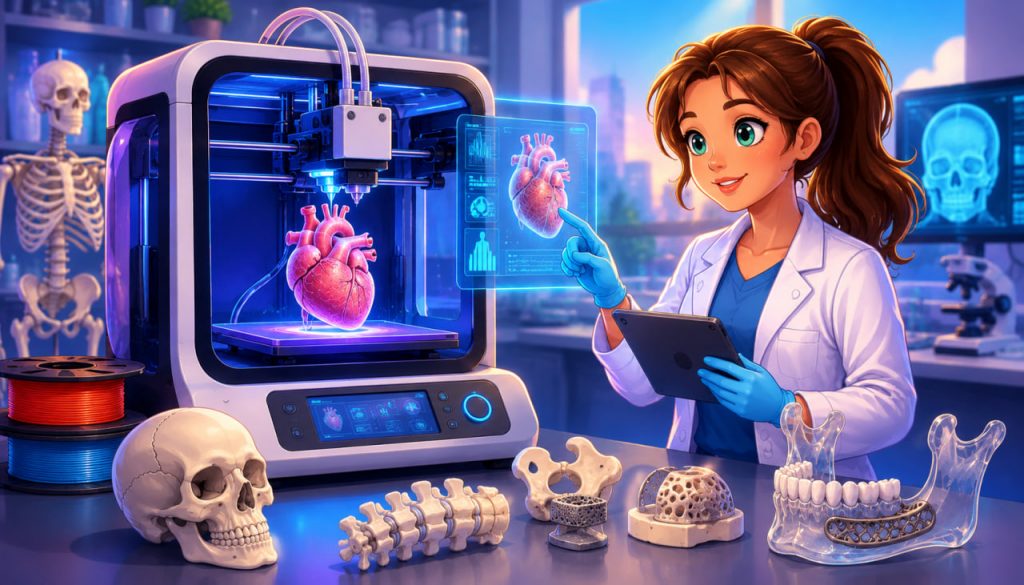
3D printing in medicine has moved far beyond experimental prototypes. Hospitals, dental laboratories, medical-device manufacturers, and research institutions now use the technology to create anatomical models, surgical tools, prosthetics, implants, and customized treatment solutions.
Also known as additive manufacturing, 3D printing builds an object layer by layer from a digital design. This approach allows engineers and clinicians to produce complex shapes that may be difficult or impossible to manufacture using traditional methods.
The greatest advantage is personalization. A medical product can be designed around the anatomy and clinical needs of an individual patient rather than produced only in standard sizes.
What Is Medical 3D Printing?
Medical 3D printing begins with a digital three-dimensional model. This model may be created using computer-aided design software or reconstructed from medical imaging data such as computed tomography or magnetic resonance imaging scans.
The printer then deposits, melts, hardens, or binds material in successive layers until the physical object is complete.
Depending on the application, manufacturers may use:
- Medical-grade polymers
- Titanium and other metals
- Ceramics
- Resins
- Hydrogels
- Cell-containing bioinks
The US Food and Drug Administration identifies orthopedic implants, cranial implants, surgical instruments, dental restorations, anatomical models, and external prosthetics among the established medical applications of 3D printing.
Patient-Specific Anatomical Models
One of the most practical applications of 3D printing in healthcare is the production of anatomical models.
Doctors can convert a patient’s scan into a physical replica of a bone, blood vessel, heart, tumor, or other structure. The model allows the clinical team to examine complicated anatomy before entering the operating room.
These models are particularly valuable in complex procedures involving:
- Congenital heart abnormalities
- Craniofacial reconstruction
- Spinal deformities
- Difficult fractures
- Tumor removal
- Vascular surgery
A surgeon can hold the model, study it from several angles, and rehearse important stages of the operation.
Better preparation can improve communication, clarify the surgical strategy, and help clinicians anticipate anatomical challenges.
Models can also help patients understand their diagnosis and proposed treatment. A physical replica is often easier to interpret than a two-dimensional scan displayed on a screen.
Customized Implants and Surgical Guides
Traditional implants are commonly manufactured in a limited range of standard shapes and sizes. However, human anatomy varies considerably.
3D printing allows manufacturers to produce implants that closely match a patient’s bone structure. This is especially useful in orthopedic, spinal, cranial, dental, and maxillofacial surgery.
Titanium is frequently used because it combines strength, corrosion resistance, and biocompatibility. Additive manufacturing can also create porous implant surfaces that encourage bone to grow into the device.
Surgeons may use customized cutting or drilling guides during an operation. These guides are designed to fit a specific anatomical surface and help the surgeon position instruments with greater precision.
The FDA reports that additive manufacturing has become an important production method for devices such as metal spinal cages and hearing aids. The agency had cleared more than 100 additively manufactured devices by 2023.
Prosthetics and Orthotic Devices
3D printing can make prosthetic and orthotic production faster and more adaptable.
A digital scan of a patient’s body may be used to design a personalized socket, brace, splint, or external support. Adjustments can be made digitally without rebuilding the entire design from the beginning.
This approach may be especially helpful for children, whose devices must be replaced or modified as they grow.
Customized designs can also improve comfort, appearance, and function. However, a 3D-printed prosthetic still requires professional fitting, mechanical testing, and appropriate medical supervision.
The fact that an object can be printed does not automatically mean it is safe for clinical use.
3D Printing in Dentistry
Dentistry is one of the areas where 3D printing has achieved widespread practical adoption.
Dental professionals use digital scanning and additive manufacturing to create:
- Surgical guides
- Temporary crowns
- Denture components
- Orthodontic models
- Aligners and aligner molds
- Bite splints
- Custom trays
Digital workflows can reduce the need for conventional impressions and allow laboratories to reproduce designs consistently.
A patient’s mouth can be scanned, the restoration or appliance can be designed on a computer, and the required component can then be printed or manufactured from the digital file.
This combination of speed and customization has made dentistry one of the most visible examples of medical additive manufacturing.
Personalized Medicines and Drug Delivery
Researchers are also studying 3D printing as a method for producing personalized medications.
A printed tablet could potentially be customized according to the required dose, shape, internal structure, or drug-release profile. Several active ingredients might also be combined into a single carefully designed pill.
This could be useful for children, older adults, and people who need complex medication schedules.
Research suggests that 3D printing can adjust medication geometry, dosage, and release behavior, creating opportunities for more individualized drug delivery.
However, printed medicines must meet strict requirements for dose accuracy, stability, manufacturing consistency, and quality control. Personalized pharmaceutical printing is therefore a promising field, but it is not yet routine in most healthcare settings.
What Is 3D Bioprinting?
3D bioprinting is different from printing a plastic anatomical model or metal implant.
Instead of using only conventional manufacturing materials, bioprinting places living cells and supportive biomaterials in controlled patterns. The goal is to create tissue-like structures that reproduce aspects of human biology.
A bioink may contain:
- Living cells
- Hydrogels
- Growth-supporting substances
- Structural biomaterials
Researchers are developing bioprinted skin, cartilage, bone-like tissue, blood-vessel structures, tumor models, and miniature tissue systems for laboratory research.
These constructs can help scientists study diseases and test potential medicines in environments that may resemble human tissue more closely than ordinary flat cell cultures.
Modern bioprinting research is increasingly focused on multifunctional bioinks and scaffolds that support cell survival, organization, and tissue development.
Can Scientists Print Human Organs?
The idea of printing a complete replacement heart, liver, or kidney attracts enormous attention. However, fully functional transplantable organs are much more difficult to create than simple tissue structures.
A large organ contains multiple cell types arranged in an extremely precise architecture. It also requires blood vessels capable of delivering oxygen and nutrients throughout the tissue.
Researchers have made progress in printing vascular networks and tissue constructs, but producing a durable, safe, fully functional organ remains a major scientific challenge. NIH-supported research has demonstrated techniques for creating complex channels that can transport fluids through printed structures, an important step toward larger engineered tissues.
At present, patients should not expect hospitals to routinely print complete replacement organs for transplantation.
Bioprinting is currently more advanced as a research tool, a platform for drug testing, and a method for producing smaller or less complex tissue constructs.
Expert Perspective
The World Health Organization describes 3D bioprinting as a technology that could eventually help address the need for human tissue repair and organ replacement.
At the same time, WHO experts emphasize that its development raises major questions concerning safety, effectiveness, ethical governance, regulation, and equal access.
This perspective is important because medical innovation must be evaluated by more than technical possibility.
A printed tissue, implant, or device must perform reliably, remain safe over time, and provide a meaningful clinical benefit. Healthcare systems must also decide who will have access to advanced personalized treatments and how those treatments will be regulated.
Safety and Regulatory Challenges
Medical 3D printing creates several quality-control challenges.
A small change in printer calibration, raw material, temperature, layer thickness, or post-processing can affect the final product.
Manufacturers must consider:
- Mechanical strength
- Material purity
- Sterility
- Biocompatibility
- Printing consistency
- Design validation
- Long-term durability
- Traceability of digital files
The FDA has issued technical guidance addressing design, manufacturing, testing, and process considerations for additively manufactured medical devices.
Bioprinting introduces additional difficulties because living cells are sensitive to mechanical pressure, temperature, nutrients, and environmental conditions.
For clinical use, researchers must demonstrate that printed tissues remain viable, behave as intended, integrate safely with the body, and do not create unacceptable risks.
The Future of 3D Printing in Healthcare
The next stage of medical 3D printing will probably involve closer integration with medical imaging, robotics, artificial intelligence, and advanced biomaterials.
Hospitals may increasingly produce selected models, guides, and devices near the point of care. Digital designs could also support faster responses when conventional supply chains are disrupted.
At the same time, the technology will not replace doctors, engineers, or traditional manufacturing.
Its greatest value lies in giving medical teams new ways to plan, personalize, test, and manufacture treatments that were previously difficult to create.
Interesting Facts
- 3D printing usually creates objects by adding material rather than cutting it away.
- Hearing aids were among the earliest medical products to adopt highly customized digital manufacturing.
- A physical anatomical model can be created from a patient’s CT or MRI data.
- Titanium implants can be printed with porous surfaces designed to support bone integration.
- Bioprinted tissues are already used in research and experimental drug-screening systems.
- Creating blood-vessel networks is one of the biggest challenges in printing thick living tissues.
- The same digital model can be modified without producing an entirely new physical mold.
- Medical 3D printing may be performed by specialized manufacturers, laboratories, or qualified healthcare institutions.
Glossary
- 3D Printing — A manufacturing process that builds a physical object layer by layer from a digital model.
- Additive Manufacturing — The technical term for production methods that create objects by adding material.
- Bioprinting — The controlled placement of living cells and biomaterials to create tissue-like structures.
- Bioink — A printable biological material that may contain cells, hydrogels, and supportive substances.
- Biocompatibility — The ability of a material or device to function in the body without causing an unacceptable harmful response.
- Anatomical Model — A physical representation of a body structure created for education, planning, or diagnosis.
- Surgical Guide — A patient-specific tool that helps position surgical instruments during a procedure.
- Scaffold — A supporting structure designed to help cells attach, grow, and organize.
- Hydrogel — A water-rich polymer material commonly used in tissue engineering and bioprinting.
- Vascularization — The formation or inclusion of blood vessels within a tissue.
- Point of Care — The location where medical treatment is delivered, such as a hospital or clinic.
- Computer-Aided Design — Software-based creation and modification of digital three-dimensional models.