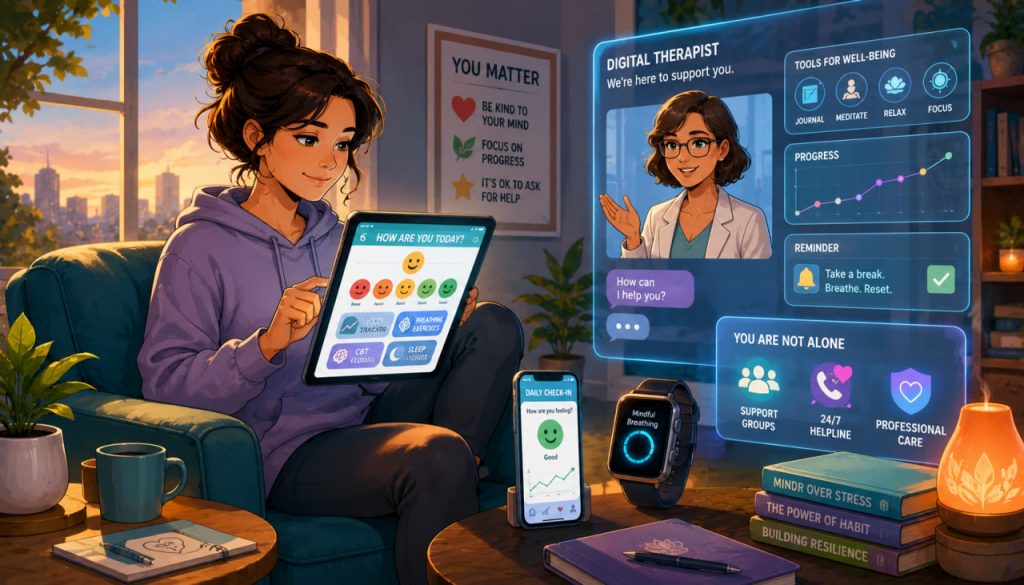
Digital therapists and mental health apps promise support that is available at any hour, often at a lower cost than traditional therapy. They can guide users through breathing exercises, cognitive behavioral therapy lessons, mood tracking, sleep programmes, journaling, and structured coping strategies.
Some products are simple wellness tools. Others are clinically tested digital interventions, and a smaller group may be regulated as medical devices.
This distinction matters because an attractive interface and an artificial intelligence chatbot do not automatically make an app safe or effective.
Digital mental health tools can improve access and support treatment, but they should not be treated as universal replacements for qualified human care.
What Is a Digital Therapist?
“Digital therapist” is an informal term covering several different technologies.
It may refer to:
- A chatbot that conducts supportive conversations
- A structured cognitive behavioral therapy programme
- An app that teaches coping skills
- A platform connecting patients with licensed clinicians
- A virtual reality treatment
- A regulated digital therapeutic prescribed for a specific condition
- An AI system that monitors symptoms or suggests exercises
These products do not all have the same evidence, purpose, or legal status.
A meditation app designed for general relaxation is different from software intended to treat diagnosed depression. The second may qualify as software as a medical device, depending on its claims, functions, and national regulations.
The US Food and Drug Administration maintains a dedicated Digital Health Center of Excellence and evaluates certain software functions as medical devices when they are intended to diagnose, prevent, monitor, or treat disease.
How Mental Health Apps Work
Many evidence-based mental health apps use principles from cognitive behavioral therapy, commonly known as CBT.
CBT helps people identify unhelpful patterns of thought and behavior, test those patterns, and develop more constructive responses. A digital programme may divide this process into short interactive lessons.
Typical features include:
- Mood and symptom questionnaires
- Thought records
- Behavioral activation plans
- Exposure exercises
- Sleep diaries
- Relaxation training
- Medication reminders
- Progress charts
- Messages from a clinician or coach
Some apps adapt content according to a user’s responses. Others rely on fixed modules completed in a predetermined order.
NICE has recommended selected digitally enabled therapies for depression and anxiety within NHS Talking Therapies while additional evidence is collected. Importantly, these programmes are used within an organized healthcare pathway rather than offered as unmonitored substitutes for all professional treatment.
What Benefits Can Digital Therapy Provide?
The most obvious benefit is accessibility.
A person living far from a clinic may be able to begin a structured programme immediately. Apps can also help people who face mobility limitations, long waiting lists, work constraints, financial barriers, or anxiety about attending appointments.
Other potential advantages include:
- Privacy and convenience
- Repeated practice between therapy sessions
- Consistent delivery of structured material
- Real-time symptom tracking
- Lower delivery costs
- Support outside normal clinic hours
- Easier monitoring of long-term patterns
The National Institute of Mental Health notes that mobile technologies can offer convenience, anonymity, lower cost, broader reach, and continuous collection of relevant information. It also warns that effectiveness, privacy, regulation, and crisis response differ widely between products.
The strongest use of an app may be to extend good care beyond the consulting room, not to eliminate the therapist.
Are Mental Health Apps Effective?
The evidence is mixed because the category is extremely broad.
A structured programme based on established therapy and tested in controlled trials should not be evaluated in the same way as a generic mood chatbot created without clinical oversight.
Research suggests that some digital interventions can reduce symptoms of depression, anxiety, insomnia, and substance-use disorders. Results tend to be stronger when programmes contain evidence-based therapeutic content, personalized feedback, or access to human support.
However, effectiveness in a clinical trial does not guarantee effectiveness in everyday use. Participants in studies may receive reminders, technical help, and regular assessments that ordinary customers do not receive.
User dropout is one of the largest problems. Many people download a mental health app, use it briefly, and then stop before completing enough material to benefit. Recent research identifies usability, personalization, motivation, privacy concerns, technical problems, and intervention complexity as important influences on engagement.
AI Chatbots Are Not the Same as Therapists
Generative AI can produce fluent, empathetic-sounding responses. This makes a chatbot feel attentive and psychologically insightful.
But conversational fluency is not clinical judgment.
An AI system may:
- Misunderstand the seriousness of symptoms
- Provide inaccurate information
- Reinforce a user’s distorted beliefs
- Miss signs of psychosis, mania, abuse, or suicide risk
- Respond inconsistently to similar situations
- Invent facts or resources
- Fail to understand cultural and personal context
In November 2025, an FDA advisory committee specifically examined generative AI-enabled digital mental health medical devices, including their possible benefits, health risks, required evidence, and need for post-market monitoring.
WHO guidance on artificial intelligence in healthcare emphasizes transparency, safety, accountability, data protection, human oversight, and careful evaluation rather than assuming that technological sophistication guarantees clinical value.
A chatbot may simulate therapeutic conversation, but it does not automatically possess professional qualifications, ethical responsibility, or dependable crisis judgment.
Privacy Is a Mental Health Issue
Mental health information is exceptionally sensitive.
An app may collect mood entries, diagnoses, sleep patterns, conversations, medication use, location data, device identifiers, and information about relationships or traumatic experiences.
Users should determine:
- What information is collected
- Where it is stored
- Whether it is encrypted
- Who can access it
- Whether it is shared with advertisers or analytics companies
- Whether conversations are used to train AI models
- How data can be deleted
- What happens if the company closes
A general consumer app may not receive the same legal protection as records held by a hospital or licensed clinician.
Privacy policies can also change. A company’s reputation, ownership, and business model are therefore relevant when selecting a service.
Can an App Diagnose Depression or Anxiety?
Screening questionnaires can identify symptoms that may deserve attention. They cannot independently provide a complete diagnosis.
A proper clinical assessment considers symptom duration, severity, medical conditions, medication effects, substance use, sleep, trauma, family history, functioning, and alternative explanations.
For example, fatigue and low mood may be related to depression, but they may also accompany anemia, thyroid disease, chronic pain, sleep disorders, medication effects, or another illness.
Digital assessment tools can help organize information before an appointment. NICE has evaluated “digital front door” technologies that gather patient information for anxiety and depression assessments, but such systems remain part of a wider clinical service.
When Digital Tools Are Not Enough
An app is not an appropriate sole source of support during a mental health emergency.
Urgent professional help is necessary when someone has:
- Thoughts of suicide or self-harm
- Plans or intent to harm another person
- Hallucinations or severe confusion
- Symptoms of mania
- Inability to care for basic needs
- Severe withdrawal from alcohol or drugs
- Immediate danger from abuse or violence
Digital programmes may also be insufficient for severe depression, complex trauma, eating disorders, psychosis, bipolar disorder, or complicated substance dependence unless they are incorporated into professionally supervised care.
People should never stop psychiatric medication solely because an app or chatbot advises them to do so.
How to Choose a Mental Health App
Begin with the app’s purpose. Is it intended for general well-being, symptom monitoring, or treatment of a diagnosed disorder?
Look for:
- Involvement of qualified mental health professionals
- Published studies involving the actual product
- Clear explanation of intended users
- Transparent limitations
- Crisis and emergency instructions
- Strong privacy protections
- No exaggerated cure claims
- Regulatory authorization when applicable
- A realistic plan for human support
Be cautious when a product promises to replace every therapist, diagnose several disorders instantly, or produce guaranteed results.
Ratings in an app store mainly reflect user satisfaction and marketing success. They do not establish clinical effectiveness.
Expert Perspective
Digital mental health researcher John Torous and colleagues describe the field as promising but still affected by evidence gaps, implementation failures, weak engagement, and difficulty translating research products into routine care. They argue that co-design, rigorous evaluation, and implementation science are essential for meaningful progress.
WHO’s approach to digital health similarly emphasizes that technology should strengthen health systems and improve informed decision-making rather than become an objective by itself. Digital interventions must be assessed for benefits, harms, feasibility, acceptability, resource demands, and equity.
The most credible future is not “AI instead of therapists,” but carefully evaluated technology working alongside clinicians, patients, families, and public health services.
Interesting Facts
- Digital mental health includes apps, teletherapy, virtual reality, online CBT, wearable sensors, and AI systems.
- Some mental health software is regulated as a medical device, while many wellness apps are not.
- A product’s clinical claims help determine whether medical-device rules may apply.
- Human guidance often improves completion of digital therapy programmes.
- App-store popularity does not prove therapeutic effectiveness.
- Mood tracking can reveal patterns involving sleep, stress, work, and medication.
- Frequent symptom monitoring may help some users but make others more preoccupied with their condition.
- Virtual reality can create controlled environments for exposure-based therapy.
- AI-generated empathy can feel convincing even when the underlying response is inaccurate.
- Digital exclusion may prevent people without suitable devices, internet access, or technical skills from benefiting.
- Mental health data can be more sensitive than ordinary shopping or entertainment data.
- A high-quality app should clearly state what it cannot do.
Glossary
- Digital Mental Health — The use of digital technologies to support mental well-being, assessment, prevention, or treatment.
- Digital Therapist — An informal term for software that provides therapeutic exercises, conversations, or mental health support.
- Mental Health App — A mobile or web application designed to support psychological well-being or mental healthcare.
- Digital Therapeutic — Software intended to prevent, manage, or treat a medical condition using a clinically evaluated intervention.
- Software as a Medical Device — Software performing a medical function without being part of physical medical equipment.
- Cognitive Behavioral Therapy — A structured therapy addressing connections among thoughts, emotions, and behavior.
- Behavioral Activation — A therapeutic method that encourages meaningful activity to reduce avoidance and improve mood.
- Exposure Therapy — Gradual, controlled contact with feared situations or sensations to reduce anxiety.
- Teletherapy — Therapy delivered remotely through telephone, video, or secure messaging.
- Generative AI — Artificial intelligence that produces new text, images, audio, or other content.
- Clinical Validation — Testing that determines whether a healthcare product performs safely and effectively for its intended purpose.
- Randomized Controlled Trial — A study in which participants are assigned to different interventions for comparison.
- Engagement — The extent to which users actively and consistently interact with a digital intervention.
- Attrition — Participants stopping use or leaving a programme before completion.
- Screening — Preliminary identification of people who may have symptoms requiring further assessment.
- Human Oversight — Review or supervision by qualified people who can intervene when technology fails.
- Encryption — Protection of digital information by converting it into a form inaccessible without authorization.
- Post-Market Monitoring — Continued safety and performance evaluation after a medical product becomes available.
- Interoperability — The ability of different digital systems to exchange and use information.
- Digital Divide — Inequality in access to devices, internet connectivity, skills, or digital services.