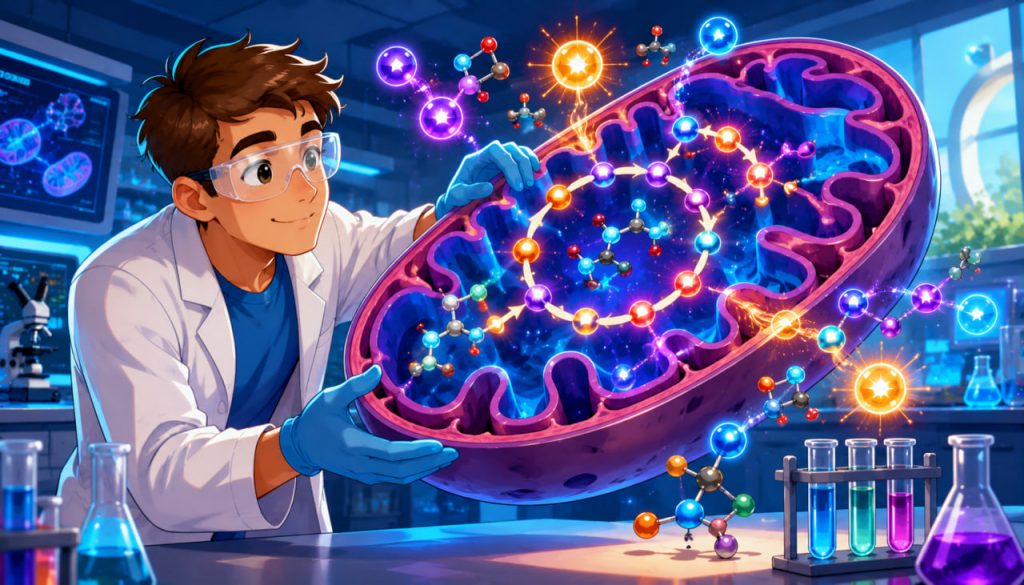
Every second of every day, trillions of cells in your body require energy to perform essential tasks. Muscles contract, neurons transmit signals, organs function, and cells repair themselves—all powered by a remarkable biochemical process occurring deep within microscopic structures called mitochondria.
At the heart of this energy-production system lies the Krebs Cycle, also known as the Citric Acid Cycle or Tricarboxylic Acid (TCA) Cycle. This metabolic pathway is one of the most important processes in biology because it helps convert nutrients from food into usable cellular energy.
Without the Krebs Cycle, complex life as we know it would not exist. Every animal, plant, fungus, and many microorganisms rely on this process to extract energy from carbohydrates, fats, and proteins.
Understanding the Krebs Cycle reveals how the body transforms a meal into the energy needed to think, move, grow, and survive.
What Is the Krebs Cycle?
The Krebs Cycle is a series of chemical reactions that occur inside the mitochondria of cells.
Its primary role is to:
- Break down carbon-containing molecules
- Release stored chemical energy
- Generate molecules used for ATP production
ATP (adenosine triphosphate) is often called the energy currency of the cell.
The Krebs Cycle does not directly produce large amounts of ATP. Instead, it creates energy-rich molecules that fuel later stages of cellular respiration.
Who Discovered the Krebs Cycle?
The cycle was discovered in 1937 by Hans Adolf Krebs.
Krebs carefully studied how cells process nutrients and identified the sequence of reactions that now bears his name.
His work revolutionized biochemistry and earned him the Nobel Prize in Physiology or Medicine in 1953.
Today, the Krebs Cycle remains one of the most studied pathways in biology.
Where Does the Krebs Cycle Take Place?
In animals and plants, the cycle occurs within the mitochondria.
These structures are often called the powerhouses of the cell because they generate most of the cell’s energy.


5
Each cell may contain hundreds or even thousands of mitochondria depending on its energy needs.
Muscle cells, for example, contain particularly large numbers because they require substantial energy.
How Does the Krebs Cycle Begin?
Before the Krebs Cycle can start, glucose from food undergoes a process called glycolysis.
This process breaks glucose into smaller molecules.
Eventually, a molecule called acetyl-CoA enters the Krebs Cycle.
Acetyl-CoA combines with another molecule called oxaloacetate to form citrate.
This reaction gives the cycle its alternative name: the Citric Acid Cycle.
The Main Steps of the Krebs Cycle
The cycle consists of several enzyme-controlled reactions.
During these reactions:
- Citrate is modified repeatedly.
- Carbon atoms are removed.
- Carbon dioxide is released.
- Energy-rich molecules are generated.
- Oxaloacetate is regenerated.
Because the starting molecule is recreated at the end, the process forms a continuous cycle.
This elegant design allows cells to repeat the process thousands of times every second.
Why Carbon Dioxide Is Produced
One of the cycle’s byproducts is carbon dioxide (CO₂).
This gas is transported through the bloodstream to the lungs and eventually exhaled.
In a sense, every breath you take contains carbon atoms that were recently processed through the Krebs Cycle.
The carbon dioxide released during respiration is a direct consequence of extracting energy from food molecules.
The Energy Harvest
The Krebs Cycle generates several important molecules:
- NADH
- FADH₂
- ATP (small amounts)
These molecules carry energy to the next stage of cellular respiration.
The majority of ATP is produced later through the electron transport chain.
The Krebs Cycle acts as a crucial energy-harvesting hub rather than the final energy-producing step.
Why Oxygen Is Essential
Although oxygen does not directly participate in the Krebs Cycle itself, the cycle depends on oxygen being available.
Without oxygen:
- NADH accumulates.
- Energy transfer slows.
- The cycle eventually stops.
This explains why oxygen is so important for aerobic organisms.
Every breath helps maintain the biochemical processes that keep cells alive.
The Krebs Cycle Connects All Food Sources
One of the most remarkable features of the cycle is its versatility.
The body can feed into the Krebs Cycle using energy derived from:
- Carbohydrates
- Fats
- Proteins
This makes the cycle a central metabolic hub.
Regardless of whether you eat bread, fish, vegetables, or nuts, much of the extracted energy eventually passes through the Krebs Cycle.
Beyond Energy Production
The Krebs Cycle serves purposes beyond ATP generation.
Its intermediate molecules help produce:
- Amino acids
- Fatty acids
- Neurotransmitters
- Other important biomolecules
Because of this, the cycle supports both energy production and cellular construction.
Expert Perspective
Biochemist Hans Adolf Krebs emphasized that metabolism is not a collection of isolated reactions but an interconnected network. His discovery demonstrated how cells efficiently recycle molecules through cyclic pathways, allowing organisms to maximize energy extraction from nutrients.
Modern research continues to confirm the central importance of the Krebs Cycle in health, disease, aging, and cellular function.
The Krebs Cycle and Human Health
Disruptions to mitochondrial function can affect energy production.
Researchers study the Krebs Cycle in relation to:
- Metabolic disorders
- Cancer
- Neurodegenerative diseases
- Aging
- Exercise physiology
Understanding how the cycle works helps scientists develop new approaches to medicine and biotechnology.
Why the Krebs Cycle Matters
The Krebs Cycle is one of the most fundamental processes in life.
Every heartbeat, muscle movement, thought, and breath depends on energy generated through pathways connected to this cycle.
It transforms nutrients into biochemical fuel, links multiple metabolic systems, and supports the functioning of virtually every cell in the body.
Few discoveries in biology have been as influential or as universally important.
Interesting Facts
- The Krebs Cycle operates billions of times every second throughout the human body.
- Hans Krebs discovered the cycle in 1937.
- The cycle occurs inside mitochondria.
- Carbon dioxide that you exhale is partly produced through the Krebs Cycle.
- The pathway helps process carbohydrates, fats, and proteins.
- Many cancer researchers study alterations in Krebs Cycle metabolism.
Glossary
- ATP — The primary energy-carrying molecule used by cells.
- Mitochondria — Organelles that generate most cellular energy.
- Acetyl-CoA — A molecule that enters the Krebs Cycle.
- Citrate — The first major compound formed in the cycle.
- NADH — An energy-carrying molecule produced during metabolism.
- FADH₂ — Another molecule that transports energy to the electron transport chain.
- Cellular Respiration — The process by which cells extract energy from nutrients.
- Metabolism — The collection of chemical reactions that sustain life.