Snake bites can be frightening and potentially dangerous, especially in regions where venomous species are common. However, with the right knowledge and immediate first aid, the risks can be significantly reduced. Understanding how to respond quickly and correctly can save lives and prevent serious complications. This guide provides a detailed, science-based approach to snake bite first aid, helping you stay prepared in emergency situations.
Understanding Snake Bites
Snake bites occur when a snake injects venom through its fangs. Not all snakes are venomous, and even venomous snakes do not always inject venom with every bite (a “dry bite”).
Venom affects the body in different ways depending on the species:
- Hemotoxic venom damages blood cells and tissues
- Neurotoxic venom affects the nervous system
- Cytotoxic venom causes localized tissue destruction
Symptoms can vary but may include:
- Severe pain and swelling
- Bruising or bleeding
- Nausea or vomiting
- Difficulty breathing
- Weakness or paralysis in severe cases
Recognizing early signs is crucial for proper treatment.
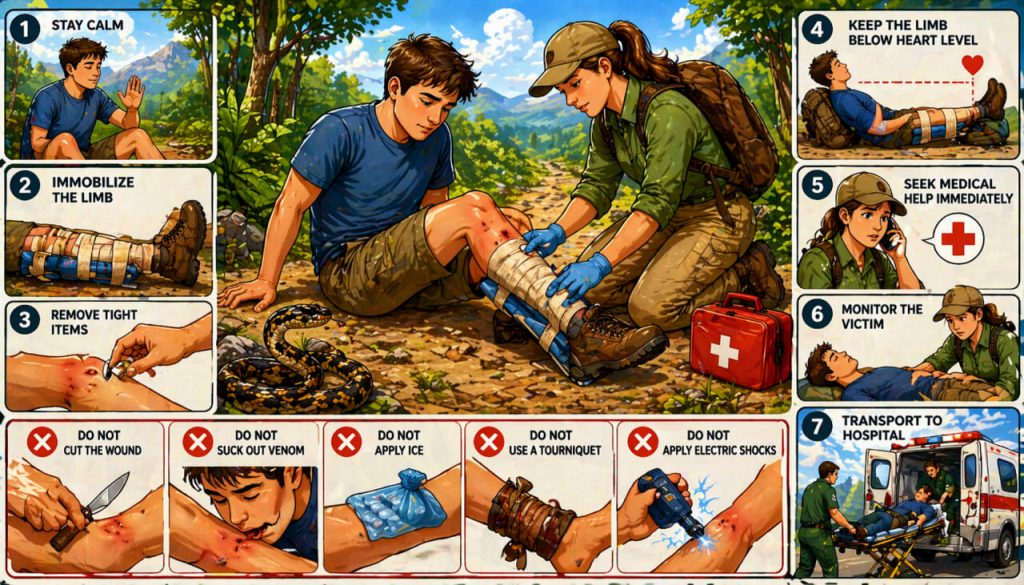
Stay Calm and Limit Movement
The most important first step is to remain calm. Panic increases heart rate, which can cause venom to spread more quickly through the bloodstream.
If bitten:
- Sit or lie down immediately
- Keep movement to a minimum
- Reassure the victim if helping someone else
Staying calm is not just psychological—it directly affects how quickly venom spreads.
Immobilize the Affected Limb
Keeping the bitten area still is essential. Movement accelerates venom circulation.
Proper steps:
- Keep the limb below heart level
- Use a splint or sling to immobilize it
- Avoid walking if possible
This technique is similar to treating fractures and helps slow the spread of toxins.
Remove Tight Items
Swelling can develop rapidly after a bite.
Immediately remove:
- Rings
- Bracelets
- Tight clothing or shoes
This prevents complications caused by restricted blood flow as swelling increases.
Seek Medical Attention Immediately
Professional medical care is critical. Antivenom is the only effective treatment for venomous snake bites.
Actions to take:
- Call emergency services right away
- Transport the victim to the nearest hospital
- Inform medical staff about the situation
If possible, note the snake’s appearance (color, size, pattern), but do not attempt to capture or photograph it at close range.
What NOT to Do
Many outdated methods are still widely believed but can be dangerous.
Avoid the following:
- Do not cut the wound
- Do not suck out the venom
- Do not apply ice
- Do not use a tourniquet
- Do not apply electric shocks
These methods are ineffective and can worsen the injury.
Pressure Immobilization Technique (Advanced)
In some cases, especially with neurotoxic bites, a pressure immobilization bandage may be recommended.
This involves:
- Wrapping the limb firmly with a bandage
- Starting from the bite site and moving upward
- Ensuring circulation is not completely blocked
This technique should only be used if properly understood, as incorrect application can cause harm.
Monitoring the Victim
While waiting for medical help, closely observe the victim’s condition.
Watch for:
- Increasing swelling
- Changes in breathing
- Loss of consciousness
- Signs of allergic reaction
Keep the person warm, still, and reassured until help arrives.
Expert Insight
According to the World Health Organization (WHO), snakebite envenoming is a neglected tropical disease that affects millions annually.
Dr. David Williams, a toxinologist and expert advisor to WHO, explains:
“The most important factors in surviving a snakebite are rapid access to medical care and minimizing movement after the bite. Improvised treatments often do more harm than good.”
This reinforces the importance of proper first aid and avoiding myths.
Prevention: Reducing the Risk
Preventing snake bites is always better than treating them.
Simple precautions include:
- Wearing boots and long pants outdoors
- Using a flashlight at night
- Avoiding tall grass and dense vegetation
- Not reaching into hidden spaces
- Staying on clear paths
Awareness and caution significantly lower the chances of an encounter.
Interesting Facts
- Many venomous snakes can control how much venom they inject.
- Some bites are “dry,” meaning no venom is released.
- Antivenom is made using small doses of venom to create antibodies.
- Snakebite treatment has improved significantly over the past century.
- Most snakebite fatalities occur due to delayed medical care, not the bite itself.
Glossary
- Venom — a toxic substance injected by animals to immobilize or defend.
- Antivenom — a medical treatment that neutralizes snake venom.
- Envenoming — the process of venom entering the body.
- Hemotoxic — affecting blood and tissues.
- Neurotoxic — affecting the nervous system.