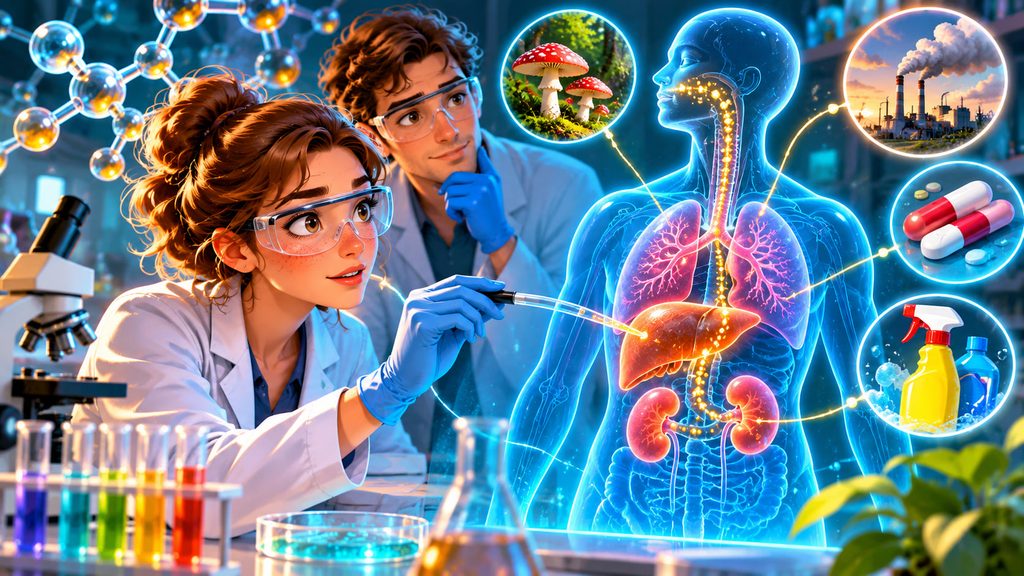
A common painkiller, a household cleaning product, or even the air inside your home can become dangerous under certain circumstances. Some substances can cause serious harm within minutes, while others may affect health gradually over many years. Surprisingly, the difference between something beneficial and something poisonous is not always as straightforward as it seems.
This is where toxicology becomes essential. Often described as the science of poisons, toxicology investigates how chemicals and other harmful agents interact with living organisms, why some exposures cause illness, and how dangerous effects can be prevented.
The most fascinating discovery in toxicology is that danger depends not only on what a substance is, but also on how much enters the body, how exposure occurs, and how the body responds.
What Is Toxicology and Why Is It Important?
Toxicology is the scientific study of the harmful effects that chemical substances, biological agents, and environmental exposures can produce in living organisms. Although the field originally focused heavily on poisons, modern toxicology has expanded into medicine, food safety, environmental protection, pharmaceutical research, and public health.
Toxicologists investigate everything from accidental medication overdoses to industrial pollutants and naturally occurring toxins. Their research helps establish safety limits, identify potentially hazardous substances, and understand how chemicals affect different organs and biological systems. Without toxicology, developing safe medicines, regulating industrial chemicals, and protecting drinking water would be considerably more difficult.
The Famous Principle: The Dose Makes the Poison
One of the most important ideas in toxicology comes from the sixteenth-century physician and alchemist Paracelsus, widely recognized as a foundational figure in the field. He argued that substances cannot be judged solely by their identity because the amount consumed or absorbed plays a crucial role in determining their effects.
Consider water, which is essential for human survival. Drinking appropriate amounts supports normal physiological functions, but consuming excessive quantities within a short period can dangerously dilute sodium in the bloodstream. Similarly, medications that provide therapeutic benefits at recommended doses may cause serious organ damage when taken in excessive amounts.
The principle that the dose makes the poison remains fundamental to modern toxicology, although scientists also consider exposure duration, individual susceptibility, and whether certain effects can occur even at very low doses.
How Do Toxic Substances Enter the Human Body?
Harmful substances can enter the body through several pathways, including swallowing, breathing, skin contact, and injection. These different exposure routes influence how quickly a substance reaches the bloodstream and which organs may be affected. Inhaled gases, for example, can enter the circulation through the lungs, while swallowed chemicals must first pass through the digestive system.
Once absorbed, substances may circulate through the blood, accumulate in particular tissues, or undergo chemical changes inside the body. The liver plays a major role in processing many compounds, while the kidneys help remove numerous substances and their breakdown products through urine.
Interestingly, the body sometimes transforms a relatively less harmful compound into a more toxic metabolite. The danger of a chemical therefore depends not only on the original substance but also on what happens to it after exposure.
Everyday Substances That Can Become Dangerous
Some of the most important toxicological risks involve familiar products rather than exotic poisons. Paracetamol, also known as acetaminophen, is widely used to relieve pain and reduce fever, but excessive intake can cause severe liver injury. Accidental overdoses sometimes occur when people unknowingly combine several medications containing the same active ingredient.
Carbon monoxide provides another striking example. This colorless, odorless gas can be produced by malfunctioning fuel-burning appliances, generators, and other combustion sources. It interferes with the body’s ability to deliver oxygen to tissues and may cause headaches, dizziness, confusion, unconsciousness, or death.
Household cleaning products also require care because some contain irritating or corrosive chemicals, and combining incompatible products can release dangerous fumes. A product being common, commercially available, or useful does not mean that every form of exposure is safe.
Acute Poisoning vs. Chronic Toxicity
Toxicologists distinguish between acute and chronic exposure because harmful effects can develop over very different timescales. Acute poisoning generally results from a relatively short exposure and may produce symptoms such as nausea, breathing difficulties, confusion, or seizures. Depending on the substance, these symptoms can appear rapidly or remain delayed for several hours.
Chronic toxicity develops through repeated or prolonged exposure, sometimes involving amounts too small to produce immediate symptoms. Lead is a particularly important example because long-term exposure can damage the nervous system and contribute to developmental problems in children. Certain persistent environmental contaminants may also remain in the body or environment for extended periods.
The absence of immediate symptoms does not always mean that exposure was harmless, particularly when substances accumulate or produce damage gradually.
Why Are Children More Vulnerable to Certain Poisons?
The same chemical exposure does not necessarily produce identical effects in every person. Age, body weight, genetics, nutritional status, and existing medical conditions can influence how substances are absorbed, distributed, metabolized, and eliminated. Children are often particularly vulnerable because their bodies and nervous systems are still developing.
Young children may also encounter household chemicals through behaviors such as putting objects into their mouths or exploring unfamiliar containers. During pregnancy, certain substances can interfere with fetal development, making the timing of exposure especially important.
Modern toxicologists investigate these sensitive periods to better understand long-term health consequences. A dose that produces limited effects in one person may be considerably more dangerous to someone at a vulnerable developmental stage.
How Scientists Discover Whether Something Is Toxic
Determining whether a chemical is dangerous involves much more than observing whether it causes immediate illness. Researchers investigate cellular changes, organ damage, exposure levels, and biological mechanisms using laboratory experiments, human exposure data, computational models, and other scientific methods.
Modern toxicology increasingly uses advanced cell cultures, organ-on-chip systems, and computer-based predictions to investigate potential hazards. These approaches can reveal important biological effects while helping reduce reliance on traditional animal testing.
Scientists also distinguish between hazard and risk. A hazard describes a substance’s potential to cause harm, while risk considers the likelihood of harm under actual exposure conditions. This distinction explains why identifying a dangerous property does not automatically tell us how much danger a particular real-world situation presents.
Can Poisoning Be Treated With Antidotes?
Some types of poisoning can be treated with specific antidotes, although no universal antidote exists. One well-known example is N-acetylcysteine, a medication used in hospitals to help prevent or reduce liver damage following certain acetaminophen overdoses. Its effectiveness depends on the circumstances, making prompt medical evaluation particularly important.
Other treatments may focus on supporting breathing, maintaining circulation, correcting metabolic disturbances, or preventing further absorption of the harmful substance. In selected cases, specialists may use activated charcoal or treatments that help remove particular toxic compounds.
Suspected poisoning requires professional advice rather than home experimentation. Inducing vomiting, taking activated charcoal without medical direction, or attempting to neutralize a swallowed chemical can make the situation more dangerous.
How Can Toxicology Help Keep Us Safe?
Understanding toxicology helps people make practical decisions about medication, cleaning products, indoor air quality, and environmental exposures. Following medicine labels, storing chemicals securely, using cleaning products as directed, and installing carbon monoxide alarms are simple measures that can prevent serious incidents.
If poisoning is suspected, contact a poison control center or seek urgent medical advice without waiting for symptoms. Following inhalation exposure, move to fresh air if it is safe to do so; after chemical contact with the skin or eyes, immediate rinsing with running water is often important. Severe breathing difficulties, seizures, collapse, or loss of consciousness require emergency services.
Toxicology also reminds us that many dangerous exposures are preventable through knowledge and appropriate precautions. Which everyday substance surprised you most when you learned it could become toxic, and do you think people pay enough attention to hidden chemical risks at home? Share your thoughts in the comments!
Interesting Facts
- The famous principle that the dose makes the poison dates back approximately 500 years and remains central to modern toxicological science.
- Carbon monoxide is particularly dangerous because humans cannot detect it by smell or sight.
- The liver can sometimes transform a substance into a more harmful compound during metabolism.
- Some toxic substances cause damage only after repeated exposure over months or years.
- Certain life stages, especially early childhood and fetal development, are particularly sensitive to specific chemical exposures.
- Modern scientists can study toxic effects using miniature laboratory models that reproduce some functions of human organs.
- Antidotes are highly specific: a treatment effective against one poison may be ineffective against another.
Glossary
- Toxicology — The scientific study of harmful effects caused by chemical substances and other potentially dangerous agents.
- Toxicity — The ability of a substance to cause harmful biological effects.
- Toxin — A poisonous substance produced by a living organism.
- Toxicant — A chemical substance capable of causing harmful effects, often used to describe nonbiological or synthetic agents.
- Dose-Response Relationship — The relationship between the amount of exposure to a substance and the biological effect it produces.
- Acute Poisoning — Harmful effects associated with a relatively short exposure to a toxic substance.
- Chronic Toxicity — Harmful effects associated with repeated or prolonged exposure.
- Metabolism — The chemical processes through which the body transforms substances, including nutrients, medicines, and toxic compounds.
- Antidote — A treatment that counteracts or reduces the harmful effects of a particular poison.
- Hazard — The inherent potential of a substance or situation to cause harm.
- Risk Assessment — The process of evaluating the likelihood and severity of harm under particular exposure conditions.