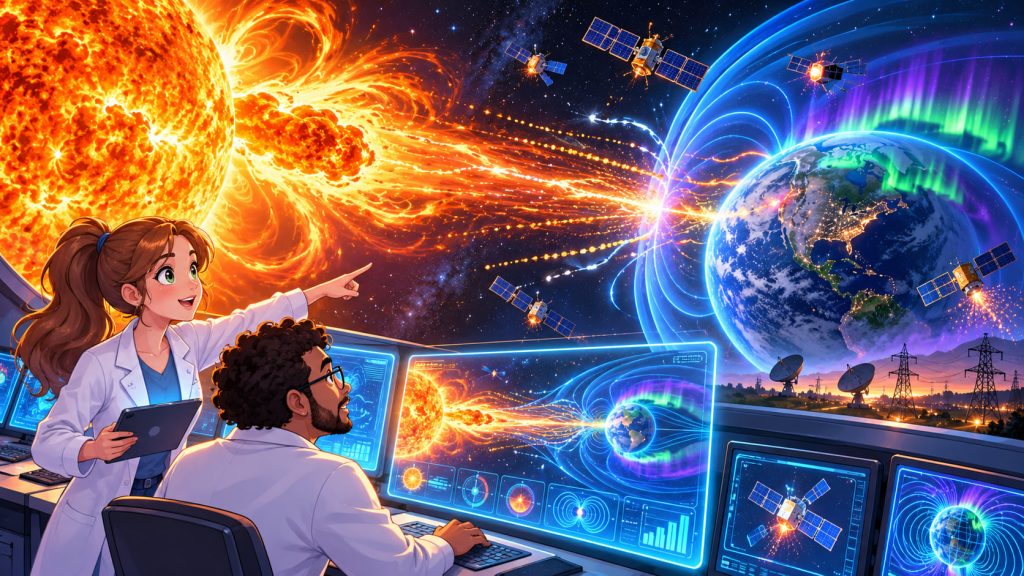
The Sun is essential for life on Earth, providing the light and energy that support our planet’s ecosystems. But our star is far from calm.
Its surface and atmosphere constantly release radiation, electrically charged particles, and enormous clouds of magnetized gas into space.
Some of these emissions travel approximately 150 million kilometers before reaching Earth.
Most pass unnoticed. Others can produce spectacular northern lights, disrupt satellite communications, interfere with navigation systems, or even threaten electrical power grids.
Understanding what the Sun sends toward Earth reveals how solar activity can affect our technology, our atmosphere, and human safety.
The Sun Is Constantly Sending Energy Into Space
The Sun releases much more than visible light.
Its activity produces several forms of energy and matter, including:
- Visible light and infrared radiation
- Ultraviolet radiation
- X-rays and other high-energy electromagnetic radiation
- Streams of electrically charged particles
- Enormous clouds of solar material
- Extremely elusive particles called neutrinos
The changing conditions created by solar activity are collectively known as space weather.
Unlike ordinary weather, space weather takes place in the environment surrounding Earth and throughout the solar system.
Its effects depend on the strength, direction, and type of solar activity.
Solar Wind: The Invisible Stream Reaching Earth
The Sun continuously releases a stream of charged particles called the solar wind.
This stream consists mainly of electrons and protons, moving through interplanetary space at speeds commonly ranging from approximately 300 to 800 kilometers per second.
Solar wind constantly interacts with Earth’s magnetic environment.
Fortunately, Earth possesses a protective magnetic region called the magnetosphere.
This magnetic shield deflects much of the incoming charged-particle flow.
However, particularly fast solar wind streams can disturb Earth’s magnetic field.
These disturbances may affect satellites, radio systems, and the upper atmosphere.
Solar wind is a normal feature of our solar system, but changes in its speed and magnetic properties can produce significant effects near Earth.
Solar Flares: Powerful Bursts of Radiation
A solar flare is an intense release of electromagnetic energy from the Sun’s atmosphere.
Flares occur when magnetic energy stored in solar regions is suddenly released.
They can produce powerful emissions of X-rays, ultraviolet radiation, and other wavelengths.
Because electromagnetic radiation travels at the speed of light, its effects can reach Earth approximately eight minutes after the flare occurs.
Scientists classify solar flares into categories including A, B, C, M, and X.
X-class flares are the strongest category.
Despite their enormous energy, solar flares do not normally burn people or destroy objects on Earth’s surface.
Our atmosphere absorbs the most dangerous X-rays and extreme ultraviolet radiation.
However, powerful flares can disturb the ionosphere, an electrically charged region of the upper atmosphere essential for certain radio communications.
Strong solar flares can interrupt high-frequency radio signals, particularly on Earth’s sunlit side.
Coronal Mass Ejections: Giant Clouds From the Sun
Among the most powerful solar events are coronal mass ejections, often abbreviated as CMEs.
These are enormous eruptions of plasma, a state of matter containing freely moving charged particles.
A large CME can release billions of tons of solar material into space.
Unlike radiation from solar flares, these clouds travel much more slowly than light.
Earth-directed CMEs commonly take around one to three days to arrive, although particularly fast eruptions can reach Earth in approximately 15 hours.
Not every CME threatens our planet.
Many eruptions travel in completely different directions.
However, when a large CME reaches Earth’s magnetic environment under favorable magnetic conditions, it can trigger a powerful geomagnetic storm.
What Happens During a Geomagnetic Storm?
A geomagnetic storm occurs when energy from solar wind or a CME strongly disturbs Earth’s magnetic field.
These disturbances can affect technological systems across large geographic areas.
One important mechanism involves geomagnetically induced currents.
Changes in Earth’s magnetic field generate electrical currents in long conductive structures, including power transmission networks.
During severe events, these currents can overload certain electrical equipment and create problems for power-grid operators.
Satellites may also experience increased atmospheric drag, electronic disturbances, and changes in orbital conditions.
The greatest danger from extreme solar storms is generally not direct injury to people on the ground, but disruption of infrastructure that modern society depends on.
Can Solar Storms Cause Power Outages?
History shows that powerful solar activity can disrupt electricity supplies.
In March 1989, a geomagnetic storm caused a major power failure in Quebec, Canada.
Approximately six million people lost electricity, and the blackout lasted around nine hours.
An even more famous event occurred in 1859.
Known as the Carrington Event, this exceptionally intense geomagnetic storm caused electrical disturbances in telegraph networks and produced unusual auroral displays.
Modern civilization depends far more heavily on electricity than societies did in the nineteenth century.
A comparable event today could seriously challenge vulnerable power systems, satellite services, and communication infrastructure.
However, forecasting improvements and protective engineering measures help reduce these risks.
Solar Radiation Storms: Are People in Danger?
Major solar eruptions can accelerate solar energetic particles to extremely high speeds.
These particles, especially protons, sometimes reach Earth within tens of minutes.
They can damage spacecraft electronics and increase radiation exposure beyond Earth’s protective atmosphere.
Astronauts are particularly vulnerable during intense events.
Airline crews and passengers on some high-altitude polar flights can also experience increased radiation exposure, although the actual risk depends on the event and flight conditions.
People at ground level remain well protected by Earth’s atmosphere and magnetic field.
A powerful solar storm does not normally require people on Earth’s surface to seek shelter from solar radiation.
Ordinary ultraviolet sunlight remains a much more direct everyday health concern, particularly because excessive exposure can damage skin and increase skin cancer risk.
Why Solar Storms Create Beautiful Northern Lights
Not every effect of solar activity is destructive.
One of the most spectacular results is the aurora, commonly called the northern or southern lights.
Auroras occur when energetic charged particles collide with atoms and molecules in Earth’s upper atmosphere.
These collisions excite atmospheric gases, which release light as they return to lower-energy states.
Oxygen commonly produces green and red emissions, while nitrogen contributes blue and purple colors.
During strong geomagnetic storms, auroras can become visible much farther from the polar regions than usual.
In May 2024, an extreme G5 geomagnetic storm produced remarkable auroral displays across large portions of the world.
The same disturbance also affected some satellite operations and communication systems.
Expert Perspective: Understanding Space Weather Risks
NASA space physicist Alexa Halford has explained the importance of Earth’s magnetic shielding and the challenges that solar disturbances create for technological systems.
Her work highlights a central principle of space-weather science: Earth’s natural defenses protect life at the surface, but they cannot prevent every disturbance from reaching satellites, communication systems, and electrical infrastructure.
This distinction is essential.
Solar storms are not generally a direct threat to people walking outdoors, but extreme events can create serious technological complications.
Modern preparation therefore focuses on monitoring solar activity, improving forecasts, and protecting vulnerable infrastructure.
How Scientists Predict Dangerous Solar Activity
Solar activity follows an approximately 11-year solar cycle.
During periods of increased activity, sunspots, solar flares, and coronal mass ejections become more frequent.
Scientists continuously observe the Sun using satellites, specialized telescopes, and instruments measuring charged particles and magnetic fields.
Forecasting teams analyze:
- Sunspot development and magnetic complexity
- Solar flare intensity
- The speed and direction of coronal mass ejections
- Solar wind measurements
- Changes in Earth’s magnetic field
Early warnings allow satellite operators to take protective measures and electricity providers to prepare for possible disturbances.
Although not every event can be predicted precisely, space-weather monitoring provides an important defense against the technological consequences of extreme solar activity.
Interesting Facts
- Sunlight takes approximately eight minutes and twenty seconds to travel from the Sun to Earth.
- A powerful coronal mass ejection can carry billions of tons of electrically charged material.
- The Sun continuously produces enormous numbers of neutrinos that pass through Earth and human bodies with almost no interaction.
- The Carrington Event of 1859 produced auroras visible at unusually low latitudes.
- The 1989 Quebec blackout demonstrated that space weather can directly affect electrical infrastructure.
- In May 2024, Earth experienced a G5 geomagnetic storm, the highest category on the five-level scale.
- Auroras can appear green, red, blue, or purple depending on the atmospheric gases and physical conditions involved.
- Not every powerful solar flare produces a coronal mass ejection directed toward Earth.
Glossary
- Space Weather — Changing conditions in space caused primarily by solar activity that can influence Earth and technological systems.
- Solar Wind — A continuous stream of charged particles flowing outward from the Sun.
- Magnetosphere — The region surrounding Earth where its magnetic field strongly influences charged-particle motion.
- Solar Flare — A sudden, intense release of electromagnetic energy from the Sun’s atmosphere.
- Ionosphere — An electrically charged region of Earth’s upper atmosphere that influences radio-wave propagation.
- Coronal Mass Ejection — A large eruption of magnetized plasma expelled from the Sun into space.
- Plasma — A state of matter containing free electrons and positively charged ions.
- Geomagnetic Storm — A major disturbance of Earth’s magnetic environment caused by solar activity.
- Geomagnetically Induced Currents — Electrical currents generated in conductive systems by changes in Earth’s magnetic field.
- Solar Energetic Particles — High-energy charged particles accelerated by solar eruptions and associated processes.
- Aurora — Natural atmospheric light produced when energetic particles excite gases in Earth’s upper atmosphere.
- Solar Cycle — The approximately 11-year pattern of increasing and decreasing solar magnetic activity.