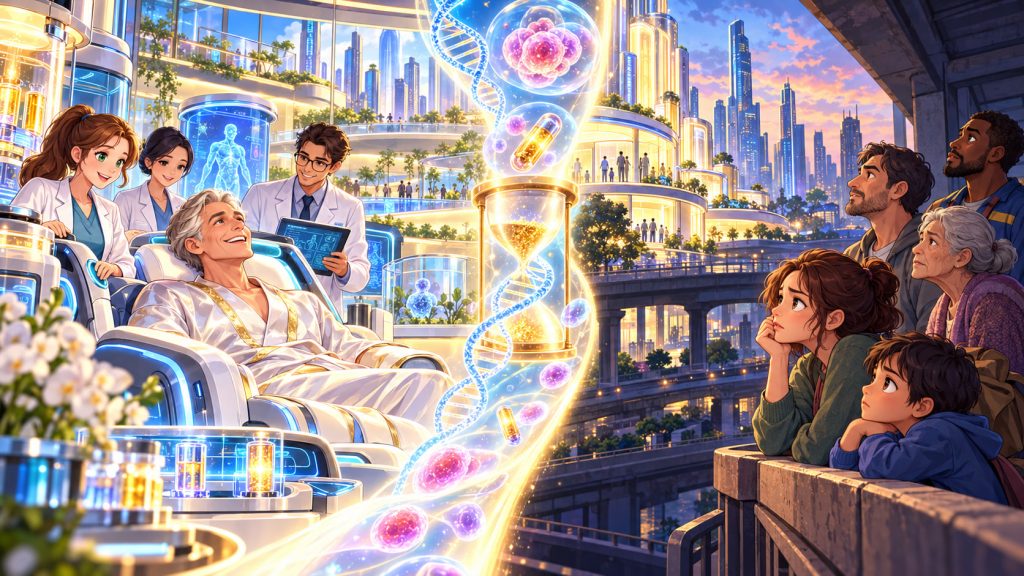
For thousands of years, humanity has dreamed of defeating aging and escaping death. Today, that ancient ambition is becoming a serious scientific pursuit.
Biotechnology companies, pharmaceutical researchers, and wealthy investors are pouring resources into technologies designed to slow biological aging, repair damaged tissues, and extend healthy human life.
But an extraordinary question is emerging alongside these developments.
What happens if the wealthy gain access to decades of additional healthy life while everyone else continues aging normally?
The possibility raises profound questions about medicine, economics, social justice, and the future of civilization.
Life extension could become one of humanity’s greatest achievements. Yet access to its benefits may determine whether it reduces suffering or creates an unprecedented divide between rich and poor.
The Science Behind Human Life Extension
Modern longevity research focuses on understanding the biological mechanisms responsible for aging.
Scientists increasingly study geroscience, a field examining the relationship between aging processes and age-related diseases.
Rather than treating each disease separately, researchers hope to target biological mechanisms involved in several conditions simultaneously.
These include cellular damage, chronic inflammation, changes in gene regulation, and declining tissue repair.
One important concept is healthspan, the period of life spent in relatively good health.
Extending healthspan could allow people to remain physically active, mentally sharp, and independent for longer.
The immediate scientific objective is not literal immortality, but slowing biological deterioration and delaying diseases associated with aging.
Can Science Really Slow Human Aging?
Several experimental approaches are attracting considerable attention.
One involves senolytic drugs, compounds designed to eliminate certain aging-related cells that accumulate in tissues and contribute to inflammation.
Another promising research direction is epigenetic reprogramming, which attempts to modify aspects of cellular aging by changing patterns of gene regulation.
Scientists are also investigating regenerative medicine, stem-cell treatments, and compounds affecting metabolic pathways linked to longevity.
For example, the drug rapamycin has extended lifespan in laboratory mice under experimental conditions.
However, results from animals cannot automatically be applied to humans.
No medical treatment has demonstrated the ability to make humans biologically immortal.
The greatest breakthroughs may initially involve preventing age-related diseases rather than dramatically extending the maximum human lifespan.
Why the Wealthy Could Benefit First
Revolutionary medical technologies often begin as expensive, specialized treatments.
Developing new therapies requires extensive laboratory research, manufacturing facilities, clinical testing, and regulatory approval.
These costs can create an access barrier for people without substantial financial resources.
Some existing advanced gene therapies have been introduced with prices exceeding one million dollars per patient.
Although these therapies do not provide immortality, they demonstrate how expensive breakthrough biotechnology can become.
Future longevity treatments could similarly require repeated procedures, personalized testing, or specialized medical supervision.
Wealthy individuals may therefore gain access earlier through advanced medical centers and private healthcare systems.
Biological Age Could Become a New Social Divide
People of the same chronological age can differ considerably in their physical condition.
Researchers investigate biological age, an estimate of how far certain biological systems have progressed through aging-related changes.
Although current biological-age measurements have important limitations, the concept could become increasingly relevant to future preventive medicine.
Imagine two people born in the same year.
One receives advanced preventive treatments, personalized monitoring, and effective interventions against age-related diseases.
The other cannot afford similar care.
At age 80, their functional abilities could be dramatically different.
If sophisticated aging treatments become available only to privileged groups, financial inequality could increasingly translate into unequal years of healthy life.
Could Longevity Create a Society of Biological Classes?
History already demonstrates significant differences in life expectancy between socioeconomic groups.
Income, education, nutrition, housing, environmental conditions, and access to healthcare all influence health outcomes.
Advanced life-extension technologies could amplify these existing differences.
A wealthy minority might remain healthy and professionally active for decades longer.
Meanwhile, less affluent populations could experience conventional aging patterns and earlier retirement due to illness.
Over generations, these differences might affect employment opportunities, inheritance, political influence, and wealth accumulation.
Such a system could create a new form of health inequality based partly on access to biological enhancement.
Longer Lives Could Transform Wealth and Power
Extended healthy lifespans might fundamentally alter economic structures.
Individuals who remain active for additional decades could accumulate greater experience, capital, and professional influence.
Longer investment periods could strengthen the advantage of families already possessing substantial wealth.
Corporate leadership might also change.
Executives and business owners could potentially maintain control of organizations for considerably longer periods.
Political systems could face similar challenges if powerful individuals remain active for much longer than previous generations.
These outcomes are not inevitable.
However, longer lifespans could reinforce existing concentrations of power unless institutions adapt to changing demographic realities.
The Impact on Retirement and Employment
Modern pension systems developed around assumptions about working lives and retirement duration.
Significant increases in healthy lifespan could challenge those assumptions.
People might choose to pursue multiple careers, return to education later in life, or work part-time across longer periods.
Employers could benefit from experienced workers remaining productive.
Yet unequal access to longevity treatments might create additional problems.
Some people could enjoy decades of healthy professional activity, while others face disability or declining health much earlier.
Retirement policies would need to balance increased opportunities with protection for workers whose health prevents longer employment.
Expert Perspective: Health Inequality Already Matters
Public-health researcher Sir Michael Marmot has extensively documented how social and economic circumstances influence health outcomes.
His work on the social determinants of health demonstrates that access to medical care is only one part of a much larger picture.
Education, working conditions, income, and social environments also shape people’s chances of living healthy lives.
This perspective is particularly relevant to longevity technology.
A groundbreaking anti-aging treatment would not automatically eliminate the disadvantages created by poverty, inadequate housing, or limited preventive healthcare.
Extending human life fairly requires attention to both medical innovation and the social conditions that determine who benefits from it.
Should Life Extension Be Available to Everyone?
If future treatments substantially delay aging-related diseases, societies will face difficult decisions about affordability and distribution.
One possibility involves public funding for treatments demonstrated to provide meaningful medical benefits.
Governments and insurance systems could negotiate prices, support large-scale manufacturing, and establish eligibility based on medical need.
Policies might prioritize treatments that prevent disability, dementia, cardiovascular disease, or other major age-related conditions.
However, distinguishing essential medical treatment from optional biological enhancement could become increasingly complicated.
A therapy that prevents debilitating disease may have a different ethical status from one intended primarily to extend an already healthy lifespan.
Could Longevity Treatments Eventually Become Affordable?
The history of technology offers reasons to consider broader future access.
Many innovations initially reserved for wealthy consumers eventually became cheaper through improved manufacturing, competition, and technological development.
Certain medical technologies have followed similar patterns.
However, complex biological therapies do not necessarily experience the same cost reductions as consumer electronics.
Some require individualized manufacturing, specialized facilities, or prolonged clinical monitoring.
The results of each clinical trial will also influence whether insurers and public healthcare systems consider a treatment worth covering.
Affordable longevity medicine will depend not only on scientific discovery, but also on manufacturing methods, regulation, competition, and healthcare policy.
The Future of Longevity and Human Equality
The development of life-extension technology may become one of the defining social challenges of the coming century.
If effective treatments become widely accessible, they could reduce disability, increase independence, and allow millions of people to enjoy longer healthy lives.
If access remains concentrated among wealthy populations, they could deepen existing inequalities.
The most beneficial future would combine scientific innovation with effective preventive medicine and broad access to treatments that demonstrably improve health.
The central question may eventually become more important than whether humanity can significantly slow aging.
Will longer, healthier lives become a shared human achievement, or an expensive privilege available mainly to those who can afford it?
P.S. For fans of science fiction, and in the context of the article’s theme, I recommend checking out the film Atlantis: The Elite in Search of Immortality.
Interesting Facts
- The longest reliably documented human lifespan belongs to Jeanne Calment, who lived 122 years and 164 days.
- Scientists study several interconnected biological mechanisms of aging rather than searching for one universal cause.
- Rapamycin has extended lifespan in some animal experiments, but its ability to extend human lifespan remains unproven.
- Certain experimental treatments aim to remove aging-related cells instead of replacing entire organs.
- Two people of identical chronological age can have substantially different physical and metabolic health.
- Some existing advanced gene therapies cost more than one million dollars per treatment.
- Extending healthy lifespan could potentially reduce the years people spend living with severe age-related disability.
- Significant changes in human longevity could reshape pension systems, inheritance patterns, and career structures.
Glossary
- Geroscience — The scientific field investigating how biological aging contributes to chronic diseases and declining health.
- Healthspan — The period of life during which a person remains relatively healthy and functionally independent.
- Senolytic Drugs — Experimental compounds designed to eliminate certain aging-related cells from tissues.
- Epigenetic Reprogramming — A technique intended to alter patterns of gene regulation, potentially changing aspects of cellular aging.
- Access Barrier — A financial, geographic, institutional, or practical obstacle preventing people from obtaining a service or treatment.
- Biological Age — An estimate of biological aging based on physiological or molecular characteristics rather than chronological time.
- Life Expectancy — The average number of years a person is statistically expected to live under specified mortality conditions.
- Health Inequality — Differences in health status or access to healthcare between individuals or population groups.
- Public Funding — Financial support provided by governments or public institutions for services, research, or medical treatments.
- Clinical Trial — A structured scientific study involving human participants to evaluate the safety or effectiveness of medical interventions.